


Across
the Asia-Pacific region, there are over 1.1 billion digital video viewers, and
more and more are beginning to consume content-on-the-go. With the maturing of
5G technology, some broadcasters in the region are conducting tests to enable
consumers to seamlessly download and watch premium content on their mobile
devices any time, anywhere. But first, what is EnTV and how will it impact the
TV industry? Lara Tan finds out …
EnTV, more commonly known as 5G
Broadcast, is the ‘heart’ of delivering high-quality content directly to
consumers. It will bring about true digital transformation as 5G networks can
distribute not only content to smartphones, with or without SIM cards, but also
inspire new ways of producing content — augmented reality (AR), live broadcast
with free-viewpoint and more.
According to a study conducted by Qualcomm,
a multinational semiconductor manufacturer, 5G’s full economic effect will be
realised across the globe by 2035, supporting a wide range of industries and
producing up to US$12 trillion worth of goods and services.
This further intensifies the competition
among the countries to be in the forefront of 5G technology. However, the speed
of implementation of the next-generation networking technology will be
determined by the coming together of regulators, telcos and equipment
manufacturers.
The media and entertainment industry is
currently teaming up with telcos to study and create a plethora of services to
commercialise ‘EnTV’. With the convergence of the two industries, it will
provide a great opportunity for broadcasters to simplify and enhance content
production, distribution and reduce costs.
Live and remote broadcast
With its lightning speed and spectrum
efficiency, 5G is ideal for live and remote broadcast. In a survey conducted by
Ovum, a research company, more than a third of the media operators responded
are planning to deploy 5G, in preparation for major sports events such as the
2020 Summer Tokyo Olympics.
For instance, KDDI, a telecommunications
company from South Korea, and Samsung, a global technology conglomerate, have
completed a live real-time free-viewpoint video (FVV) stream test on 5G with
Korea Telecom.
This will facilitate an enterprise 5G
network between 5G mobile newsgathering (MNG) equipment and Seoul Broadcasting
System (SBS), allowing the live broadcast of its Morning Wide news programme.
It also allows agile remote production to meet the round-the-clock demand for
content and help to reduce costs.
Furthermore, 5G capabilities can use a
single reliable communication link to connect cameras to remote production
studios, thus reducing reliance on complicated and expensive on-site set-ups.
Quah Mei Lee, associate director of Frost
& Sullivan (Info-communications Technology, APAC) said: “5G can offer
affordable content creation through interactive free-viewpoint video
visualisation and remote viewing of live events that can be made accessible by
viewers any time and from any place.
“This will help the monetisation of content
produced by sports producers and distributed by broadcasters.”
OTT & TV broadcast
With 5G, the industry can shift towards
audio-visual broadcasting over IP and fully realised the power of digitisation.
This will allow OTT and TV broadcasters to explore the realm of personalised
content delivery with 5G.
According to a research conducted by Ovum,
63% of network operators worldwide are planning to offer 5G-based AR and/or
virtual reality (VR) applications to people attending sports events at stadiums
or watching events at home by 2020.
AR applications powered by 5G technology
will be able to produce interactive experiences for viewers, such as streaming
360° video views, thus opening up another window of opportunity to monetise the
new offerings and personalised viewing experience.
Noticing that network operators around Asia
are snapping up the ‘EnTV opportunity’, Quah told APB: “5G has the
potential to revolutionise the media and entertainment industries. It is
currently being tested by sports producers and broadcasters worldwide … Content
owners will gain the flexibility and agility to address shifting consumer needs
and continue to monetise content amid increasing competition with OTT players.
“For TV broadcasters and content providers,
5G can create an opportunity for them to broaden their reach and to offer
content in new ways, for example, with Ultra HD (UHD) video, Dolby Audio and
3D-VR-360, to meet viewer expectations.”
Quah concluded: “As Asia-Pacific viewers are
more likely to pay for online content than their global counterparts, 5G
Broadcast represents a unique opportunity for broadcasters and content
providers in the region.”
Direct-to-consumer broadcast
With higher bandwidth spectrum, 5G
Broadcast can broaden the reach of broadcasters and deliver high-quality
content directly to consumers’ devices. As 5G Broadcast is based on FeMBMS
(Further evolved Multimedia Broadcast & Multicast Services) technology, it
will offer a much higher quality of TV service and higher quality of
experience.
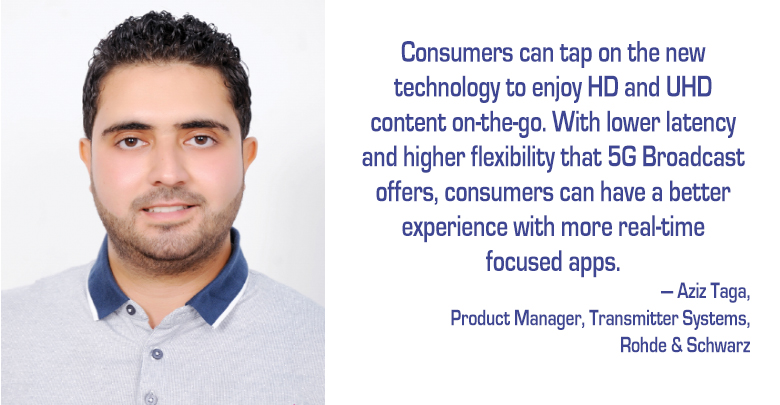
“Consumers
can tap into the new technology to enjoy HD and UHD content on-the-go. With
lower latency and higher flexibility that 5G Broadcast offers, consumers can
have a better experience with more real-time focused apps,” said Aziz Taga,
product manager of transmitter systems at Rohde & Schwarz (R&S), the
company that is involved in a 5G Broadcast field trial in China.
The Academy of Broadcasting Science (ABS)
and China Broadcasting Network (CBN), two public institutions in China, have
obtained commercial 5G licence of 4.9GHz with 50MHz band. And CBN is relying on
R&S’ transmitter and core network components as this is in line with FeMBMS
and High-Tower High-Power (HTHP) concept specified by 3GPP (3rd Generation
Partnership Project) Release 14.
Taga explained: “Using High-Power
High-Tower (HPHT) transmitters allows broadcasters to distribute video over 5G
networks in downlink-only mode with all the advantages of classic broadcasting.”
“This
provides high-quality HDTV broadcasting, low-latency live content as well as
enormous spectrum efficiency and wide coverage. In addition, there is no need
for a SIM card in the receiving mobile device; end-users just have to be within
the range coverage.”
The Beijing
Trial network comprises three stations operating in a single-frequency-network
(SFN). The stations located at CCTV Tower, Jing Guang Center and Ming Ren
Square are about 10km away from each other. Transmitters from Rohde &
Schwarz with 1kW output power will be working at central frequency 754MHz with
5MHz bandwidth (and at a later stage on 10MHz).
With this end-to-end implementation, ABS and
CBN plan to carry out an array of tests, such as field strength propagation,
network coverage, mobility reception, application possibilities and
interworking with LTE unicast network.
Taga maintained: “Broadcasting or
multicasting the content via the HPHT overlay network is much more efficient
than sending it hundreds of thousands of times to mobile network cells.
“With 60km cell coverage, this improved
flexibility, wider coverage and spectrum efficiency will substantially reduce
the cost of deployment and operation.”
The trial affirms that 5G can deliver
multi-Gbps peak rates, ultra-low latency, massive capacity, and more uniform
user experience. Thus, 5G broadcast will play a larger role in delivering video
content as compared to its predecessors.
In another study conducted by Qualcomm, the
company found that 5G NR (New Radio) can deliver fast speed even in challenging
conditions, proving itself to be a more reliable and consistent network over
4G. The comparison also showcases a five-fold improvement in user experience.
To stay ahead of the technological curve,
different network infrastructures may be used in a complementary or
collaborative way to make efficient use of network and spectrum resources,
according to 3GPP — the organisation that is helping to define and accelerate 5G
acceptance.
With an efficient 5G network, broadcasters
and OTT providers can look forward to truly monetising their assets in the
increasingly connected world.