


By Dr Amal Punchihewa
The broadcast industry started its migration to digital over four decades ago, initially by introducing digital processing in production equipment. Then during the early 2000s, we saw the introduction of terrestrial digital transmission of broadcast content augmenting direct-to-home satellite and cable television delivery in digital form.
In recent years, as audience consumption patterns change, broadcasters have been considering radical strategies for future broadcast delivery. Concentration spans have also shortened, with audiences preferring short-form content, although some may follow long-form as a follow-up.
As traditional media such as print and broadcasting take longer time to publish due to strict journalistic processes, scheduling and so on, these media suffer from the fierce competition from other media and platforms that are quicker to process and publish “instant digital news”.
Without compromising the competitive advantage traditional broadcasters enjoy today due to their rigorous process to check the accuracy of information, they are taking steps to respond to current audience demands.
Indeed, publishing to other platforms known as “digital-first” has been in discussion for some time. Broadcast in “digital-first” refers to the strategy of prioritising digital channels over traditional broadcast channels. This strategy is used by media organisations to reach audiences through digital platforms such as social media, websites, and mobile apps.
The goal is to provide content that is easily accessible and shareable on digital platforms and can be seen as broadcasters embracing complementary delivery methods such as the integration of broadcasting with broadband (IBB) followed by convergence (native IP).
In May 2022, BBC announced its digital-first strategy and it was followed by the Australian Broadcasting Corporation (ABC), a public broadcaster in Australia.
BBC’s plan to deliver digital-first focuses on creating a modern, digital-led and streamlined organisation that drives the most value from the licence fee. BBC’s digital-first aims to deliver more for audiences through reforms to stay relevant while continuing to provide great value for all. Reforms are meant to include changes to content and services, efficiency savings and a drive to seek new commercial investment.
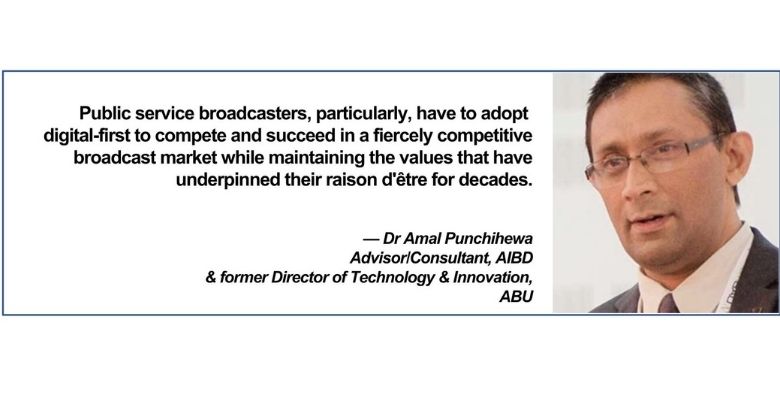
Public service broadcasters, particularly, have to adopt digital-first to compete and succeed in a fiercely competitive broadcast market while maintaining the values that have underpinned their raison d’être for decades. In the future, broadcasters may only have a few essential linear channels; instead, they will focus on online delivery, using streaming technologies as well as other digital platforms.
Broadcasters are now investing in new, digital-only products (non-broadcast media services) as the boundary between the real world and the digital one is becoming increasingly blurry. For example, BBC wants to introduce new on-demand content and formats for news and current affairs and also an ambition to reach 75% of BBC viewers through iPlayer (BBC’s online content portal that can be accessed via the iPlayer App) each week in addition to shifting several World Service languages to be digital only.
Recently, ABC announced a range of savings measures and reinvestment initiatives designed to address rising costs and more support for its transition to digital-first media services. ABC aims to increase investment in digital transformation to improve its efficiency and meet the needs of audiences. By 2028, ABC wants to engage the majority of its audience through its digital platforms and to possess a digital-first approach to commissioning, producing, and distributing content.
ABC plans to achieve them by enhancing its primary digital products (content services), ABC iView, ABC Listen and ABC News, to provide personalised services that enable audiences to more easily discover the journalism and content that is relevant to them.
ABC aims to launch a Current Affairs Digital Transformation Project to ensure some of its best investigative programmes have the capability to meet audience demand for long-form, on-demand video and in-depth digital content.
The Australian broadcaster’s news services will continue its shift in the News Operations team from linear television programming to on-demand digital content and modernising ABC’s skills base. With a shortage of talent in the media and broadcast sectors, organisations such as the Asia-Pacific Institute for Broadcasting Development (AIBD) will have new challenges and opportunities to develop human resources for future broadcast organisations.
ABC has also reported that an increasing number of Australians are primarily using digital media services, and ABC’s on-going value and relevance will depend on their ability to change and meet audience’s demands. In an era of rapid technological change, ABC believes that the digital-first strategy will ensure they remain trusted, relevant and valued by all Australians for the long term, which is also true for all broadcasters.
BBC and ABC are just two examples of national broadcasters or media organisations that are embarking on digital-first transformation to retain eyeballs. In the Asia-Pacific region, a high degree of diversity is manifested in many facets, including technology, economy, culture, social and political aspects. Hence, every broadcaster’s digital transformation journey will be unique.
Recently, New Zealand launched an investigation into a merger of two public broadcasters — radio broadcaster RNZ and television broadcaster TVNZ. However, this was abandoned before its completion.
New Zealand has a more complex public media landscape than Australia, with ABC’s role spread across three different entities, each with quite different functions. TVNZ is publicly owned but fully commercial, with three linear channels (currently, available over the air and as streaming online via TVNZ+ App), a relatively small digital news operation and a strong streaming platform; RNZ is a radio broadcaster, with a solid but compact digital news service, a growing suite of podcasts and a presence on the national Digital Terrestrial TV (DTT) multiplexer with video products.
However, neither RNZ nor TVNZ has committed major resources to social or youth brands. NZ on Air, as the Broadcasting Commission and provider of funds for public media content, enables New Zealand broadcasters to produce and offer content on a wide variety of channels and platforms.
In Australia, ABC is committed to achieving net zero emissions by 2030 and will engage with suppliers to further reduce the impact of ABC operations and its use of resources on the environment. The broadcaster is also dedicated to the investment of its people, building the capabilities they need for a digital-first ABC. To reshape itself as a digital media organisation that will serve Australian audiences into the future, ABC has to acquire and develop the technical, editorial, production, and leadership skills needed to be future-ready.
In the future, broadcasters have to engage audiences on the platforms they prefer, delivering relatable high-quality content from themselves and third-party digital platforms. For example, ABC believes that by 2028, more than half of their audience engagement will be via digital services. Hence, ABC will focus on bringing audiences to ABC-owned platforms while also creating content for audiences who prefer social media and other third-party platforms.
Broadcasters have to ensure they provide relevant content in engaging formats for younger audiences, especially those who do not use traditional broadcast services.
Where there is yet to be any major project where a national or public service media broadcaster in APAC has embarked on a digital-first strategy, it is important to combine the digital transformation of media and broadcast operations with a sustainability journey. Digitisation and digitalisation stages of digital evolution have little value today and we need a new mindset to start a digital transformation journey that keeps sustainability at its core.
Dr Amal Punchihewa is an ITU expert and advisor/consultant to the Asia-Pacific Institute for Broadcasting Development (AIBD), and was formerly Director of Technology & Innovation at the Asia-Pacific Broadcasting Union (ABU).