


By Dr Amal Punchihewa
IBC 2023 ended on 19 September 2023 in Amsterdam, with the five-day event discussing a wide range of technologies for the broadcast and media sector. In this review, we will critically analyse some selected technologies that are particularly relevant for the Asia-Pacific region.
According to the International Broadcasting Convention (IBC), this year’s show attracted 43,065 attendees from 170 countries and attracted over 1,250 exhibitors and a 16% increase in total attendees. There was a sense of purpose at the show as business leaders and tech innovators came together to help the broadcast and media industry navigate some profound changes and build a better future for media and entertainment.
For instance, IBC 2023 discussed Versatile Video Coding (VVC) usage in streaming applications. Online delivery, both live and on-demand streaming, has generated discussions concerning energy usage and the consequences of the carbon footprint.
The most relevant topic for APAC is sustainability. APAC’s broadcast and media industry has been discussing and taking a wide range of actions to mitigate the impact on the environment, carbon footprint and climate change. The Asia-Pacific Institute for Broadcasting Development (AIBD) initiated discussions and action among APAC broadcasters that resulted in capacity building, creating awareness and educating the wider community. IBC 2023 discussed greener technologies, much like the Bali Asia Media Summit of AIBD held in Bali in May 2023 did.
The majority of APAC countries are using DVB-Terrestrial technologies for their television broadcasting while DVB-Satellite standards are being used globally. DVB celebrated its 30 years of service to digital broadcasting with a wide range of technologies for digital terrestrial, satellite, cable and IP-based delivery mechanisms. One of the IBC 2023 awards was presented to a team that piloted the DVB-I service in Germany. DVB-I, or the DVB-Internet, together with DVB-NIP (Native IP), will provide a converged broadcast and media environment facilitating service discovery and network-agnostic access to content.
Radio is a very important medium of communication globally, especially for APAC, which has many islands, and developing and disaster-vulnerable nations. WorldDAB said, as per the view of experts from around the world, that “Radio remains in good health, with DAB+ offering a firm foundation for its digital future”.
WorldDAB unveiled the latest data on the global growth of DAB+ from the updated WorldDAB Infographic published in September 2023. This Infographic shows emerging markets leading the continued growth with launches in Saudi Arabia and Bahrain, as well as new trials in Ghana. Meanwhile, over 125 million DAB+ devices have now been sold to date, and almost all new cars not only in Europe but also in Australia now come with DAB+ as standard. In APAC, Australia operates a very successful service of DAB+ from both commercial radio and public service media. And while many APAC countries have shown interest in DAB+, Thailand is the only country to commence services after Australia. Both Australia and Thailand may provide good case studies for other countries to learn and commence DAB+ services successfully.
Radio plays a vital role in APAC. The Head of Radio at the European Broadcasting Union (EBU) mentioned that radio is still the most trusted form of media, and is the primary source of information in emergencies. This is true for APAC too and AIBD reiterates this every year when we celebrate World Radio Day.
Hence, AIBD has taken action in a wide range of capacity-building activities and training of journalists as the leader in training broadcast and media personnel in APAC and beyond.
“This trust has been preserved since the very beginning,” EBU noted. Further, at IBC 2023, it was explained how the concept of “radio” is alive and evolving: “Radio for us is a combination of live radio, on-demand content, as well as everything that goes on a podcast.” This applies to APAC and all other regions.
Sustainability is at the core of most of our activities, especially in digital transformation. During the Radio session of IBC 2023, the economic benefits and sustainability of DAB+ were highlighted, along with how DAB is “revitalising” radio by offering more and better services for listeners, and ensuring that broadcasters remain relevant in the competition for listeners' attention. This is coupled with a better environmental footprint.
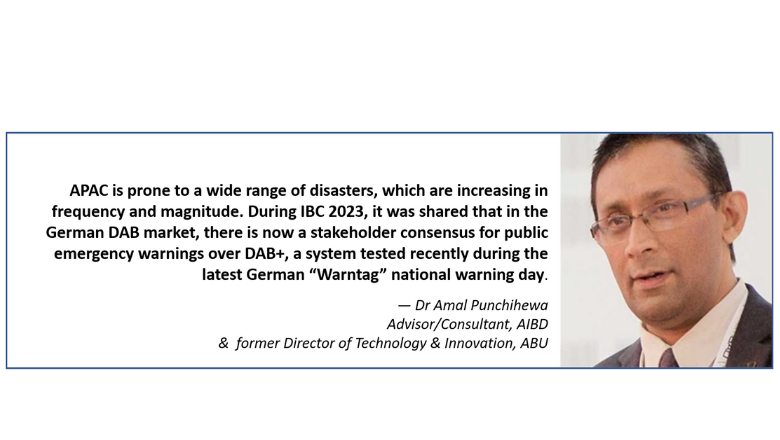
APAC is prone to a wide range of disasters, which are increasing in frequency and magnitude. During IBC 2023, it was shared that in the German DAB market, there is now a stakeholder consensus for public emergency warnings over DAB+, a system tested recently during the latest German “Warntag” national warning day.
WorldDAB standardisation work is in the process of creating specifications for alert warnings that would provide a basis for public emergency announcements over DAB for worldwide use. A major technical breakthrough has been achieved by a joint BBC-Deutschland Radio proposal for the geofencing of alert warnings.
Artificial intelligence (AI) is not merely a buzzword but a transformative paradigm shift that promises to redefine the way we engage with content and unlock unprecedented possibilities for the future of entertainment. The broadcasting landscape is rapidly changing, with AI playing an increasingly critical role.
During IBC 2023, the industry showcased the latest advancements in the world of broadcasting. Among the standout technologies in the exhibition, there was an emphasis on AI, which is at the forefront of many discussions. Some detailed integration of AI services into recent product releases, including features like speech-to-text in media composer, were demonstrated and discussed. The current approach to product development is pushing for advanced research and incorporating recommendation engines, summary engines, and interactive chatbots.
The APAC market is highly diverse in many facets, particularly regarding the requirement to support multiple languages. With AI, it is possible now to support several languages, even mixed languages and translations. Many broadcast and media solutions tend to focus on end-to-end solutions that do not just solve one piece of the workflow, but offer a full suite, from ingest and asset management to editing and publishing.
The effects of disruption across the global media ecosystem and the opportunities to be found in navigating a brave and volatile new world can be observed by all.
In summary, IBC 2023 covered many topics such as content, delivery, sustainability in broadcasting and the future of the media industry. In today’s media landscape, the only constant is change and embracing a culture of adaptability is mission-critical to surviving and thriving.