


By Dr Amal Punchihewa
On 21 November 2023, we celebrated World Television Day. The International Telecommunication Union (ITU) organised “The Future of Television for the Americas" workshop in Bogotá, Colombia, hosted by Colombian regulator Comisión de Regulación de Comunicaciones, Government of Colombia. Meanwhile, as you read this article, the ITU World Radio Conference (WRC23) is taking place in Dubai.
What are some of the key challenges for the TV and media sector as we prepare to step into the year 2024?
One key goal should be to ensure that digital television reaches its full potential to deliver long-term growth enabling television for all (Television4All). The Asia-Pacific Institute for Broadcasting Development (AIBD), together with other UN organisations such as the ITU, facilitates countries and members of those institutions to develop and standardise appropriate technologies and enable policy formulation.
Television4All has to ensure that broadcasting is open, available, affordable, safe, and controllable based on standards and laws.
Currently, even Digital Terrestrial Television (DTT) deployments are taking place at a different pace in the Asia-Pacific region (APAC). What traditional broadcasting and the future of television distribution have in common, is the importance of technical standards and well-applied engineering. The broadcast uses a dedicated network to deliver content to larger audiences across a wide footprint. It works incredibly well for one-to-many, and is still appropriate, especially during times of disasters and national emergencies.
Over-the-air (OTA) terrestrial broadcasting is environmentally cost-efficient. As we are planning for future broadcast delivery over the Internet, broadcasters and media operators need to be able to handle the scale. Further developments in multicast technologies that are capable of delivering mainstream content to larger audiences are needed, as well as the ability to blend with unicast technologies to support future delivery. Such a blend of technologies can facilitate services such as interactivity, personalisation, enhanced services and more consumer choices, resulting in a competitive global market rather than a national broadcast market, which national broadcasters were historically used to.
The pandemic accelerated online content consumption. Global television consumption is reliant on traditional broadcast, which is supplemented by increasingly popular streaming broadcast video-on-demand (BVoD) services, and integrated broadcast broadband (IBB) TV such as hybrid broadcast broadband TV (HbbTV). IBB makes sure that audiences have seamless access and easy navigation across networks, with live TV still a huge driver for broadcast and television. Also, notable revenue is still coming from traditional broadcast advertising.
Younger audiences are those that broadcasters risk losing for television. A great deal of work is required to reach younger audiences and keep them on the platforms, devices, and networks that they watch. The broadcast sector is aiming to adapt to those user needs and society's needs and is doing so in the most ethical and energy-efficient manner.
Globally, the broadcast and media sector is innovating across a wide range of broadcast technologies and many are innovating in the online space too. The lifecycle to make changes is becoming shorter, which makes regular investments in infrastructure harder. A key feature in the innovation roadmap for TV and broadcast is an enhanced user experience.
Besides the audience and the content, technology is another key market driver and influencer. Technology has introduced a wide range of changes to production workflows and infrastructure, with the industry moving very quickly towards all-IP to reflect the many changes the Internet has undergone during the last few decades. A similar transformation is happening to television, where AI and cybersecurity are presenting many challenges beyond gains.
The technology advancements in cloud technology have offered processing and distribution options as alternatives to having dedicated infrastructure for broadcasters. Though there are some complexities and uncertainties in the cost of operations, public cloud services reduce the capital cost. Some broadcast operators such as Sky in New Zealand have been working on migration to a cloud playout for its services in New Zealand.
High levels of compression efficiency have been reached in video compression systems. There are some improvements in compression efficiencies and how we deploy them in distribution networks. Some countries such as the UK are unlikely to move to higher compression systems. In France, they are working hard to launch HEVC-encoded Ultra High Definition (UHD) services both terrestrially and on satellite for the 2024 Paris Olympics.
Different regions and the countries in them are advancing in television broadcasting at different speeds and ways. In APAC for example, South Korea has been moving to UHDTV and adopting the ATSC 3.0 standard when some countries have not even started the DTT transition.
Legislation is beginning to attempt to catch up with the market in many ways, addressing regulation to create a level playing field while the industry and countries are working to keep up with the market. Regulators and legislators are also doing their best to keep up across all regions.
Some countries like the UK are now considering the challenges of further transitions from DTT and possibly the transition to all-IP eventually. Given the TV ecosystem today, it is a complex process for many countries.
Some governments are working very hard to plan not only for the implementation of appropriate legislation but also to enhance regulation and legislation for broadcast and streaming to protect broadcasting, especially by ensuring the continued prominence of public service broadcasting (PSB) services.
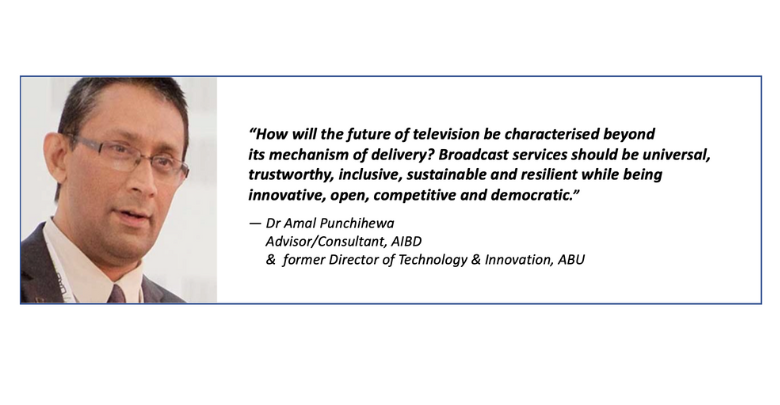
How will the future of television be characterised beyond its mechanism of delivery? Broadcast services should be universal, trustworthy, inclusive, sustainable and resilient while being innovative, open, competitive and democratic. With several small, land-locked and developing countries, APAC is one of the least connected regions in the world. By achieving those features, online delivery can be the dominant form of delivery.
If a broadcaster has a large audience to be served by a tower, then OTA terrestrial broadcast is incredibly valuable and the broadcasters are unlikely to want to move away from it. If the broadcaster has a smaller audience or has far more channels serving fewer viewers, then a very different migration strategy might be chosen. If the broadcaster has an IP advantage, then an online strategy may be chosen.
While sticking to national broadcast strategies as a strategic approach for the future might provide an economic advantage, national broadcasters also need to compete with global streaming platforms. Good local content could have a greater impact on this strategy. Some countries are considering legislation to ensure that PBS continues to receive due prominence across platforms in the future. This should help to sustain that national dialogue, but also protect PSB, which still plays an increasingly important part in our society.
While changes are afoot, PSB and free-to-air (FTA) broadcasting are likely to continue to thrive and innovate in 2024 and beyond.