


By Dr Amal Punchihewa
Two vital conferences ended in the middle of December 2023. While the 2023 World Radio Conference (WRC-23) of the International Telecommunication Union (ITU) focused on innovation and the use of limited spectrum for better connectivity, data gathering for science, research and making human lives better, COP28 — the 28th annual United Nations (UN) climate meeting, where governments discuss how to limit and prepare for future climate change — focused on mitigation action by reducing environmental impacts.
This article presents the key outcomes of the two conferences and the deployment of an improved streaming technology for media and broadcast distribution.
During COP28, the UAE Consensus calls for the world to “transition away from fossil fuels in energy systems, in a just, orderly and equitable manner, accelerating action in this critical decade, to achieve net zero by 2050.” This signifies both a rapid near-term shift away from fossil fuels and a long-term direction of travel to a zero-carbon future.
The outcome also included an agreement to triple the world’s renewable energy capacity and double its energy efficiency by 2030, goals reflecting a pledge made by 130 countries at the start of COP.
As energy usage in broadcast and media has a major impact on carbon footprint, all broadcasters and media stakeholders globally need to address mitigation of the impact on carbon footprint to achieve net zero and sustainability.
In September 2023, ITU published the Report ITU-R BT.2383-5 as a part of BT Series: Broadcasting Service (Television) with the title “Typical frequency sharing characteristics for digital terrestrial television broadcasting systems in the frequency band 470-862 MHz”.
The report spells out the “Quality of service” requirements for planning terrestrial television broadcasting services. It reports that it is required by many administrations (the member countries of ITU) to cover a high percentage of the population/households (e.g. 98%) or geographic regions (e.g. the entire country), in accordance with statutory requirements or commercial agreements, with all reception in the area defined by this coverage requirement essentially stipulated for continuous use to a specified time availability, within the hours of transmission.
There are similar requirements such as Universal Access and Quality of Service for telecommunication services. Hence, the future broadcast and media online services and regulatory frameworks need to ensure content for everybody is affordable, easy to access, easy to discover and has an acceptable quality of service and experience.
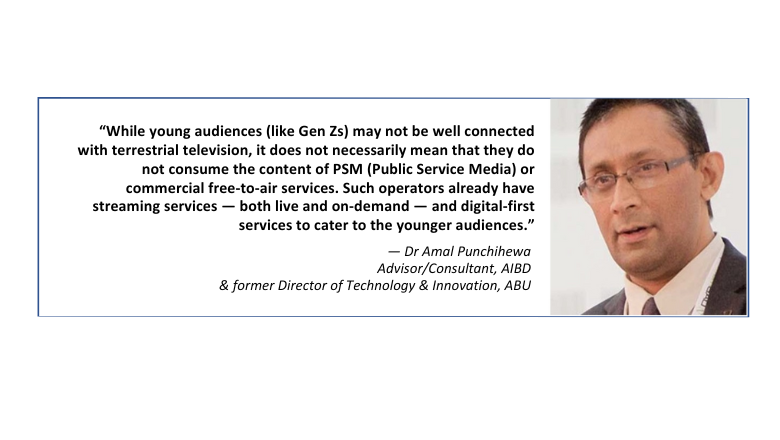
While young audiences (like Gen Zs) may not be well connected with terrestrial television, it does not necessarily mean that they do not consume the content of PSM (Public Service Media) or commercial free-to-air services. Such operators already have streaming services — both live and on-demand — and digital-first services to cater to the younger audiences.
As small percentages consume online, there are no major congestion issues that may impact the Quality of Service.
Globally, the ageing population is growing except in a few countries. From an easy accessibility point of view for the elderly to receive broadcast services, they prefer the big screen television in the lounge as they could interact and control for a better viewing experience.
While countries are trying to address the level-playing field for the broadcast industry, regulators have to look at how uniform and equitable regulations are applied across all broadcasters.
A question arises — how do we ensure online services for the majority of people, which we could call Universal Access, and also a minimum level of service quality for the audience?
Member States of the International Telecommunication Union (ITU) agreed on revisions to the global treaty governing the use of the radio frequency spectrum, both on Earth and in space, at the close of the World Radiocommunication Conference 2023 (WRC-23) on 15 December 2023 in Dubai, United Arab Emirates.
Region 1 managed to gain a positive response to their No Change Position of the UHF frequency band that is currently primarily used for television broadcasting services until 2030. The spectrum management team of EBU worked hard to achieve this positive result for both broadcasting and Programme Making and Special Events (PMSE).
The EBU (European Broadcasting Union) maintains, “The WRC-23 decision ensures continued access to spectrum and stable regulatory conditions, which are essential for investments and the evolution of DTT and PMSE, including the introduction of new technologies such as UHDTV, 5G Broadcast and WMAS (wireless multichannel audio systems).”
Among the key outcomes of WRC-23, the approval of a recommendation by the Radio Regulations Board to allow 41 countries to acquire new and usable orbital resources for satellite broadcasting is notable and is worth mentioning here as it is related to broadcasting
The countries, however, were unable to use their assigned orbital slots in recent years due to factors such as lack of coordination and interference from other satellite networks. The decision aims to enable countries to implement sub-regional satellite systems.
Linear content, including live TV and other scheduled content, is increasingly being delivered to audiences via IP networks. This move is being driven by both audiences and content providers.
Data and analytics of audience consumption patterns are important in designing and implementing distribution networks. However, some methodologies used for data gathering are not always acceptable. To address this issue, one of the audience measurement organisations in Australia is introducing a new system that could capture consumption from connected devices.
Generally, the way people consume content varies depending on live or not, genres such as sports and lifestyles, free-to-access, over-the-air (terrestrial or satellite) subscriptions or a mixture of them, and availability and affordability of broadband (fixed, wireless or mobile).
Research commissioned in 2023 by BT found that 90% of British audiences still valued live content on TV, especially news and sports, with more than half watching at least once a day.
The latest IP transmission innovation is designed to meet the needs of customers, as a new survey reveals picture quality and reliability are prioritised when watching live television.
One of the challenges in IP delivery is how we can ensure an acceptable level of Quality of Service. A technical paper on a technology known as Multicast-Assisted Unicast Delivery (MAUD) was presented during IBC 2023.
Though this technology would not address Universal Access and Television4All, MAUD could provide some incremental improvements to current online services.
In December 2023, BT Group in the UK introduced this new technology, designed to be a more reliable, quality-focused and sustainable way of delivering live content over the Internet. MAUD technology is aimed at improving viewer experiences and increasing the efficiency of the complex journey that content takes to reach them.
Major broadcasters, including the BBC, will be involved in evaluating and potentially trialling the technology to support a range of live content.
In traditional unicast delivery, each viewer watches the action via a dedicated, personal online stream. However, MAUD technology uses multicast to group those individual streams into a single shared stream, directing it to the audience that wants to watch the content.
MAUD claims that it has a further significant advantage over current multicast streams, as its integration is made completely transparent to the player application. This means content service providers do not need to modify their customer apps to take advantage of this technology, which will save time and money.
BT also claims that removing the need to select and serve millions of individual streams to viewers substantially increases the efficiency of content delivery, but also reduces environmental impact and overall costs for broadcasters, content delivery networks (CDNs) and Internet Service Providers. BT reported that MAUD technology uses up to 50% less bandwidth during peak events, reducing energy usage through the use of fewer caches.
By freeing up the Internet capacity, it will help to deliver a higher Quality of Experience for both live and non-live content at lower environmental impact.