


By Dr Amal Punchihewa
It is worth keeping an eye out for upcoming events such as the Asia Media Summit (AMS2024) of the Asia-Pacific Institute for Broadcasting Development (AIBD) and the International Broadcasting Convention in Amsterdam, which will discuss important topics like 5G broadcasting and other related emerging technologies, as well as the relevance of satellite in the broadcasting and media sector.
The recent anniversary of the use of satellite started in the 1960s reminds us of the relevance of satellite in today's broadcast and media services. This is especially important as the Asia Pacific Telecommunity (APT) agenda for the World Radiocommunication Conference in 2027 (WRC2027) will be focusing more on the use of satellite for a wide range of services except broadcasting. Incumbent broadcasting services need to be protected while other services are being developed.
The current boom in non-geostationary satellite networks has presented another issue for many countries. The challenge at hand is to effectively regulate the use of those orbits and the associated spectrum internationally.
The WRC set tolerances for certain orbital characteristics of space stations deployed as part of non-geostationary-satellite orbit systems in the fixed-satellite, broadcasting-satellite and mobile-satellite services. This decision corresponds to some regional positions regarding the need to balance the efficient utilisation of satellite orbits and flexibility in the construction and operation of non-geostationary satellite systems.
The WRC 23 concluded in November 2023 with three principles:
1. Creating the conditions for the development of innovative radio technologies while ensuring equitable access to spectrum and orbital resources for all ITU Member States;
2. Fostering more efficient use of spectrum and orbital resources with modern methods of international regulation; and
3. Eliminating unintentional radio interference for existing and planned radio systems, providing the stability needed for investment in sectors associated with spectrum and orbital resource use.
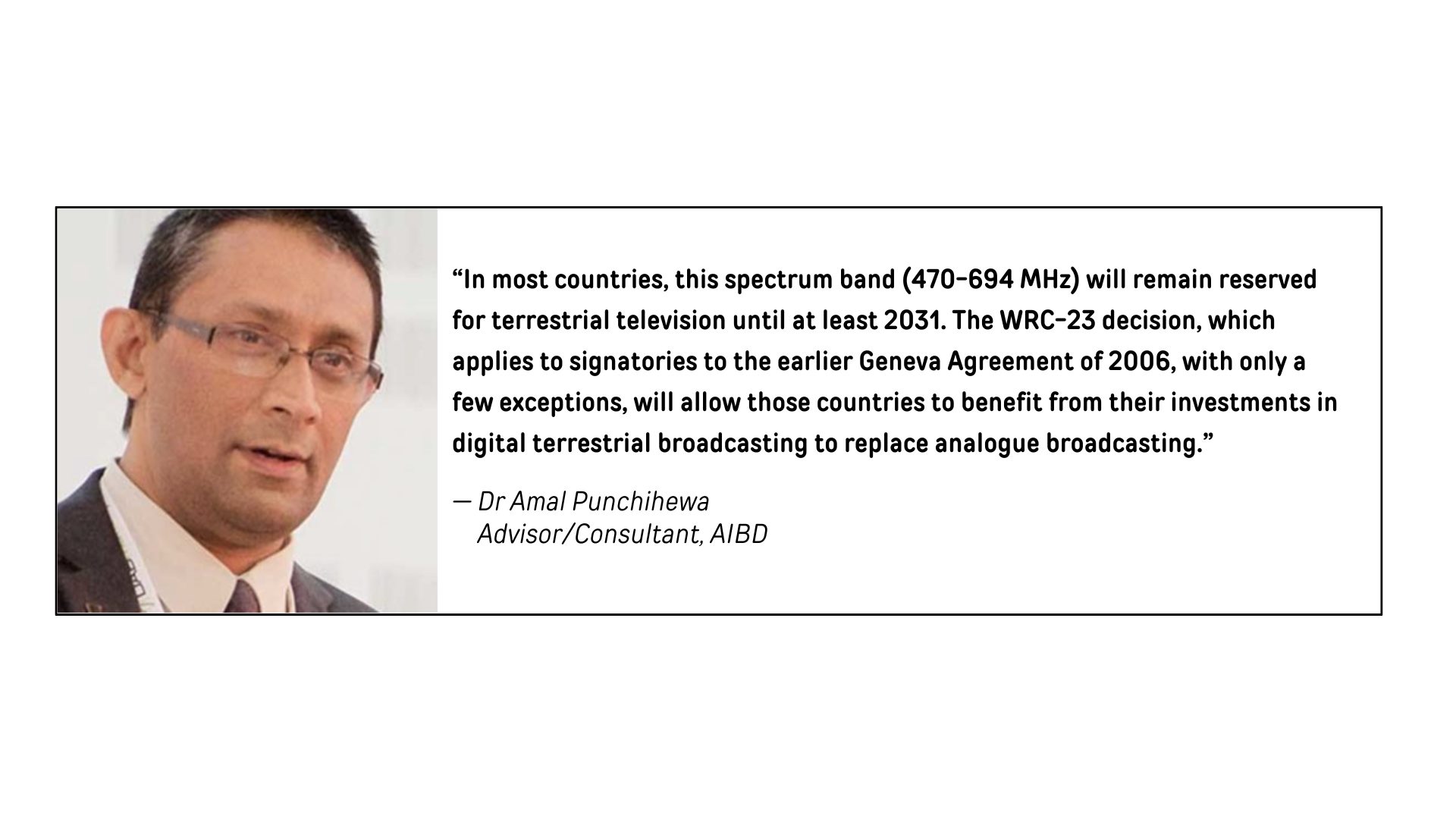
The decision to preserve the ‘television’ band in the 470-694 MHz spectrum, was welcomed by many countries. In most countries, this spectrum band will remain reserved for terrestrial television until at least 2031. The WRC-23 decision, which applies to signatories to the earlier Geneva Agreement of 2006, with only a few exceptions, will allow those countries to benefit from their investments in digital terrestrial broadcasting to replace analogue broadcasting.
It also offers the chance to re-evaluate the trend of phasing out terrestrial television broadcasting, with over-the-air television giving way to alternative broadcasting platforms.
This was perhaps the most complex WRC 23 agenda item from the standpoint of those countries. Their joint proposal on this item required fine-tuning to take account of the interests of countries that had already taken significant steps to phase out over-the-air television broadcasting.
The final WRC23 decision ensures those regional positions regarding the protection of the broadcasting service in the 470-694 MHz range.
Recently, on July 22, Brazil’s Sistema Brasileiro de TV Digital Terrestre (SBTVD) Forum published its final Phase-3 recommendations and forwarded them to Brazil’s Ministry of Communications, which will consider the recommendations for adoption as the country’s TV 3.0 system, including the ATSC 3.0 transmission technology, Physical Layer for over-the-air broadcasting.
The SBTVD Forum is a non-profit organisation of private and public companies, including broadcasters, manufacturers, software developers and academia that advises and makes recommendations to the Brazilian Ministry of Communications on digital TV technology and policy matters.
The broadcast and media industry has been embracing cyberspace in recent times, deploying both private and public cloud. The risk presented by software vulnerabilities however, needs to be addressed and mitigated using appropriate actions. A recent global Information Technology (IT) outage due to software glitches is a loud wake-up call for all critical industries.
Those major IT outages have hit industries across the world, with almost 1,400 flights cancelled and banking, broadcasters, national health systems, rail services and retail shops also affected.
Dr Juande Ali, Cyber Security Expert and Institution of Engineering and Technology (IET) Fellow, said, “The scale of this outage is unprecedented, and will no doubt go down in history, potentially surpassing the 2017 WannaCry attacks … this situation directly impacts end-user computers and could require manual intervention to resolve, posing a significant challenge for IT teams globally.”
This incident should provide a key learning lesson for the software engineering profession and cloud-based broadcasters to consider the safety and security implications of software updates.
5G broadcasting has been a hot topic for many conferences and discussions all over the world, as the broadcast and media industry continues to ponder the possibilities offered by the technology.
At IBC2024, a technical paper-based conference session titled, “5G Technology - Convergence with Broadcast”, will present several papers addressing the blending of 5G and traditional broadcast services. A paper will investigate the technical feasibility of a 5G broadcast simultaneously co-existing in the same UHF channel as a traditional broadcast (ATSC 3.0, DVB-T2, ISDB-T). This promises to be a powerful tool for service migration in a congested spectrum when balancing the needs of legacy devices and existing regulations.
The second paper will outline some conclusions from ongoing work to provide service discovery using DVB-I with various 5G delivery options, including 5G broadcast, 5G media streaming or a hybrid of both. DVB successfully demonstrated a proof-of-concept system at DVB World, which was held in March 2024 delivering to a commercial smartphone. Another paper from 3GPP, a standardisation body for mobile standards, will provide an update on their extended reality (XR) and media activities for 5G and beyond.
IEEE Broadcast Technology Society (BTS) will host a “free to attend” session on Saturday, September 14. BTS invites broadcast engineers and other personnel will be attending this exciting session on the future of mobile television with 5G broadcast titled, "Mobile TV - Finally?". Through two sessions, BTS will explore the potential of 5G broadcast technologies in transforming media consumption. The technical session will be developed by IEEE BTS, 5G MAG and Qualcomm.
Session one will present an in-depth overview of critical topics such as the latest developments in standards development organisations like ATSC, DVB and 3GPP. Currently, several field trials are being conducted during the Paris Olympics. The session will share a deeper analysis of the latest field trials covering the Paris Olympics, as well as the recently concluded EURO 2024 football championship in Germany.
The second session will facilitate a round-table discussion where implementers and other stakeholders will share their experiences and future plans, focusing on real-world applications and the path forward for bringing 5G broadcast technologies into the market.
In Asia, on 10 July 2024, the Malaysian Communications and Multimedia Commission (MCMC) held an engagement session on the 5G broadcast test-bed facility at MCMC, which marks another key milestone in the Malaysian 5G broadcast project journey.
It took more than three months to plan, craft the strategy, and engage with potential stakeholders. According to MCMC, it was not a simple task, but with patience and strong support from all the stakeholders, MCMC managed to bring together the relevant industry players to explore 5G broadcast technologies in Malaysia. Despite the technology being at an early stage and the exploration that lies ahead, MCMC is proud to have initiated this journey of creating a significant moment for both the Malaysian broadcast and telecom industries.
As these 5G trials around the world continue, the broadcast and media will be closely following their progress, hoping to gain more insights into 5G broadcasting and the next cutting-edge development stage of mobile TV innovation.