


By Shirish Nadkarni
Every management consultancy worth its salt has been predicting humongous growth for the media and entertainment (M&E) industry in the latter half of the 2020s.
Recent projections by PwC’s Global Entertainment and Media Outlook report estimate that the M&E industry will grow to US$3.4 trillion by 2028. This growth is fuelled by digital advancements, consumer preferences for personalised experiences, and the expansion of global connectivity, particularly in emerging markets.
Digital advertising, especially on mobile and connected TVs, is surging, with an anticipated 9.5% annual growth, driven by data-targeted and personalised ads. Additionally, over-the-top (OTT) video services are expected to reach 2.1 billion global subscriptions by 2028, reflecting a strong move toward on-demand content. Video gaming, especially mobile gaming, is forecast to exceed US$300 billion, led by the Asia-Pacific market.
According to McKinsey, media companies that use artificial intelligence (AI) for customer personalisation can achieve revenue boosts of up to 15%. Beyond just recommendations, AI tools like IBM Watson are helping script writers predict audience reactions, blending art with science in content creation.
Moreover, immersive technologies such as virtual reality (VR) concerts are increasingly going mainstream. For instance, 19% of US consumers used VR in 2020, up impressively from previous years. These innovations are expanding revenue streams by creating unique audience engagement methods.
These significant transformations that the M&E industry undergone, has in turn severely impacted the future of television. Key trends to watch in the near future include the pervasive influence of generative AI (Gen-AI) and large language models (LLMs) throughout the video supply chain; the growing prevalence of multi-cloud and hybrid cloud deployments by video service providers; rising cybersecurity threats and the use of deepfakes; and new content monetisation techniques … as well as a growing emphasis on sustainability.
As video service providers navigate these trends, AI- and machine learning (ML)-driven technology innovations will empower them to amplify productivity, improve viewer engagement, boost monetisation, and protect their content. One such technological advancement making a significant impact is digital satellite technology.
“Digital satellite technology is transforming the media and entertainment industry by enabling access to multimedia services, including TV, radio, and the internet,” said Dror Mangel, Director of Products & Solutions at Viaccess Orca. “It also supports disaster recovery and emergency response efforts.”
Mangel points to the manner in which satellite technology is reshaping the M&E industry.
“In broadcasting, satellites deliver TV and radio programming to many regions,” he said. “In the field of communications, satellites provide voice, data and multi-media services to remote areas. In the entertainment arena, satellites provide access to entertainment, news, and educational content. Satellites can also support virtual events and ticketing.”
Other technologies reshaping M&E include 5G, whose speed and low latency enables personalised content and real-time interactions; extended reality (XR, which includes V-virtual reality, augmented reality and mixed reality), which has the potential to redefine how people experience media and entertainment; AI and ML, which are revolutionising content production and consumption.
There is also edge computing, which benefits from increased bandwidth and throughput, and non-fungible tokens (NFTs), which can be used for ticketing, virtual events, and digital art. The M&E industry is also shifting toward sustainability, including reducing carbon footprints and using renewable energy.
“With streaming now a fully matured business, the M&E industry has experienced a major shift toward data-centric and cloud-based TV service delivery, observed the emergence of generative AI for video workflows, and seen a rise in targeted TV advertising,” observed Mangel.
He continued, “Gen AI and large language models (LLMs) will be a major underlying theme in M&E this year. Language models are propelling AI into realms beyond our initial expectations, automating tasks like extensive dataset analysis and amplifying productivity for providers of video services.
“In 2025, we anticipate that Gen AI and LLMs will further disrupt the entire video supply chain, influencing content creation, distribution, security, personalisation, recommendations, advertising, and analytics.”
Gen AI is expected to play a crucial role in personalised content suggestions, handling shopping queries, productising content recommendations, facilitating interactive advertising, and addressing cybersecurity threats.
“Simultaneously, we expect to see a rise in deepfakes, aided by Gen AI, posing additional challenges for content service providers,” cautioned Mangel. “Successfully navigating these challenges will necessitate a combination of technological innovation and regulatory responses.
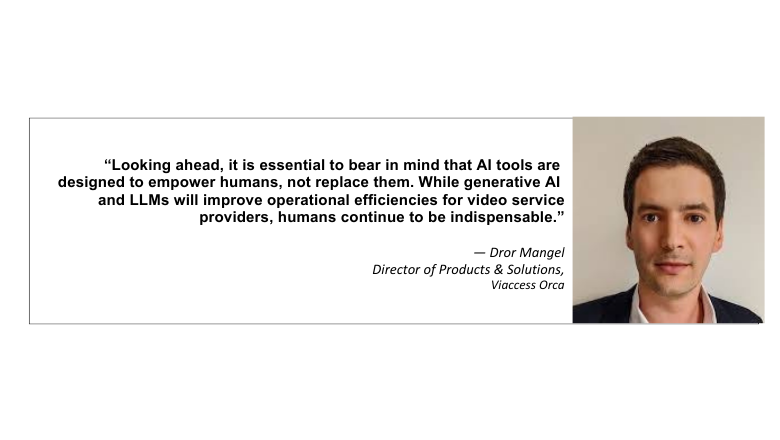
“Looking ahead, it is essential to bear in mind that AI tools are designed to empower humans, not replace them. While generative AI and LLMs will improve operational efficiencies for video service providers, humans continue to be indispensable.”
To stay competitive, video service providers will need to find new, advanced ways to drive viewer engagement and increase monetisation. Providing an exceptional quality of experience and personalised content will be a chief focus area for service providers in 2025 as they look to grow their revenue streams. AI will prove to be beneficial for improving revenue and workflow efficiency for video service providers.
“Companies must rethink their approaches to digital transformation and cloud integration," said Andy Shenkler, Co-founder and CEO of TMT Insights, a professional services and software development company delivering leading capabilities in digital supply chain, including media content.
"There's a tendency to chase the latest technological trends, such as artificial intelligence (AI), without a clear strategic framework, often leading to a fool’s errand. This phenomenon is not new; it mirrors historical transitions, such as the move from tape-based to file-based workflows. In such transitions, organizations often make superficial changes without rethinking the underlying processes. Effective media entertainment business transformation requires new skill sets and a reconfiguration of team dynamics to fully leverage new technologies.”
By harnessing AI/ML-powered targeted TV advertising solutions, broadcasters and service providers can precisely categorise audiences according to their viewing interests, household composition, life moment events, demographics, and other relevant factors to boost engagement.
Kiprotich Patrick of training outfit Edstellar added: "As conventional media approaches become outdated, the shift toward interactive and personalised digital experiences (DX) is inevitable.
“Media leaders must adapt and empower their teams with the right skills and strategic vision to excel in this fast-changing environment. Upskilling teams in DX will be essential for seamless adaptation, ensuring businesses adopt new technologies and foster a forward-thinking mindset across all operations. DX in M&E requires rethinking traditional business models, enhancing the customer experience, and optimising internal workflows.
DX is the integration of digital technologies into all areas of an organisation, fundamentally altering how businesses operate and deliver value. It involves adopting advanced technologies such as AI, cloud computing, blockchain, and data analytics to optimise processes, improve customer experiences, and create new business models.
DX, according to Patrick, is not just about the implementation of technology, but also about rethinking business strategies, culture, and organisational structures to fully leverage the potential of digital tools. The goal of DX is to drive greater efficiency, enhance personalisation, and maintain competitiveness in a rapidly evolving digital landscape.
Traditionally, M&E industries relied on physical media and broadcast channels to engage audiences. Nonetheless, DX in M&E merges the digital shift with the evolving demands of content consumption. It involves the adoption of technologies like AI for personalised content recommendations, blockchain for secure content distribution, cloud solutions for seamless access, and VR/AR for immersive experiences.
This transformation allows M&E companies to respond to the increasing clamour for on-demand, mobile-first, and interactive content while optimising their internal processes, business models, and content delivery. As the industry evolves, leveraging digital tools becomes essential for staying competitive in a consumer-driven, digital-first world.
Free advertising supported television (FAST) channels are another avenue for service providers to improve monetisation. According to Digital TV Research, FAST revenues for TV series and movies are forecast to reach US$17 billion by 2029.
In 2025, we are likely to see video service providers proposing curated FAST offerings that align with audience preferences. Generative AI technologies will be central to helping service providers optimise content discovery and the creation of FAST channels. As with targeted advertising, through AI-driven recommendations, service providers will have the option to adapt FAST channels to audience interests, enhancing viewer engagement and satisfaction.
In today’s TV environment, there are endless viewing options. Video service providers can prevent subscriber churn and enhance viewer satisfaction by tailoring content recommendations to users’ preferences. This year, critical metrics for global search, aggregation, and super aggregation will include performance, availability, and the ability to scale.
Additionally, interactive shopping will find its place on the TV, blurring the boundary between content consumption and e-commerce.
“Advertising experiences on the TV will evolve from being passive to interactive, with viewers directly purchasing products showcased in commercials or within the content they watch, through the user interface on the TV or on a secondary screen such a smartphone or tablet by scanning a QR code,” said Viaccess Orca’s Mangel.
The M&E industry is expected to see a heightened focus on sustainability in 2025. While this subject has been a major talking point in recent times, companies are expected to go beyond mere discussion and start implementing sustainability initiatives more seriously.
This shift is supported by the rapid advancements in technology, particularly in the satellite industry.
“Technological advancements and disruptive technologies are rapidly transforming the satellite industry,” noted a report from Frost & Sullivan, an American business consulting firm that offers market research and analysis, growth strategy consulting, and corporate training.
“From AI integration to advanced communication networks, these shifts are setting the pace for unprecedented growth and transforming how satellites in space are utilised. Understanding these key drivers is essential for organisations aiming to stay ahead in this dynamic domain and leverage the full potential of telecom satellite technology for future success.”