


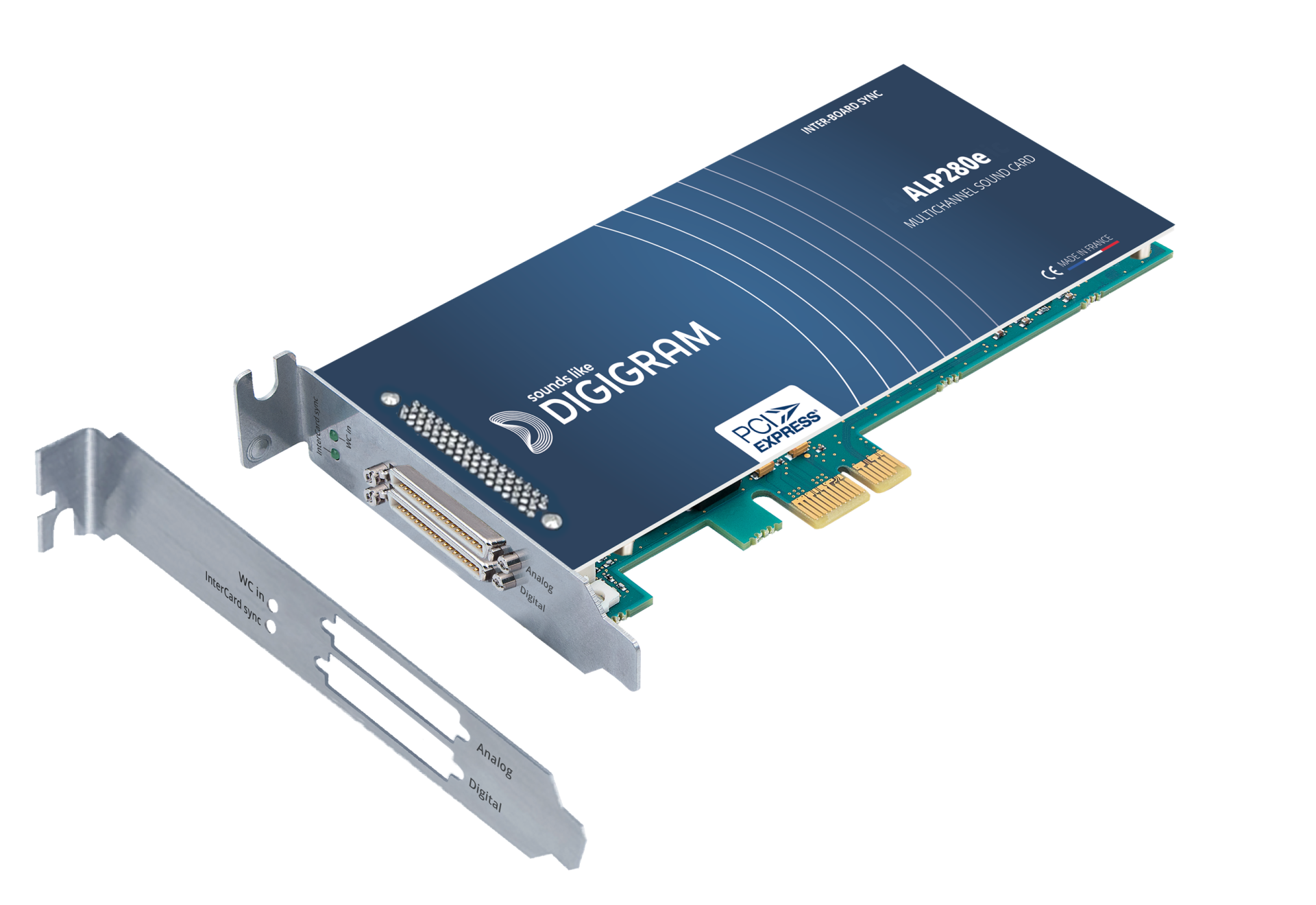
Audio specialist and equipment manufacturer Digigram has expanded its ALP-X series of sound cards with the addition of its ALP280e and ALP280e-MIC.
Building on the success of the ALP-X range, the new ALP280e and ALP280e-MIC cards are purpose-built to address the evolving needs of audio acquisition and processing in critical audio industries such as broadcast, acoustic measurement, court rooms, public safety, and 24/7 operation installations where reliability and audio quality are paramount.
The ALP280e and ALP280e-MIC are low profile Peripheral Component Interconnect Express (PCIe) sound cards optimised for the recording of eight analogue line-level or mic-level audio inputs with zero latency, monitoring and onboard mixing capabilities.
Featuring eight balanced analogue inputs, two balanced outputs, eight General Purpose Inputs (GPIs) and General Purpose Outputs (GPOs), the cards offer exceptional performance with +24 dBu max analogue level, adjustable analogue gain (up to +56 dB for mic inputs), an E.I.N of -124 dB and an SNR higher than 115 dBA on inputs, as well as a sampling rate from 8 kHz to 192 kHz.
An FPGA-based zero latency mixer supports the flexible routing and mixing of 16 inputs (eight analogue channels and eight playback channels) to 10 outputs (two analog channels and eight recording channels), making the ALP280e and ALP280e-MIC ideal for complex audio capture workflows. Inter-board synchronisation with up to eight ALP-X cards, combined with Digigram’s unified Windows control panel and Linux support, ensures uninterrupted integration into any system.
Stéphane Bert, Presales Manager, Digigram, said, “ALP-280e and ALP280e-MIC will power a larger array of 365/24/7 run applications that require reliable acquisition and recording of audio signals.
“Thanks to the low-profile form factor, plus support for Linux and Windows operating systems, these new cards deliver performance where it matters most – from broadcast studios to critical communication systems.”