


By Joe Tan
The television landscape is undergoing another seismic shift. Streaming consumption is rapidly overtaking traditional cable, and within this new paradigm, Free Ad-Supported Streaming Television (FAST) and Advertising-based Video-on-Demand (AVoD) are experiencing explosive growth. “Streaming consumption is surpassing viewing time on cable and is trending to be the predominant way of consuming video content overall,” declared Jim Turner, Vice-President of Product Management, Streaming Platforms, Synamedia.
This transition, he added in his blog post, is seeing consumers move from subscription services to FAST, a return to a model “consumers enjoyed for many years”.
This surge in FAST and AVoD viewership presents both an opportunity and a complex challenge for advertisers. The key to unlocking its potential, lies in leveraging advanced data analytics for more targeted and effective advertising. APB+ spoke with Guy Southam, Senior Product Director, Advanced Advertising at Synamedia, to delve into how data is making this possible.
The power of real-time insights
The ability to deliver relevant advertising without disrupting the viewer experience is paramount. Southam explained how real-time data is the engine driving this. “On FAST and AVoD platforms, real-time data plays a crucial role in tailoring ads to individual viewers.
“They can leverage signals like content context, time of the day, location, device, and viewer behaviour to deliver more relevant and engaging ad experience,” he stated.
However, this calls for a delicate balance. Bombarding viewers with ads, however relevant, can lead to ad fatigue.
Southam shared some strategies platforms could employ to mitigate this, “To orchestrate the optimal viewer experience, platforms can apply techniques such as frequency capping and contextual targeting to minimise ad fatigue and repetition.
Platforms should also be able to personalise ad loads, adapting the frequency and volume of ads to match each viewer’s tolerance.” The ultimate goal, he clarified, is “to create a seamless, non-intrusive ad experience that respects the viewer’s interests while driving results for advertisers.”
Despite the advancements, the path to truly efficient data-driven advertising on FAST and AVoD platforms is not without its hurdles. A significant challenge, according to Southam, is the absence of user registration and login limits access to first-party data, making personalisation and measurement more complex. He elaborated that while platforms often rely on device IDs and content engagement to build audience cohorts, this approach alone falls short of meeting advertiser expectations.
What then, is the solution?
“Unlocking higher-value audiences requires investment in data infrastructure and strategic partnerships with second-party data or ID providers, all while respecting viewer privacy,” Southam advised.
The rise and rapid growth in programmatic advertising — driven by the demand for audiences at scale and data-led solutions — adds another layer of complexity, particularly in the Connected TV (CTV) space.
Southam added that challenges remain, particularly around fragmented data, inconsistent measurement, and identity resolution. Looking at trends in Western markets, he suggested that the convergence of platforms and services must be accompanied by greater standardisation to fully unlock CTV’s programmatic potential.
Organisations like Synamedia and Imagine Communications are at the forefront of developing solutions to tackle these challenges and empower content providers.
Synamedia, as highlighted by Turner, has developed a suite of products that enable them to deploy and launch channels quickly, while leveraging cloud services to deliver efficient scale and performance.
Their offerings, including Synamedia-powered scheduling, transcoding, packaging, ad insertion, and ad serving, allow providers to build a FAST solution that enables them to monetise their content with targeted digital ads on all CTV and mobile devices, without the hassle of complex technical integrations.
A key component is Synamedia Iris, an advertising solution designed to bring the power of digital to FAST TV services, enabling services to find the right audience and push resonant content.
Similarly, Imagine Communications is making strides with its Aviator Automation platform. Brendon Mills, Chief Product Officer at Imagine Communications, told APB+, “Customers are facing a two-pronged challenge, as channel playout has become increasingly complex and everyone is under pressure to do more with less.”
Aviator Automation, he added, enables customers to use a mix of ground and cloud resources based on economic considerations to efficiently and effectively drive more screens and reach more viewers.
The platform facilitates multi-site channel origination and dynamic scaling, crucial for the evolving media landscape. Its integration with Aviator Orchestrator further accelerates deployment, allowing users to spin up resources on demand and burst to the cloud when needed.
Notably, Aviator Automation can control Amagi CLOUDPORT channels via API, enabling uninterrupted management of both broadcast and FAST channels. Recent enhancements, such as role-based access control (RBAC) and a new timeline view, are focused on improving usability, security, and operational efficiency.
Mills highlighted a recent large-scale, cloud-based project as proof of the platform’s power. He emphasised that the deployment was completed in record time without disrupting existing operations, showcasing Aviator’s ability to support complex workflows, reduce deployment time, and meet the evolving demands of hybrid media environments.
Aviator Orchestrator itself is a tool that synchronises content, playlists, metadata and channel status across all deployed playout environments, regardless of whether channels are on-premises, in the cloud, or a hybrid of both. This ensures consistency and simplifies the management of live streams and channels as business needs evolve.
The AI-powered future of ad tech
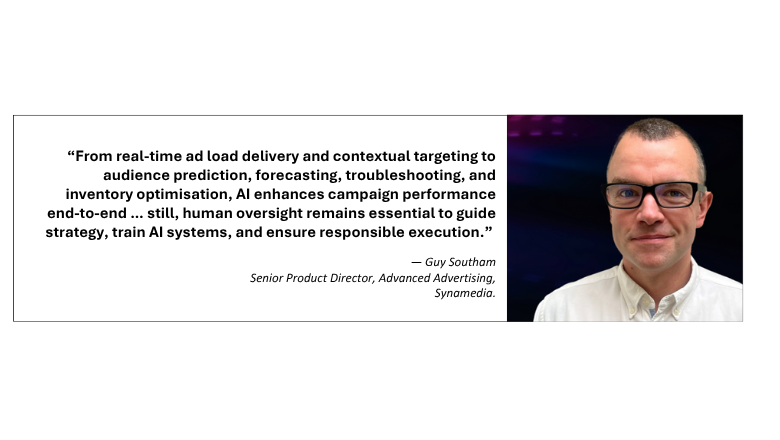
Looking ahead, AI and predictive analytics are set to play an even more significant role. Synamedia’s Southam is optimistic about AI’s impact, saying, “AI is reshaping digital advertising by bringing greater efficiency, scale, and precision.”
He sees AI as critical in automating campaigns, especially as programmatic adoption accelerates. “From real-time ad load delivery and contextual targeting to audience prediction, forecasting, troubleshooting, and inventory optimisation, AI enhances campaign performance end-to-end.”
What ad tech innovations can the industry anticipate?
Southam pointed to dynamic ad insertion, creative optimisation, and advanced fraud detection, which he believes will continue to strengthen both impact and trust.
In markets like Asia-Pacific, AI can also lower the entry barrier by simplifying campaign creation for smaller advertisers. However, Southam cautioned, “Still, human oversight remains essential to guide strategy, train AI systems, and ensure responsible execution.”
As FAST and AVoD continue to reshape the media landscape, the fusion of real-time data, AI, and cloud-powered infrastructure is proving essential to unlocking their full monetisation potential.
The future of advertising lies in delivering smarter and more personalised experiences, while balancing precision with privacy, and automation with human insight.