


By Dr Amal Punchihewa
The Asia Media Summit (AMS) is an annual international media conference organised annually by the Asia-Pacific Institute for Broadcasting Development (AIBD). As the AIBD’s flagship event, AMS brings together global media leaders, experts, and stakeholders to explore emerging trends and challenges in the broadcasting industry. Each year, a carefully selected theme — developed in consultation with members, partners, and international media professionals — guides the summit’s discussions, presentations, and strategic direction.
As a premier broadcasting event in the Asia-Pacific region, AMS draws approximately 500 high-level participants each year, including broadcasters, policymakers, media professionals, regulators, scholars, and industry stakeholders from across the globe. Beyond its plenary sessions and pre-summit workshops, AMS serves as a vital platform for inter-governmental dialogue aimed at elevating media standards across the region.
This year marks a significant milestone as Cambodia hosts the 20th edition of the summit under the theme Celebrating Two Decades of Excellence and Beyond.
The Ministry of Information of the Kingdom of Cambodia warmly welcomes AIBD members, partners, and collaborators to the 20th AMS, taking place from 21 - 24 July 2025 in the historic city of Siem Reap. This milestone event celebrates two decades of impactful dialogue, international collaboration, and forward-thinking in the Asian media industry.
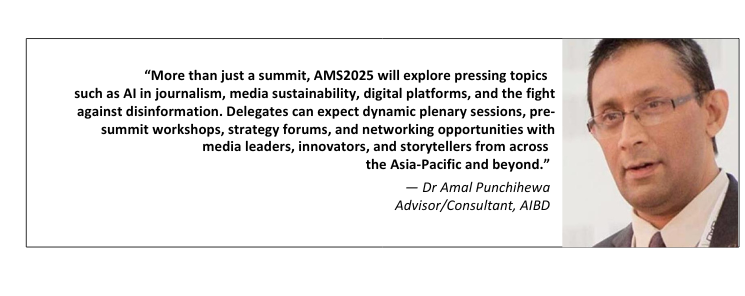
More than just a summit, AMS2025 will explore pressing topics such as AI in journalism, media sustainability, digital platforms, and the fight against disinformation. Delegates can expect dynamic plenary sessions, pre-summit workshops, strategy forums, and networking opportunities with media leaders, innovators, and storytellers from across the Asia-Pacific and beyond, all while experiencing Cambodia’s renowned hospitality, cultural showcases, and a few surprises along the way.
AMS2025 will feature seven dynamic pre-summit workshops designed to equip participants with cutting-edge insights and practical tools. These include AI in Media: Opportunities and Challenges; Masterclass on Digital Newsroom; Transforming Media Content Creation through AI-powered Tools & Technologies; Technology Driving Accessibility for the Future Broadcast and Media; The Role of Information Diplomacy in Dispelling Disinformation; Role of Broadcasting in Early Warning Dissemination (EWD); and Youth in ICT.
These sessions will set the stage for deeper conversations during the summit, offering delegates a chance to engage with emerging technologies, policy frameworks, and the evolving role of media in society.
The Role of Broadcasting in Early Warning Dissemination (EWD) workshop aims to bring together participants from across Asia Pacific, including professionals from national broadcasting, disaster management, ICT, academia and the telecom sector. The session will spotlight the critical role of both traditional and digital broadcasting in Early Warning Systems (EWS), emphasising its capacity to deliver timely, accurate alerts that enhance public safety and disaster preparedness. By leveraging technological advancements, broadcasters can play a pivotal role in saving lives and minimising the impact of natural and man-made disasters.
The rapid evolution of artificial intelligence (AI) is reshaping the global media landscape, and for state-owned and public services broadcasters in the Asia-Pacific region, this transformation presents both significant opportunities and complex challenges.
On one hand, AI technologies offer powerful tools to enhance data analysis, streamline content creation, accelerate news production, and deepen audience engagement. On the other hand, they raise critical concerns around misinformation, copyright integrity, algorithmic bias, and ethical governance.
Navigating this duality will be essential for broadcasters seeking to remain relevant, trusted, and innovative in a rapidly digitising world.
The development and deployment of AI in media are shaped by three critical actors:
- Service providers,
- State institutions, and;
- Society at large.
A comprehensive understanding of AI’s impact requires examining the moral responsibilities of service providers to ensure transparency, fairness, and accountability in their technologies; the regulatory role of states and institutions in establishing legal frameworks that safeguard media freedom, data protection, and ethical standards, and the essential need for education and digital literacy among individuals and communities to navigate AI-driven media landscapes responsibly.
The adoption and implementation of AI technologies vary widely across broadcasters in the Asia-Pacific region. To bridge this gap, AIBD has organised a series of workshops and webinars aimed at enhancing understanding and fostering the responsible use of AI in media.
The pre-summit workshop titled AI in Media: Opportunities and Challenges at AMS2025 will serve as a platform for knowledge exchange, practical learning, and strategic dialogue. It will explore AI-powered tools for data analysis, content creation and curation, distribution, and audience engagement.
The workshop will also address the broader implications of AI, including policy and regulatory considerations, ethical concerns, and implementation challenges. By focusing on real-world applications and promoting AI literacy, the session aims to deepen participants’ understanding of varying levels of technological adoption and to cultivate a collaborative environment for shared growth and innovation.
As part of the pre-summit activities at AMS2025, the one-day AIBD/Viory Digital Newsroom Masterclass will provide media professionals with intensive, hands-on training in the latest tools, technologies, and strategies for digital news production. This session will cover AI-driven journalism, fact-checking, social media engagement, and monetisation models, offering participants practical skills to thrive in today’s fast-evolving media environment.
A key principle underpinning this transformation is Universal Access (UA), or the idea that all individuals, regardless of geography or income, should have the ability to access public service media without barriers or gatekeepers.
Much like the telecommunications sector, where regulations mandate service provision beyond lucrative markets, the media industry must also ensure inclusive access to information. Upholding UA in the digital age means leveraging both policy and technology to bridge divides and ensure that no audience is left behind.
While traditional over-the-air (OTA) television broadcasting has reliably served audiences for decades, recent years have seen a steady decline in viewership. This shift is largely driven by the rise of streaming services, which have gained significant momentum over the past two decades by offering on-demand and linear content with greater flexibility, personalisation, and accessibility.
Despite this trend, a substantial portion of the population in many countries still relies on OTA broadcasting for free, ad-supported access to news, entertainment, and public service media.
While fulfilling the principle of UA, broadcasters must also ensure that content is inclusive for audiences with diverse abilities, including those with hearing or vision impairments.
In the analogue era, hybrid transmission methods allowed for closed captions to be delivered discreetly. Today, digital broadcasting offers even greater potential to enhance accessibility through customisable features such as closed captions, audio descriptions, sign language overlays, and screen language overlays as well as screen reader compatibility.
The media and broadcasting industry is undergoing a profound transformation, driven by rapid advancements in AI. These technologies are fundamentally reshaping how content is conceptualised, created, and delivered to audiences. Intelligent algorithms can autonomously generate scripts, edit footage, produce photorealistic imagery, and adapt storytelling to individual viewer preferences.
For public service broadcasters in the Asia-Pacific region, this evolution presents a dual challenge: harnessing the power of AI to enhance efficiency, creativity, and audience engagement, while also addressing critical concerns around misinformation, ethical use, and regulatory oversight.
Traditional video production workflows are often resource-intensive, requiring substantial time, technical expertise, and financial investment. As consumer demand for high-quality, engaging content continues to grow, evidenced by over one billion hours of video watched daily on YouTube, broadcast organisations must evolve to remain relevant.
The rise of the creator economy, valued at over US$104 billion in 2021 and projected to approach half a trillion dollars by 2027, underscores the growing influence of video creators, who now represent at least half of this market.
To meet this demand and remain competitive, public service broadcasters in the Asia-Pacific region have a significant opportunity to leverage AI-powered tools. These technologies are dramatically lowering barriers to entry by reducing production costs, minimising the need for specialised skills, and accelerating turnaround times. In doing so, they not only democratise content creation but also enable broadcasters to amplify diverse, culturally relevant stories that might otherwise go untold.
As part of AMS2025’s pre-summit activities, the workshop Transforming Media Content Creation through AI-powered Tools & Technologies aims to equip participants with practical knowledge and hands-on skills to harness AI in modern content production.
The session will explore AI-assisted workflows across pre-production, production, and post-production stages, including the use of text-to-video tools, automated editing, and personalised storytelling.
This aligns with AIBD’s proactive emphasis on AI, reaffirmed by insights shared during BroadcastAsia2025, where IABM reported that 60% of global media tech respondents ranked AI as their top innovation priority.
In the Asia-Pacific region, 54% of industry leaders identified AI as the most critical technology area shaping their roadmaps.
Continuing on the theme of AI, we will delve into inclusive broadcasting next month, specifically, how AI is revolutionising real-time captioning. Stay tuned.