


By Shaun Lim
There was a time when Netflix was seen as the chief disruptor of traditional broadcast TV; the catalyst for a demise that traditional broadcast TV would never recover from.
Today, while the existential threat to survival is real, traditional broadcast continues to evolve and adapt to be relevant to viewers. Netflix, on the other hand, is just one of the increasing number of protagonists who continue to reshape the way media content is consumed.
With traditional broadcasters and networks continuing to ponder how they can pivot and survive in an increasingly competitive market, can they plausibly find salvation from the very same actors who have played a key role in dismantling previously lucrative business models?
After all, if you can’t beat them, join them, as France broadcaster TF1 Group is demonstrating.
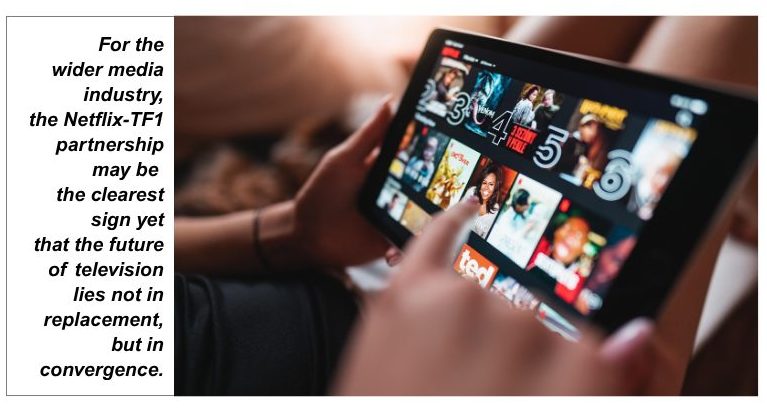
Earlier this year, TF1 Group announced that from 2026, all Netflix subscribers in France will be able to watch all five linear channels from TF1 Group. They will also reportedly be able to consume more than 30,000 hours of on-demand TF1 content in the summer of 2026.
Randolph Belmer, CEO, TF1 Group, said, “As viewing habits shift towards on-demand consumption and audience fragmentation increases, this unprecedented alliance will enable our premium content to reach unparalleled audiences and unlock new reach for advertisers within an ecosystem that perfectly complements our TF1+ [streaming] platform].”
Can this Netflix-TF1 collaboration foretell a hybrid future where on-demand and live broadcast co-exist, and how can traditional broadcasters benefit from working with streaming platforms?
The integration of live streaming channels onto the likes of Netflix and Amazon Prime Video presents a real opportunity for broadcasters, suggested Rory Gooderick, Senior Analyst, Ampere Analysis.
Speaking with APB+, he explained, “Amid a dramatic drop in linear viewing — and hence (a drop in) linear advertising revenue — over the past 10 years, broadcasters know that engaging audiences online is crucial for their long-term health, and deals of this are a great way of doing just that.
“The main benefit for broadcasters is that they can capitalise off the extensive local reach of the likes of Netflix and Prime Video, helping to drive engagement with a larger and younger audience base.
“Additionally, in the deals we have seen so far, the broadcasters are benefiting from significant prominence, with TF1 getting its own section on Netflix where its content and channels will be housed.
“This will allow the broadcaster to ensure its content will not be diluted into Netflix’s vast catalogue, and that its brand identity is maintained through the shows it licenses to Netflix.”
When news broke of the Netflix-TF1 collaboration, Ampere Analysis had described the deal as a “perfect example” of “diagonal integration”.
Essentially, this type of integration involves leveraging the reach and resources of a dominant platform (Netflix) to offer content or services from a company facing challenges in its traditional market.
How might diagonal integration partnerships then reshape the economics of content licensing and distribution for legacy broadcasters?
These broadcaster-streamer partnerships, said Gooderick, are essentially a kind of content agreement, or a new-age carriage deal. While exact details of the Netflix-TF1 deal have not been disclosed, he believes they will be splitting the advertising revenue from TF1’s live linear channels on the service.
“This form of deal is very different to a traditional content licensing deal, where the streaming service pays upfront for access to specific titles from a licenser,” Gooderick elaborated. “Instead, this approach ties revenue to ad performance, meaning the value of the deal depends on how well the broadcaster’s content performs with audiences. As a result, it is likely only the biggest broadcasters with the most appealing content that will be able to make these sorts of deals work.”
With audience fragmentation increasingly on the rise, it is perhaps also worth considering how audiences will react. For instance, will older or mainstream viewers who continue to tune in to linear TV for news, talk shows, and drama series change their viewing habits because of broadcaster-streamer partnerships?
The effect on viewing habits will be subtle for now, said Gooderick, who does not foresee viewers throwing away their TV boxes just yet in favour of watching TF1 on Netflix. This status quo, however, may not last for long.
He explained, “We are noting a significant shift away from linear TV in France, as well as an increased, albeit slow, uptake of broadcast video-on-demand (BVoD) services in the territory. In fact, viewers of TF1’s linear channels do not seem to be increasingly adopting TF1’s BVoD service. In 2016 the percentage of TF1 linear viewers that also used TF1+ sat at 22%. Today in 2025 this figure has barely budged, sitting at just 24%.
“On the contrary, 32% of TF1 linear viewers also take Netflix, meaning there is a large segment of customers that TF1 will be hoping to engage with its content on the country’s largest streaming service.”
There is also an argument to be made that most consumers do not really care where content is coming from, as long as it’s convenient, high-quality, and easy to access. It just happens that for many consumers — particularly those of a younger persuasion — the viewer experience is best enjoyed in the online universe of their connected devices; a fact not lost on traditional broadcasters.
“For broadcasters, these deals are crucial to getting more of their viewers watching online rather than on linear to protect their revenue streams in the future,” said Gooderick.
As traditional income streams decline and audiences converge towards streaming, this future will also prominently feature diagonal integration, where businesses are expanding into areas that are not necessarily in the product’s supply chain but instead are complimentary to its primary business line, he predicted.
While expecting to see a rise in Netflix-TF1-esque complementary partnerships, Gooderick was also quick to point out that this is only applicable to certain markets.
“Such deals are far more viable in markets where linear TV is still watched more than subscription over-the-top (OTT) services, as the likes of Netflix can tap into a highly engaged audience that remains relatively loyal to linear TV.
“There are a few markets in Western Europe where deals of this kind make sense. However, as streaming viewing is so much higher than linear TV viewing in APAC, we expect these deals are unlikely to take place in this region,” he concluded.
For the wider media industry, this may be the clearest sign yet that the future of television lies not in replacement, but in convergence.
The sharp divide between broadcast and streaming, once seen as a zero-sum game, is giving way to a hybrid model that blends the strengths of both worlds: the immediacy and familiarity of linear TV with the convenience and reach of digital platforms.
For broadcasters, the path forward is no longer about resisting disruption, but about redefining relevance in a fragmented, multi-platform landscape. As partnerships like Netflix and TF1 show, survival no longer depends on scale alone, but on strategic integration, brand adaptability, and the ability to meet audiences where they are, not where they used to be.
While such collaborations may not yet be universal, they represent a crucial experiment in what the next era of television could look like: one where competition gives way to cohabitation, and where content is king, regardless of where it comes from.