


By Dr Amal Punchihewa
Asia Media Summit (AMS) 2025 marked a significant milestone – the 20th since its inception – and brought together AIBD members, partners, and global media leaders under the theme “Celebrating Two Decades of Excellence & Beyond.”
The theme, developed in consultation with stakeholders, reflected both a celebration of the summit’s legacy and a commitment to shaping the media landscape for years to come.
As a unique broadcasting event in the Asia-Pacific region, AMS 2025 attracted around 500 top-ranking broadcasters, decision makers, media professionals, regulators, scholars, and stakeholders from both within and beyond the region.
With the broadcast and media industry focused on future growth and innovation, the AMS 2025 held in Siem Reap, Cambodia, from 21 to 24 July 2025 was hailed as a success. Organised by the Asia-Pacific Institute for Broadcasting Development (AIBD), AMS is the institute’s flagship annual international media conference.
In addition to seven plenary sessions and seven pre-summit workshops, AMS 2025 also provided a platform for inter-governmental dialogues aimed at raising the standards of the regional media industry.
Session 1 of AMS 2025 focused on “Disinformation: The Role of Media and Government”, and was moderated by advocate and solicitor Leon Loganathan. This high-level panel set the tone for a deeper commitment among member nations to combat disinformation collaboratively. Distinguished speakers included Dr Cosmas Zavazava, Director of the Telecommunication Development Bureau (BDT) at the International Telecommunication Union (ITU); H.E. Neth Pheaktra, Minister for Information of the Kingdom of Cambodia; along with other senior officials and media leaders.
A special presentation on “Enabling Accessibility in Broadcasting” educated more than 500 broadcast and media professionals on the importance of captions in promoting inclusive broadcasting. For individuals who are deaf or hard of hearing, captioning and visual cues are essential substitutes for audio content. As the industry moves towards greater inclusivity, it is crucial to serve these communities effectively.
The session showcased how advancements in AI have made real-time captioning not only accurate but also increasingly accessible and affordable. AI Media, a captioning solutions provider, demonstrated those capabilities during the presentation. All plenary sessions throughout the summit were live-captioned and displayed on two side screens flanking the main presentation screen, reinforcing the commitment to accessible communication.
On Day 3 of AMS 2025, Dr Cosmas Zavazava delivered a special presentation highlighting the role of the ITU and the importance of global collaboration in the broadcasting sector. He underscored a critical challenge: 2.6 billion people worldwide still lack meaningful connectivity, posing a significant obstacle to achieving universal access to information, particularly through public service broadcasting.
In another forward-looking session, Chetan Sharma, CEO of Chetan Sharma Consulting, dwelt on the emerging field of quantum computing, exploring how it could shape the next evolution of AI. He introduced concepts such as Physical Intelligence (PI), Dexter Intelligence (DI), and Autonomous Intelligence, or what he described as “Nirvana”, reflecting a vision for a future where intelligence systems transcend current AI capabilities.
Following the special presentations, two key sessions delved into the future of media — “Sustainable Strategies for Legacy Media” and “Bridging Legacy and Innovation: Technology’s role in Media Evolution.” Both sessions explored the complex challenges broadcasters face in adopting new technologies, particularly the significant upfront and recurrent investments required.
A central concern raised was the non-deterministic cost structure of public cloud services, which often contrasts with the promised flexibility and agility touted by technology providers.
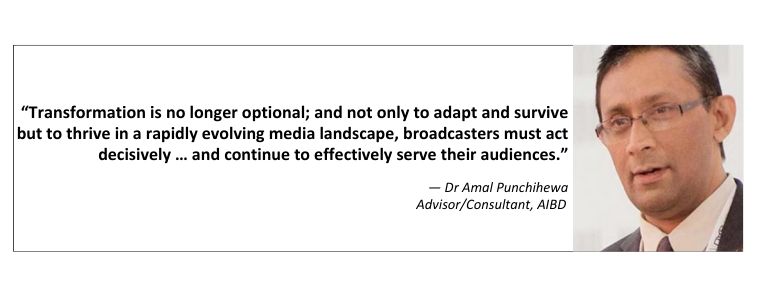
Transformation is no longer optional — and not only to adapt and survive but to thrive in a rapidly evolving media landscape, broadcasters must act decisively … and continue to effectively serve their audiences.
Reflecting on the need to balance tradition and innovation, Kumaran Subramanian, Head of the Academic Division at IPPTAR (Malaysia), said, “Legacy media is not static. By integrating credibility and broad reach with innovation, collaboration, and sustainability, it can evolve from a historical relic to a trusted pillar in the digital age.
“Embracing change while upholding public service values ensures legacy media continues to shape, inform, and unite society responsibly and resiliently.”
As a panellist in Session Six, I had the opportunity to share my experiences and insights on how broadcasters are navigating the ongoing transformation process.
“In today’s landscape, we are witnessing not revolutions but evolutions, a gradual yet impactful shift in how content is produced, delivered, and consumed. I presented a case study illustrating one broadcaster’s transition from analogue terrestrial TV to direct-to-home (DTH), digital terrestrial TV (DTT), digital first and mobile first strategies.
“Today, the same broadcaster is simulcasting its three DTT channels as a streaming service, enabling it to reach fragmented audiences across any device, anytime and anywhere, all within the boundaries of copyright restrictions.”
For those interested in a deeper exploration, I have addressed each of these distribution mechanisms in detail in my regular monthly articles, available online via the APB+ website.
On 21 July 2025, AIBD proudly hosted a series of pre-summit regional workshops in Siem Reap, Cambodia, laying the groundwork for meaningful dialogue and collaboration ahead of the 20th AMS.
These full-day workshops brought together a dynamic mix of media professionals, policymakers, technologists, producers, and academics from across the Asia-Pacific region.
The sessions offered a valuable platform for knowledge exchange, capacity building, and practical insights on emerging trends and challenges in the media and broadcasting landscape.
The workshops included:
- AIBD Regional Pre-Summit Workshop on AI Media: Opportunities and Challenges;
- AIBD Regional Pre-Summit Masterclass on Digital Newsroom;
- AIBD Regional Pre-Summit Workshop on Transforming Media Content Creation through AI-powered Tools;
- AIBD Regional Pre-Summit Workshop on Technology Driving Accessibility for Future Broadcast and Media;
- AIBD Regional Pre-Summit Workshop on the Role of Information Diplomacy in Dispelling Disinformation.
Each workshop was carefully designed to equip participants with the tools and perspectives needed to navigate the rapidly evolving media landscape, from AI integration and newsroom digitisation to inclusive broadcasting and combating disinformation.
The sessions featured insightful presentations, hands-on training, and lively exchanges among delegates, reinforcing AIBD’s commitment to advancing media excellence, capacity building, and innovation across the Asia-Pacific region.
Philomena Gnanapragasam, CEO & Secretariat Director of the AIBD, together with the AIBD team, extended heartfelt appreciation to all the resource persons, moderators, participating organisations, and sponsors who contributed to making the Pre-Summit a powerful start to the AMS 2025 journey.
Special thanks were extended to H.E. Neth Pheaktra, Minister for Information, and to the host country, Kingdom of Cambodia, for their generous support and warm hospitality.
AIBD also expressed sincere gratitude to the sponsors, partners, and collaborators of the AMS 2025 Pre-Summit Workshop. Their commitment and collaboration reflect a shared dedication to advancing critical discourse and innovation in areas such as AI in media, technology-driven content creation, and enhancing accessibility in broadcasting.
Each partnership played a vital role in strengthening AIBD’s collective efforts to build a future-ready media landscape that is inclusive, forward-thinking, and empowered by emerging technologies.
Philomena also extended AIBD’s sincere gratitude to all stakeholders for their continued support and belief in the organisation’s mission. She said, “We look forward to welcoming all participants to these dynamic and forward-looking events in future.
“Together, we’ll continue to pave the way towards a more innovative, inclusive, and connected media environment.”
The next high-profile event on the broadcast and media industry calendar is IBC 2025, where I will produce and moderate a session on the transformation of global TV services. Titled “Global TV – Service Evolution”, this session will take place on Sunday, September 14, from 10am to 10.45am, in Room E105 at the RAI Amsterdam Convention Centre.
The discussion will explore the global transformation of television services, touching on key trends, technologies, and strategies that are shaping the future of broadcasting worldwide. The evolution of television is unfolding globally, with some countries advancing toward IP-based streaming delivery, while others are still transitioning from analogue broadcasting.
Across numerous industry forums, one recurring theme is the profound societal impact of television, both positive and, at times, negative. The panel will review and analyse the current state of TV services worldwide, highlighting technological processes, challenges, and opportunities.
The session will feature three distinguished panellists offering diverse regional and technical perspectives. Representing the Asia-Pacific region are Satriyo Dharmanto, Chief Technology Officer of TVRI, Indonesia’s public television broadcaster, and Philomena Gnanapragasam of AIBD. They will be joined by Egon Verharen, Manager of Innovation at NPO, the national public broadcaster of The Netherlands.
Stay tuned for my September article in APB+; it will offer a preview of IBC 2025 from an APAC perspective, highlighting key themes, innovations, and regional contributions to the global broadcasting conversation.