


By Shaun Lim
In today’s multi-vendor, hybrid-cloud media environments, control protocols face a complex set of demands and one of the fundamental challenges in the broadcast and media industry; as Stan Moote, CTO of IABM, puts it: “How do you implement a seamless control across a multi-vendor environment, spanning on-premises hardware, local networks, remote infrastructure, and multi-cloud workflows?”
In a dialogue with APB+, Moote said, “These are exactly the kinds of questions that led SMPTE’s Rapid Industry Solutions (RIS) initiative to launch the Catena project The goal from the outset was to create an open, vendor-agnostic, and secure control protocol capable of meeting the complexity and scale of today’s media operations.”
Catena is an open source, open standard control protocol for media devices and services, and is platform and vendor agnostic to ensure maximum interoperability,
Chris Lennon, Director of Standards Strategy, Ross Video, and Executive Director, SMPTE RIS-OSA, affirmed, “It uses a device-centric data model, allowing everything from the smallest physical devices or microservices all the way up to the most complex on-prem devices or cloud-based products to be supported.
“It embraces widely accepted technologies such as Google’s Remote Procedure Calls (gRPC) or Representational State Transfer (REST) for connections, and Zero Trust for security.
“Discovery can be accomplished by an array of commonly used methods, and messages can be transported in binary or JavaScript Object Notation (JSON), which helps to accommodate the very smallest devices, while also allowing for human readability, if that’s desired.”
Catena, Lennon added, acknowledges that standardised control is needed in a wide array of devices and facilities, while offering a pragmatic approach. Catena can support everything from a small House of Worship, where part-time operators with minimal training need simple, intuitive device control, to the largest and most complex professional productions with highly demanding technical requirements.
“Security is at the heart of Catena, which is critical to maintain the integrity of its control messages and the devices they interact with. Since hybrid cloud architecture is a reality almost everywhere, the days of unsecured in-the-open control protocols are gone,” said Lennon.
How then, did the IABM come to be a key collaboration partner in the development of Catena?
“As the only trade association made up exclusively of media tech vendors, as well as having close connections with the end-user community, IABM was a natural fit to support this initiative”, explained Moote. “We joined the RIS Catena effort to bring broader vendor engagement, and to help ensure the final result truly reflects real-world needs and supports wide industry adoption.”
One of the early key objectives of the Catena working group, Moote said, was to learn from the shortcomings of past control standardisation efforts, which fell short because they were either too narrow, too proprietary, or lacked true industry alignment.
Catena, by contrast, is designed as an open-source, vendor-, and platform-neutral control protocol that delivers a single, secure interface for controlling media devices and services, regardless of where they are deployed.
For IABM, IBC 2024 was a watershed moment that saw the launch of the IABM Control Plane Working Group, which quickly attracted strong vendor participation.
Moote elaborated, “One of our first efforts was to create a comparison matrix — a living document that maps existing control standards and protocols to identify overlaps, gaps, and opportunities for synergy.
“The intention wasn't to reinvent the wheel, but to build on proven work from groups like AES70, AMWA NMOS, and others.”
He credited Ciro Noronha, CTO of Cobalt Digital, and President of the RIST Forum, for taking a leading role in developing the comparison matrix, which helped shape and inform Catena’s development. “Thanks to a cooperative agreement between SMPTE and IABM, we were able to provide direct feedback to the RIS Group based on our vendor insights, well before the drafts reached the SMPTE Standards Committee.”
At the time of writing, the Catena documents have been submitted to SMPTE’s Public Committee Draft (PCD) process, where they will go through a formal comment and revision cycle. This includes public feedback via GitHub, real-world implementation insights, and eventually a balloted vote towards full publication.
From IABM’s perspective, Catena aligns closely with their Technology and Trends Roadmap, particularly in the area of Secure Architecture.
Moote highlighted, “With the increasing move to cloud and hybrid operations, plus the added complexity of AI workflows, data integrity, authentication, and security are paramount.
“Catena’s use of Transport Layer Security (TLS) ensures control data is authentic, confidential, and tamper-proof. This is without compromising responsiveness, which is critical for real-time operations like adjusting audio levels or switching sources live.
“In short, Catena is a foundational piece of the next-generation media control landscape, and the IABM Control Plane working group is proud to be helping guide its development in alignment with industry needs.”
With the Catena standards documents submitted to PCD, Lennon encourages those who are currently struggling to support dozens of proprietary control protocols to try Catena out in their environments and provide their feedback on how best to deploy the technology.
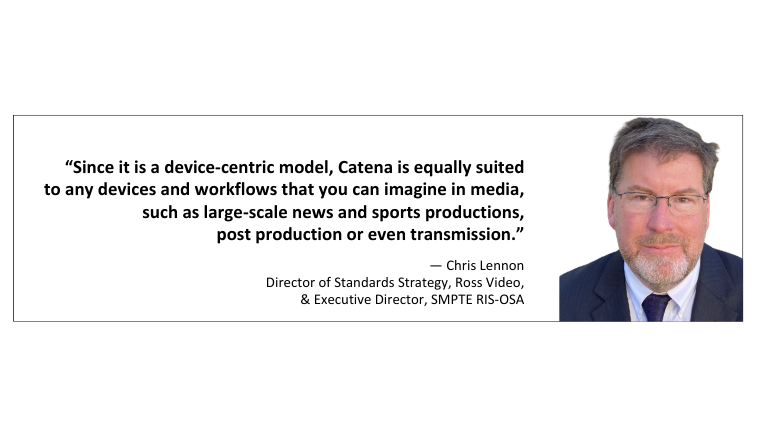
He said, “Since it is a device-centric model, Catena is equally suited to any devices and workflows that you can imagine in media, such as large-scale news and sports productions, post production or even transmission. The best standards are built in such a way that all the applications for them often haven’t even been thought of when they are built.
“I have seen that myself with several standards I have personally worked on in the past and have been amazed at the innovative and unanticipated ways in which they are used, so the sky’s really the limit.”
As Catena does not require any specific tooling requirements, implementors are free to use any devices and any orchestration systems they choose with it. “It’s simply a tool that can be used to make their lives much simpler, and hopefully to allow them to greatly reduce their reliance on proprietary protocols they are using today,” said Lennon.
While he acknowledged that Catena’s success will eventually depend on both media companies and vendors embracing it, Lennon goes as far as to declare that he has yet to run into anyone on either side of this spectrum who does not acknowledge that Catena fills a real void in today’s media control plane environment.
He continued, “It’s our hope that the fact that it’s open-source and an open standard from a trusted organisation like SMPTE will lead to it being embraced by the industry.”
While Lennon’s faith in Catena may be reasonably justified, it may yet take a more concerted effort from all stakeholders to prepare the entire media tech ecosystem — broadcasters, vendors, and creators — to integrate the Catena framework into their operations.
Moote, however, shares Lennon’s optimism, although he is quick to caution against focusing too narrowly on the term “broadcasters”.
“Today, any media outlet, publisher, or even a content creator with a global audience, is effectively a broadcaster,” he explained. “That’s why the Catena working group made a deliberate effort to ensure the protocol is scalable and flexible, and equally suited to small facilities without local servers, as well as complex enterprise, hybrid, or cloud-native media operations.”
This adaptability, said Moote, is crucial as corporate media, Pro AV, and the growing creator economy sees a continued convergence. While these users may not have traditional broadcast infrastructure, they can still benefit from the robust, secure, and interoperable control systems offered by Catena.
In terms of readiness, the Catena interface definition is live on SMPTE’s Github, while the C++ and Java SDKs are live on Ross Video’s Github. IABM, on their part, has several working groups that help to shape the MediaTech industry in a positive direction, with a continued focus on interoperability.
Neither is it mere paper talk, with Moote reporting “promising signs” of real-world integration. “One of the larger companies on the RIS committee was able to integrate Catena into their control environment in less than an afternoon, which is a powerful indication of how accessible and implementation-ready the framework already is.”
For now, Catena remains in an embryonic stage, even if all signs point to broad adoption in the not-so-distant future.
To turn that into reality, however, will require a few key elements:
- Awareness and education: Vendors and end-users need to understand what Catena is and what problems it solves.
- Tooling and examples: Sample implementations, SDKs, and reference architectures will help lower the barrier to entry.
- Commitment to interoperability: Adoption will accelerate if vendors commit to a shared framework rather than proprietary alternatives.
“Ultimately, Catena’s success hinges on its ability to fit into existing workflows without disruption and so far, all signs suggest it’s on the right track,” Moote concluded.