


By Shirish Nadkarni
Artificial Intelligence (AI) is ubiquitous. So all-pervasive has it become in every sphere of life, that to understand and adopt it has become a prime necessity, just as ignoring it is to risk being left by the wayside.
AI has transformed numerous industries, particularly with the invention of Vision Processing Units, commonly known as VPUs. These units are specifically designed to manage and process visual data, allowing AI systems to interpret images, videos and other visual inputs efficiently.
These systems are instrumental in facilitating the analysis and comprehension of visual information, paving the way for innovation in fields such as autonomous vehicles, healthcare and surveillance systems.
AI-backed VPUs accelerate computer vision tasks in devices like drones, cameras and robots, particularly in edge computing environments where local processing power is limited. These processors handle tasks like object recognition, image analysis and real-time video processing, which are central to applications in medicine, agriculture and robotics.
Take the example of autonomous vehicles. VPUs play a critical role in enabling real-time perception and decision-making. They facilitate tasks such as lane detection, obstacle recognition and traffic sign interpretation, contributing to the overall safety and autonomy of self-driving vehicles. By leveraging VPUs, autonomous vehicles can efficiently process and analyse visual inputs from cameras and sensors, enabling them to navigate complex environments with precision and reliability.
Or take medical imaging technologies. VPUs have ushered in a new era of diagnostic capabilities and image analysis. Their deployment in medical imaging technologies enables tasks like organ segmentation, lesion detection and 3D reconstruction with exceptional accuracy and speed. By leveraging VPUs, medical professionals can expedite the interpretation and analysis of complex medical images, leading to more efficient diagnostics and treatment planning.
Yet another example of innovative VPU utilisation is in surveillance systems: VPUs empower surveillance cameras to perform complex tasks such as facial recognition, behavioural analysis and anomaly detection, enhancing the overall situational awareness and threat identification. The rapid and reliable processing of visual data by VPUs has significantly advanced the effectiveness of surveillance systems in detecting and responding to security incidents.
The deployment of VPUs in AI systems entails cost implications related to specialised hardware procurement and development. And it is in this sphere that NETINT looks towards capturing the vision processing market by effecting substantial cost reductions.
“VPUs are the ultimate cheat code for video streaming profitability,” said Randal Horne, Chief Revenue Officer, NETINT. “The expenses to deliver massive volumes of video content using traditional software encoders are crippling. And here’s where we come in.
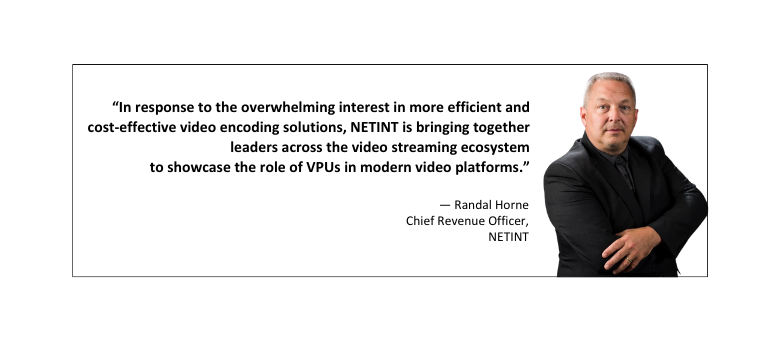
“In response to the overwhelming interest in more efficient and cost-effective video encoding solutions, NETINT is bringing together leaders from across the video streaming ecosystem to showcase the role of VPUs in modern video platforms.
“I cordially invite you to visit us in Stand 1.74 at IBC to explore how VPUs can help you delight more users while cutting operational costs by half.”
At IBC 2025, the centrepiece of NETINT’s booth will be the Quadra VPU, its latest generation ASIC-based encoder that delivers the efficiency of purpose-built hardware with the flexibility of software.
The Quadra family is an established product line, widely deployed across streaming, cloud gaming and live event workflows. At IBC 2025, the company will showcase new AI-assisted encoding features and expanded low-latency live streaming capabilities, which build on proven deployments while adding functionality that directly addresses emerging customer requirements.
Horne added, “Quadra combines the density and power efficiency of ASICs (up to 10x streams per rack unit compared to GPU-based solutions) with the flexibility of software integration.
“In practical terms, this means operators can reduce OPEX, extend their infrastructure lifespan, and meet sustainability goals without sacrificing quality or agility.”
While GPU- and CPU-based solutions remain common, they impose significant costs and power burdens as video demand scales. NETINT’s approach is purpose-built silicon that easily integrates into software-defined workflows. Their differentiation lies in enabling massive performance-per-watt and per-dollar gains.
Horne insisted that Quadra was neither a “me-too” nor a niche product. It represented a new category of infrastructure — silicon-based VPUs purpose-built for video. “Nobody else is delivering this level of efficiency with the same proven ecosystem support, which is why we are seeing adoption from top-tier players in streaming, gaming and cloud infrastructure,” he said.
NETINT’s VPUs form the core of the new category of cloud-based computer launched by Akamai, the cybersecurity and cloud computing company that has been the pioneer of VPUs in the cloud.
Akamai Cloud Accelerated Compute Instances (ACACI) is a new compute category built on specialised computer chips designed to perform specific tasks more efficiently than general-purpose processors.
The rise in live and on-demand video streaming, user-generated content, and video-driven social media has pushed companies into looking for optimised hardware and cloud solutions to improve application performance.
However, transcoding-optimised cloud computing resources are rare. Previously, the only way to deploy NETINT’s VPU hardware was to purchase it outright and run it on-premises or in a colocation facility. ACACI are designed for media companies that are delivering video on demand and live streaming services, providing the scalability needed without inflating IT budgets.
“Akamai is the first and only cloud provider to offer VPUs in the cloud,” said Jon Alexander, Vice-President of Product Management, Akamai. “By bringing traditionally hardware-confined power to the cloud, we’re removing barriers that have held businesses back.
“Companies can now cut costs, scale seamlessly and deliver better streaming experiences — solving a major industry challenge that’s been overlooked for too long.”
NETINT VPUs allow companies to reallocate their application’s CPUs by offloading compute-intensive video processing tasks to the VPU. A VPU architecture offers up to 20 times greater throughput than CPU-only solutions. This frees the CPU to do other things like dynamic packaging, de-interlacing, real-time speech-to-text captioning, software decoding for standards not supported in the VPU, and run popular applications like FFmpeg and GStreamer.
“NETINT is proud to be the VPU engine inside Akamai Accelerated Compute Instances, bringing up to 20 times the throughput at a tenth of the cost compared with traditional industry platforms,” said Horne. “With Akamai Cloud, NETINT helps media companies reduce equipment investment and cut operating expenditure to meet their growth and profitability targets.”
Akamai is making a play to be the cloud for media and to capture areas of the market overlooked by hyperscalers. Akamai media services, trusted by all top video streaming services, include solutions for contribution, transport, transcoding, packaging, digital rights management, ad insertion, and content security.
With the first-time cloud availability of VPUs, transcoding-optimised NVIDIA GPUs and industry-low egress costs, Akamai enables performance at scale. Its cloud platform is open by design, giving customers control over every aspect of their workflow and access to a vibrant and growing third-party partner network.
“Media companies can choose from multiple software and partner options across each workflow step to transport, prepare, process, deliver, secure and monetise digital content,” said Alexander. “The scale of Akamai’s massively distributed cloud gives it the unique ability to minimise egress fees and offer generous allowances, providing unmatched price-performance.”
With cost control being the name of the game, NETINT’s bold step into AI-backed VPUs poses a strong challenge to competitors in the field, like NEXCOM and AAEON. NEXCOM AIBooster-X8 card adopts Intel Vision Accelerator Design technology to provide deep neural network inference for fast, accurate video analytics.
Powered by the eighth/ninth generation Intel Core processor, the AIEdge-X300-VPU enhanced edge PC can handle powerful multimedia content. In addition, it includes one expansion slot for graphics card that supports NEXCOM AIBooster-X8 VPU, not only does it offer stunning visuals for image projecting, it is also optimal for AI machine/deep learning. The AIEdge-X 300 engages “calls to action” with virtual interactions in order to increase product interest and dwell time.
As for AAEON, which is part of the ASUS group, and is a three decades old designer and manufacturer of industrial and embedded computing platforms, it offers end-to-end services from product development to manufacturing. It would have to rely on OEM/ODM (original equipment manufacturers) customers and systems integrators who have got used to its specialised embedded solutions, and do not mind the cost difference.
With their unparalleled ability to process and interpret visual information, VPUs have redefined the boundaries of AI capabilities, fostering innovation and advancements across diverse industries. As the landscape of AI continues to evolve, the pivotal role of VPUs in enabling efficient and decisive visual data processing is poised to shape the future of intelligent systems … and in modern video platforms.