



By Shaun Lim
The US government’s decision to defund the Corporation for Public Broadcasting (CPB) after nearly six decades has reverberated far beyond American borders. While officials framed the move as a cost-saving measure, critics argue the decision lacked a clear rationale, especially given CPB’s track record of nurturing educational and cultural programming.
In lamenting the “difficult reality” of ceasing operations despite failed attempts to beseech US Congress to preserve federal funding for CPB, CEO Patricia Harrison said, “Public media has been one of the most trusted institutions in American life, providing educational opportunity, emergency alerts, civil discourse, and cultural connection to every corner of the country.”
More than 1,500 locally owned public radio and television stations are expected to be hit by the closure of CPB, where most staff positions will conclude with the close of the fiscal year on September 30.
In the Asia-Pacific region, where governments and regional bodies like the Asia-Pacific Institute for Broadcasting Development (AIBD) and the International Telecommunication Union (ITU) continue to champion public service broadcasting (PSB) for its educational and cultural, the hope is that what is happening in the US will not be emulated.
While alarm bells may not be ringing any time soon, CPB’s closure does serve as a timely reminder of how fragile public media ecosystems can become without consistent support.
Dismissing developments in the US as an outlier, Dr Amal Punchihewa, Advisor and Technical Consultant for AIBD, said there is no plausible reason for public service media (PSM) to follow the same route.
He told APB+, “Through a number of AIBD and ITU workshops, I have noticed that many countries in APAC place a very high value on the services rendered by PSB, which enable educational, cultural, and emergency communication programmes.”
While acknowledging that many Asia-Pacific countries and broadcasters are grappling with financial pressures, Dr Amal urged all stakeholders to “think globally and act locally,” and look beyond what is happening in the US.
He cited the example of the UK, where media regulator OFCOM, through studies and reports published over the past three years, has decided that it is in the best interests of the country that PSM continues to be funded.
Like the US, Dr Amal estimated that the public broadcasting system in the Asia-Pacific region consists of over 1,500 locally owned and operated broadcast stations reaching and serving about 98% of the population.
“Public service broadcasters are the only broadcasters that truly provide close to universal reach, where the public can freely access content without gatekeepers,” he said.
That reach is particularly critical in the Asia-Pacific region, where many countries rely on PSM as the only way to connect with people in rural and small markets. For this reason, terrestrial broadcasting — whether analogue or digital — remains indispensable.
Audiences in these areas depend heavily on it, as both broadcasters and communities struggle with the high costs of online distribution and the lack of affordable, reliable broadband.
Despite efforts to expand universal access, a significant portion of the population is still offline, as Dr Amal pointed out. “Recent communications from ITU reminded us that globally, 2.6 billion people still do not have access to any form of broadband,” he said.
What alternative funding models could then be deployed to ensure the long-term sustainability of PSB in the Asia-Pacific region?
While Public Broadcasting Service (PBS) and National Public Radio (NPR) in the US have access to funding beyond federal funding, including donations from the public, the funding models of public service broadcasters in the Asia-Pacific region are subjected to greater financial vulnerability due to the global economic downturn.
Dr Amal said, “While some countries continue to rely on license fees, others combine limited government support with advertising and sponsorship, and a few operate fully as public companies. Faced with mounting financial pressures and reduced support, many public service broadcasters have been forced to downsize their teams, shift more programming to streaming platforms, and explore new ways of sustaining their services.”
Donations, while providing some support, may not be a long-term solution either. “They are unpredictable and require ongoing fundraising campaigns, which can distract public service broadcasters from their core mission,” he explained.
For those who rely on license fees, the increasingly significant challenges in collecting them have resulted in drastic reductions in these contributions. Returning to the UK example, Dr Amal highlighted how difficulties in sustaining revenue through license fees alone has prompted the exploration of alternative funding models to support public service media.
Despite these financial pressures, he is heartened by countries’ continued support for PSM, recognising the critical role it plays in society. PSM, Dr Amal reiterated, delivers trusted information, provides entertainment for all, and communicates key updates on economic development, health, and disaster situations.
He noted that governments and policy makers have identified public service broadcasters as essential providers of reliable information, helping to minimise the harms caused by misinformation and fake news.
“This underscores that, even in financially challenging times, the societal value of PSM extends far beyond content delivery — it is a cornerstone of informed, resilient communities,” said Dr Amal.
PSB spotlight: How TVRI keeps public service alive
As a public broadcaster in Indonesia that reaches over 78% of an estimated 283.5 million population, it is perhaps unsurprising that TVRI relies heavily on government funding. This, however, does not diminish its commitment to safeguarding editorial independence.
Satriyo Dharmanto, Chief Technology Officer, TVRI Nasional, shared with APB+, “The allocation of government funding is prioritised for supporting national development priorities and the dissemination of information related to Digital Transformation and Digital Government programmes, encompassing digital transformation across all aspects of governance, including data, policy, public services, and citizen participation.
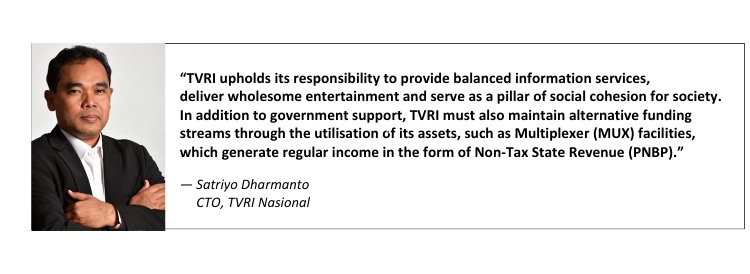
“Furthermore, TVRI upholds its responsibility to provide balanced information services, deliver wholesome entertainment and serve as a pillar of social cohesion for society.
“In addition to government support, TVRI must also maintain alternative funding streams through the utilisation of its assets, such as Multiplexer (MUX) facilities, which generate regular income in the form of Non-Tax State Revenue (PNBP).”
To prepare for potential reductions or re-prioritisation of public funding, TVRI has adopted a refocusing strategy that aligns its operations with national development goals, particularly the dissemination of information of Digital Transformation and Digital Government programmes.
TVRI also strengthens collaboration with external partners, including central and regional governments, as well as other organisations, to support the priorities outlined in the National Medium-Term Development Plan (RPJMN 2025-2029). Collaborative budget utilisation further ensures efficiency and effectiveness in resource management.
To bolster longer-term sustainability, TVRI actively collaborates with international organisations such as AIDB, the Asia-Pacific Broadcasting Union (ABU), and Canal France International (CFI) to produce high-quality broadcast programmes through joint funding initiatives and grants.
Satriyo added, “In addition, TVRI is exploring various cooperation opportunities under the frameworks of Government-to-Government foreign loans and Public-Private Partnerships
(PPP), aimed at fostering collaboration in the development of modern broadcasting infrastructure and strengthening TVRI’s long-term sustainability.”
The experiences of the US and TVRI highlight both the fragility and the resilience of public service media. While the defunding of CPB serves as a stark warning of what can happen without sustained support, the Asia-Pacific region demonstrates that with careful planning, strategic partnerships, and continued government commitment, PSBs can maintain editorial independence, reach underserved populations, and remain a trusted source of information.