

By Shaun Lim
With more content to choose from than ever before, the challenge of engaging audiences has arguably never been harder for broadcasters in 2025. Behind every live match, binge-worthy drama, or personalised playlist sits a sprawling media machine that must create, store, schedule, and deliver content at lightning speed.
While the industry buzzword may be “end-to-end workflows”, a shift towards tightly integrated technologies spanning creation, storage, playout, and personalisation is reshaping the broadcast landscape from the editing suite to the viewer’s screen.
As broadcasters scramble to meet audience expectations in real time, technology providers are racing to supply the tools that make these end-to-end workflows possible. From cloud-based systems and AI-driven personalisation, companies like Avid, GB Labs, Pebble, and Vionlabs are helping media organisations streamline operations, unlock creative potential, and keep viewers engaged.
Across the content lifecycle, for instance, Avid is providing tools that support faster and more collaborative content creation. Its new Avid Content Core platform unifies ingest, storage, search, and orchestration into a single cloud-based layer that eliminates silos and accelerates the entire production process.
The continuing challenge for both broadcasters and streaming platforms, he said, is to produce great shows that resonate with audiences. “Enabling teams to collaborate more efficiently, regardless of where they are located, will ensure the best talent have instant access to the best tools to create high quality shows.”
With applications such as Quickture and Flawless already available in Media Composer, Wilson expects AI to play an increasingly key role in automating the mundane, speed up time-consuming tasks and allow teams to focus on being more creative and producing more to meet audience demands.
“We also expect to see further adoption of hybrid and fully cloud-enabled production workflows, whether that is for news, sports, TV, or film.
“In the broadcast environment, there will be greater use of software running on commercial off-the-shelf (COTS) hardware than proprietary bits of kit, and continued growth of IP-based workflows,” said Wilson.

While Avid focuses on collaborative creation, GB Labs is tackling another crucial piece of the puzzle: managing and accessing ever-growing media libraries.
Recognising that modern media workflows are increasingly global, hybrid, and collaborative, GB Labs introduced NebulaNAS, a production cloud platform that gives teams fast, reliable, and secure access to their media hub from anywhere in the world. Whether users are in-house editors or freelancers across multiple locations, NebulaNAS ensures everyone can access the same content without delay, enabling uninterrupted end-to-end production workflows, said Dominic Harland, CEO & CTO, GB Labs.
“What sets our approach apart is the way we bring together cloud and on-premises performance,” he explained. “Our well-established operating system, CORE OS, ties everything together, integrating our powerful hardware platforms with NebulaNAS.
“For example, teams can use our NVME systems for ultra-fast editing in the office, while NebulaNAS makes the same content instantly available to other users working remotely and needing to collaborate.”
The result is a user-friendly, scalable platform designed to handle rapidly expanding media libraries, helping broadcasters and media companies manage archives and share content securely, while maintaining the speed and flexibility that today’s production environments demand.
Moreover, remote creative teams working with large format media now demand the same speed, security, and reliability they would have in the office.
“To achieve this, storage and asset management must evolve into a single point of truth, where all content is securely centralised, but accelerated by localised storage that caches data for high performance,” said Harland. “This approach ensures remote and hybrid workflows can operate without compromise.”
Ingest points are also becoming far more varied, he observed. “With content coming from multiple locations, devices, and production partners, media asset management (MAM) solutions must adapt to manage and organise this data intelligently. Workflows need to connect to large archives with live production seamlessly.”
NebulaNAS addresses these challenges by appearing to users as a familiar network-attached storage (NAS) or local volume on the desktop. It integrates readily with existing on-prem workflows, while delivering scalability, security, and flexibility of the cloud. “The result is a hybrid model that gives companies managing media the best of both worlds — enterprise-level storage efficiency paired with the agility to meet the demands of cloud-first operations,” said Harland.
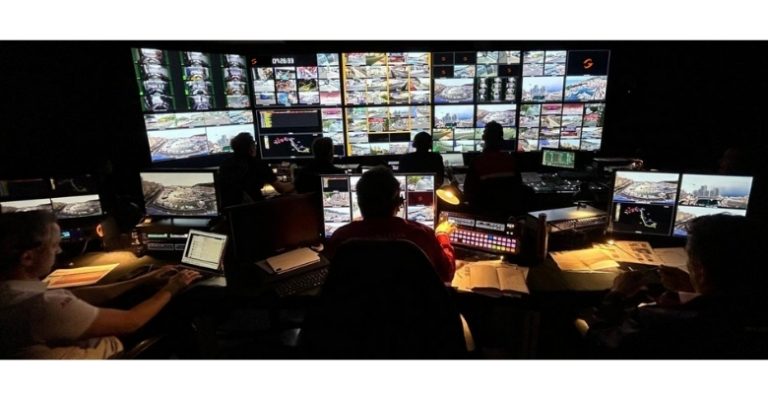
While Avid and GB Labs focus on creation and storage, Pebble addresses the crucial final step: getting content to air reliably and efficiently. Both broadcasters and new entrants in the streaming market face intense pressure to operate as efficiently as possible while maximising revenue opportunities, particularly for ad-funded channels where every slot counts, said Samir Isbaih, VP Sales for Middle East & Asia Pacific, Pebble.
He added, “Today’s playout platform must be extremely agile, automating wherever possible and providing intelligent support where it is required, like making last-minute decisions on slotting commercials into live sports action.

“Playout must be stable and resilient, with redundancy and monitoring to ensure no on-air risks. It must also be flexible, allowing new features to be added quickly through third-party plug-ins.”
To better support its customers, Pebble is delivering the key requirements to empower modern systems to do “more for less.” This includes multiple channel types triggered from a single playlist and SCTE markers integrated for dynamic ad insertion, as well as flexible and cost-effective automation customised to the customer’s workflow.
Isbaih also highlights one of the biggest operational challenges broadcasters face: ensuring system responsiveness to maintain an uninterrupted flow of content, even when last-minute decisions are required.
In this scenario, technology makes it easier for operators to act under pressure, as he explained, “Many premium, complex, multi-layered playout organisations continue to favour on-premises technology for primary services, which delivers maximum capacity, functionality, and scalability in the smallest footprint while retaining full resilience.”
This is further supported by Pebble through detailed logging of events, granular access rights, and a unified interface for all channel types. Automation manages workflows end-to-end while still giving operators visibility and manual control where needed. Built-in validation ensures media is correct, complete, and ready to air, while interfaces are easily customised to operator preferences.
“Finally, a single integrated product provides ingest, playout, content management, and scheduling tools from one system-wide database,” said Isbaih.

While Pebble ensures content reaches the screen reliably and efficiently, Vionlabs focuses on what happens once it is in front of viewers: making the experience personal, engaging, and emotionally resonant.
By leveraging AI to understand mood, narrative, and pacing, Vionlabs helps broadcasters and streaming platforms go beyond traditional “recommendation engines” to deliver content that truly connects with audiences.
AI is moving far beyond “if you liked this, you would like that” recommendations, said Marcus Bergstöm, CEO, Vionlabs.
“At Vionlabs, we build domain-specific AI models that understand video on a much deeper level — capturing mood, narrative, pacing, and other human-like dimensions.
“By combining Editorial Lab with our AI Media Agent, platforms can generate mood-based collections with more than 90% catalogue coverage, ensuring no corner of the library is left behind.”
Vionlabs’ Creative Lab then aligns curated lists with mood-matched thumbnails, shorts, and preview clips to create a viewer experience that feels coherent, emotionally engaging, and consistent.
“This creates personalisation that is not just accurate but also emotionally resonant, which is what truly drives engagement and retention,” said Bergstöm. “We are also seeing a shift from pure algorithmic recommendations to workflow-integrated AI. In other words, AI is not just surfacing ‘what to watch’; it is now embedded into the day-to-day decisions of editorial, creative, and operation teams.”
As part of this development, he identifies three big trends to note, including Curation + Creativity Convergence, where editorial and creative workflows merge. With tools like Vionlabs’ Creative Lab, programming decisions can be instantly paired with mood-matched visuals, creating stronger engagement at the point of discovery.
The next wave of Operational AI, or what Vionlabs calls Operations Lab, focuses on automating routine content tasks such as ad break detection, binge makers, and metadata checks, so teams can spend more time on creative storytelling.
Lastly, Holistic Analytics encompasses AI-driven insights spanning the full catalogue instead of just top titles, allowing programming strategies to leverage the “long tail” of content more effectively.
“In short, the industry is moving from ‘AI as a recommendation engine’ to AI as an end-to-end workflow partner that informs, accelerates, and scales decisions across editorial, creative, and operations,” said Bergstöm.
In an era where content is king but attention spans are short, the broadcast and streaming industries are leaning more than ever on technology to stay ahead. From Avid’s collaborative creation tools, GB Labs’ hybrid storage solutions, and Pebble’s agile playout systems, to Vionlabs’ AI-driven personalisation, each piece of the media workflow puzzle plays a critical role in getting the right content to the right viewer at the right time.
Beyond just streamlining operations, these innovations are shaping the way audiences experience, engage with, and ultimately fall in love with content in 2025 and beyond.