


With the philosophy of always pushing the boundaries of what is possible with IP-based video, it is perhaps not surprising that Kiloview is one of the earliest adopters and consistent innovators in the NDI ecosystem.
The release of NDI 6.2 this June thus represents not just a version update, but a major leap forward towards a most robust, scalable, and professional NDI ecosystem, said Jacob Zuo, Founder & CTO, Kiloview.
He explained, “NDI 6.2 brings critical improvements that align closely with the needs we’ve observed in the field. Our customers often require flexible deployment options, remote access capabilities, and seamless device discovery.
“This release helps make those goals more achievable and lays a stronger foundation for next-generation IP video workflows.”
One of the most impactful changes NDI 6.2 brings, is the transformation of NDI Discovery Server and NDI Bridge into Windows Services. This, said Zuo, has huge implications for real-world deployments.
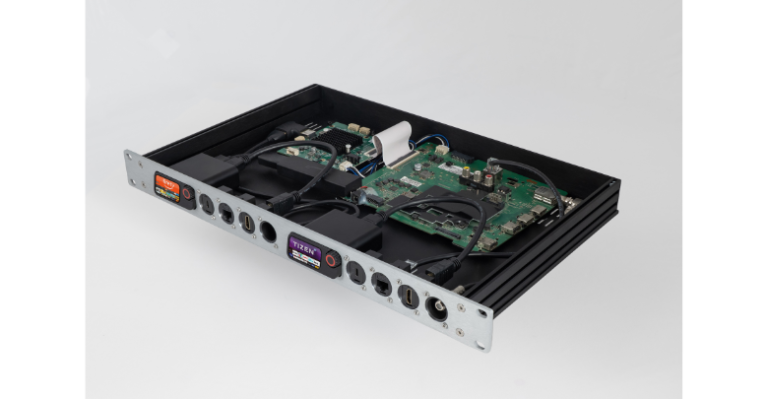
“At Kiloview, we developed a new AMD Ryzen 8000-based compute card for our 2RU rackmount chassis RF02, which can host up to four such cards. With NDI 6.2, we’re able to build hardware-based, high-performance NDI Discovery and Bridge Services with Web UI, making deployment in professional AV environments dramatically easier.
Kiloview has also played a key role to support the NDI 6.2 roadmap, including implementing full 10-bit high dynamic range (HDR) encoding and decoding on field-programmable gate array (FPGA) platforms.
Achieving this, said Zuo, required deep-level optimisation to overcome the bandwidth limitations of FPGA DDR when processing 4K 10-bit video, and this breakthrough represents more than just a technical achievement.
He continued, “It delivers real, tangible benefits for users who demand ultra-high-quality, low-latency NDI video, whether in broadcast, live production, or enterprise AV environments.”
For instance, the improved discovery and bridge services address key user pain points in managing large-scale deployments and remote workflows. “The Receiver API gives us a clearer, more efficient approach to managing NDI receivers. And on our end, the addition of full 10-bit/HDR support further complements the capabilities of the NDI SDK, especially for customers working in colour-critical environments,” said Zuo.
“Being part of the NDI 6.2 validation programme across our product portfolio gave us strong confidence in its core functionality and stability.
“While we haven’t yet fully implemented the new Receiver Advertiser API, we’re excited by its potential to standardise device discovery, an area where we previously had to build creative workarounds.”