

- APB+ News

APB+ News

APB AWARDS - NOMINATE NOW!

[master-leader-web]
[master-leader-mob]

Add Your Heading Text Here

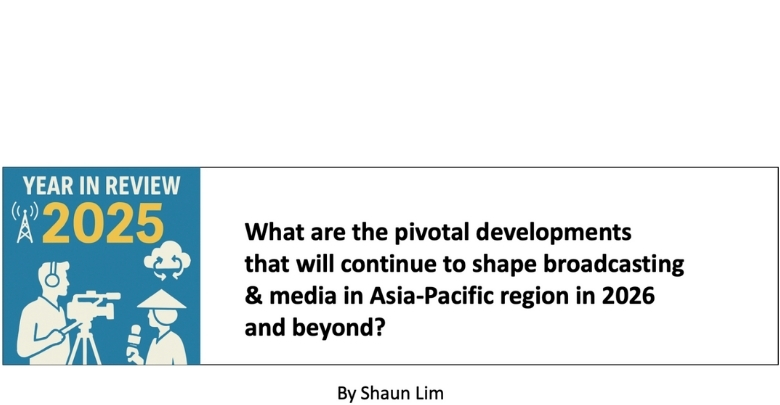
With 2026 round the corner, broadcasters in the Asia-Pacific region are taking time to reflect on the pivotal developments of 2025 and the insights they offer for shaping effective strategies in the year ahead.

In this special report, we invite you to revisit 2025 through APB+’s comprehensive coverage of the most significant trends, technological innovations, and industry shifts across broadcasting and media, highlighting lessons, opportunities, and strategies that can help the region stay ahead in an increasingly connected and competitive ecosystem.

January: The transformative power of IP broadcasting in media and technology 

The broadcast industry is undergoing a tectonic shift from traditional SDI to IP broadcasting, a transition that promises greater agility, scalability and cost-efficiency in media production and distribution. 

IP removes the rigid structures of SDI, allowing dynamic reconfiguration and remote workflows that truly support anywhere to anyone content delivery. As Jonathan Smith, Solution Area Expert Cloud at Net Insight put it, IP “becomes the unifying protocol when agility” is needed, enabling broadcasters to adapt rapidly across formats and platforms. Case studies like Shanghai Media Group’s move to 100 GbE and ST 2110 highlight how IP networks can futureproof infrastructure while handling high bandwidth 4K+/Ultra HD (UHD) content and expanding global reach.

February: Transition to the cloud by tagging on best-in-class hybrid solutions 

In February, broadcasters were urged to embrace cloud workflows with hybrid solutions that balance flexibility, scalability and cost-efficiency. TAG Video Systems highlighted the importance of partnerships with cloud providers like Tencent Cloud, AWS, Google Cloud and Azure to ensure integration, saying its technology  “is built for flexibility and scalability” and supports hybrid workflows that optimise operations while reducing hardware costs. 

Vizrt underscored how cloud-native production benefits broadcasters by enabling remote access, redundancy and scalability, with NDI’s low-latency IP transport empowering broadcasters to manage their content with versatility. 

“NDI’s flexibility and ease of use provide broadcasters with the necessary tools to streamline their workflows efficiently,” said Jon Raidel, Global Centre of Excellence Lead in Cloud & Live Production, Vizrt.

March: Stopping churn by building a clear OTT roadmap

In March, APB+ highlighted the growing urgency for broadcasters in APAC to define clear over-the-top (OTT) strategies as audience behaviour and competition evolve. With attention spans shrinking, traditional TV alone no longer engages today’s digital-first viewers. 

Wissam Sabbagh, CEO of Mangomolo, warned, “Without a clear OTT roadmap, broadcasters risk losing relevance to global and regional streaming giants.” He stressed that broadcasters must invest in personalisation, seamless UX and multi-platform presence, and leverage AI, hybrid monetisation, Free Ad-Supported Streaming Television (FAST) and regional content to retain viewers. Local strengths, including cultural storytelling, brand trust and content archives, can go a long way towards helping broadcasters stand out in a crowded OTT landscape.

April: 2025 NAB Show takes centre stage

Still widely regarded as one of the world’s premier broadcast, media, and entertainment industry exhibitions, this year saw an estimated 55,000 visitors converge on the halls of the Las Vegas Convention Centre to examine trends across AI, the creator economy, sports, streaming over-the-top (OTT), and cloud virtualisation.

Proudly flying the APB+ flag at the 2025 NAB Show was News Editor, Shirish Nadkarni, who scoured the halls of the Las Vegas Convention Centre speaking with key stakeholders on the latest trends and developments impacting the broadcast and media industry.

Expect to see more of the APB+ team at key trade events in 2026!

May: AI is reshaping media workflows, engagement and enhancing trust in news content 

AI is transforming media and broadcast workflows, from personalisation and content discovery to viewer engagement and editorial efficiency. 

Peter Docherty, CTO & Co-Founder of ThinkAnalytics, highlighted, “The adoption of AI for personalisation, content discovery, and targeted advertising, as well as optimising editorial workflows, is continuing apace as content owners, broadcasters and streaming providers look to increase engagement with viewers and monetise their investments in content and rights.”

Shailendra Mathur, Vice-President of Architecture & Technology, Avid, emphasised that AI should augment human creativity, not replace it, improving efficiency within existing workflows while maintaining editorial control and trust. “The need for trust in the content, especially in news, is critical,” he said.

June: How StarHub has evolved from broadcaster to experience maker 

In an exclusive interview with APB+, Matt Williams, Chief of Consumer Business Group, StarHub, shares how the company has redefined its role in Singapore’s media ecosystem, the impact of tech like 5G and cloud infrastructure, and what it means to truly connect with audiences in an era of rapid changes.

“We stopped asking, ‘What more can we show?’ and started asking, ‘What more can we do for our customers’ everyday lives?’”, revealed Williams.

Celebrating its 25th anniversary in 2025, StarHub now prioritises human-first experiences, leveraging 5G, cloud infrastructure, personalised services, and live sports engagements to deepen audience relationships and influence regional media convergence.

Or as Williams highlighted, “We are no longer just in the business of broadcast – we are in the business of creating seamless, human-first connections.”

July: Why innovation, trust, and the shifting boundaries of content creation are futureproofing media 

APB+ sat down with Stan Moote, CTO of IABM, to unpack insights from the IABM Technology & Trends Roadmap 2025, emphasising how innovation and trust will futureproof media. Moote highlighted that Zero Trust security is now essential for collaboration across global media supply chains, not a barrier to openness but a foundation for efficient, secure workflows. 

He also discussed sustainability challenges and the need for standardised reporting and examined the blurring lines between creator-grade and broadcast-grade production, noting creative tools are becoming more powerful but raise quality control and compliance issues. 

“Innovation and a clear future roadmap continue to be the primary drivers of investment … the companies most likely to thrive will be those that can adapt quickly, form creative partnerships, and invest not only in compelling content, but also in the technologies that power its creation, distribution, and monetisation,” said Moote.

August: Net-zero by 2030? How broadcast and media tech can work towards a carbon-neutral and sustainable future

Can the broadcast and media industry push towards net-zero carbon emissions by 2030? 

Barbara Lange, Principal & CEO of Kibo121, a boutique consultancy which works with the media industry to help educate and enhance sustainability initiatives, highlighted that while greener practices are emerging, “once content moves into the ‘digital factory’ phase… sustainability efforts often lose momentum”, due to gaps like embedded carbon in hardware and inconsistent lifecycle reporting.

For vendors, sustainability is about smart business, where lower carbon operations reduce costs, strengthen competitiveness in tenders, and align with customers who increasingly demand greener solutions.

“Sustainability is no longer a differentiator; it’s a threshold for credibility and continued relevance,” said Matthew Williams-Neale, VP of Marketing, Appear.

September: Can public service broadcasting in APAC navigate financial pressures and maintain public trust?

In September, APB+ examined the ripple effects of the US government’s decision to defund the Corporation for Public Broadcasting (CPB), a move that saw the organisation ceasing operations after nearly six decades of support for public media.

While the US experience could be seen as just a cautionary tale, strong government backing and diverse funding models can help public service broadcasters maintain editorial independence and reach underserved communities. 

APB+ columnist Dr Amal Punchihewa urged public service broadcasters (PSBs) to “think globally and act locally”, while Satriyo Dharmanto, Chief Technology Officer, TVRI Nasional, highlighted the importance of aligning funding with national priorities.

October: Traditional TV can thrive by connecting audiences, creators, and advertisers in today’s landscape

Traditional TV can remain relevant by strengthening links between audiences, creators, and advertisers amid evolving consumption habits. 

Dr Ahmad Zaki, an independent media observer and former Director of Technical Operations at Media Prima, observed that GenZ viewers “consume content on the move and in fragments,” forcing broadcasters to rethink formats and engagement strategies.

“Content that reacts quickly to current events or trends tends to gain traction rapidly, spreading across platforms through shares and reports,” he added.

Lee Hung Sheng, Head, Audience & Partnerships, Mediacorp, explained how a platform-agnostic, data-driven approach helps connect content creators with diverse audiences and advertisers across screens.

“Rather than defining audiences by platform, we leverage both our owned-and-operated as well as third-party platforms to deliver content IPs and personalities that resonate across different demographics,” he said.

November: Satellite evolves to meet growing demands for IP-driven workflow in Asia

Amid rising over-the-top (OTT) and IP-based delivery, satellite broadcasting in APAC continues to evolve. 

While the number of satellite-distributed channels may decline, satellite remains vital for universal reach and reliable delivery, particularly in remote regions.

Rather than competing directly with streaming or IP-based delivery, satellite is increasingly becoming part of a blended distribution ecosystem, said Dimitri Buchs, Managing Consultant, Novaspace. 

“This hybrid approach supports enhanced streaming services, higher-resolution video, and interactive features,” he added.

Satellite operator SES is supporting this evolution by providing flexible, cloud-native and hybrid satellite-IP solutions that enable broadcasters to deliver enhanced streaming, on-demand content, and interactive features.

“We continue to invest in ground infrastructure and next-generation terminals that support hybrid IP/DVB workflows and cloud-native platforms, reducing operational complexity and lowering total costs of ownership for broadcasters,” said Steve Bisenius, VP, Customer Solutions Engineering, SES.

December: What APAC must get right to close the digital gap

APAC is standing at a pivotal moment in its digital journey, with mobile networks contributing over 6% of regional GDP in 2024 and projected to reach US$1.4 trillion by 2030. 

Julian Gorman, Head of APAC at GSMA, emphasised that while coverage is near-universal, gaps in affordability, infrastructure, skills, and regulation leave many communities behind. He urged coordinated action between governments, mobile operators, and broadcasters to close the digital divide, stressing the need for targeted funding, infrastructure-sharing, skills programmes, and proportionate regulation. 

“If these priorities are pursued in an integrated manner and progress is tracked against clear national targets, APAC can ensure the transition to 5G and IP-based services delivers benefits to every community — not just the most connected ones,” he concluded.
Join The Community

Join The Community

Add Your Heading Text Here

With 2026 round the corner, broadcasters in the Asia-Pacific region are taking time to reflect on the pivotal developments of 2025 and the insights they offer for shaping effective strategies in the year ahead.

In this special report, we invite you to revisit 2025 through APB+’s comprehensive coverage of the most significant trends, technological innovations, and industry shifts across broadcasting and media, highlighting lessons, opportunities, and strategies that can help the region stay ahead in an increasingly connected and competitive ecosystem.

January: The transformative power of IP broadcasting in media and technology 

The broadcast industry is undergoing a tectonic shift from traditional SDI to IP broadcasting, a transition that promises greater agility, scalability and cost-efficiency in media production and distribution. 

IP removes the rigid structures of SDI, allowing dynamic reconfiguration and remote workflows that truly support anywhere to anyone content delivery. As Jonathan Smith, Solution Area Expert Cloud at Net Insight put it, IP “becomes the unifying protocol when agility” is needed, enabling broadcasters to adapt rapidly across formats and platforms. Case studies like Shanghai Media Group’s move to 100 GbE and ST 2110 highlight how IP networks can futureproof infrastructure while handling high bandwidth 4K+/Ultra HD (UHD) content and expanding global reach.

February: Transition to the cloud by tagging on best-in-class hybrid solutions 

In February, broadcasters were urged to embrace cloud workflows with hybrid solutions that balance flexibility, scalability and cost-efficiency. TAG Video Systems highlighted the importance of partnerships with cloud providers like Tencent Cloud, AWS, Google Cloud and Azure to ensure integration, saying its technology  “is built for flexibility and scalability” and supports hybrid workflows that optimise operations while reducing hardware costs. 

Vizrt underscored how cloud-native production benefits broadcasters by enabling remote access, redundancy and scalability, with NDI’s low-latency IP transport empowering broadcasters to manage their content with versatility. 

“NDI’s flexibility and ease of use provide broadcasters with the necessary tools to streamline their workflows efficiently,” said Jon Raidel, Global Centre of Excellence Lead in Cloud & Live Production, Vizrt.

March: Stopping churn by building a clear OTT roadmap

In March, APB+ highlighted the growing urgency for broadcasters in APAC to define clear over-the-top (OTT) strategies as audience behaviour and competition evolve. With attention spans shrinking, traditional TV alone no longer engages today’s digital-first viewers. 

Wissam Sabbagh, CEO of Mangomolo, warned, “Without a clear OTT roadmap, broadcasters risk losing relevance to global and regional streaming giants.” He stressed that broadcasters must invest in personalisation, seamless UX and multi-platform presence, and leverage AI, hybrid monetisation, Free Ad-Supported Streaming Television (FAST) and regional content to retain viewers. Local strengths, including cultural storytelling, brand trust and content archives, can go a long way towards helping broadcasters stand out in a crowded OTT landscape.

April: 2025 NAB Show takes centre stage

Still widely regarded as one of the world’s premier broadcast, media, and entertainment industry exhibitions, this year saw an estimated 55,000 visitors converge on the halls of the Las Vegas Convention Centre to examine trends across AI, the creator economy, sports, streaming over-the-top (OTT), and cloud virtualisation.

Proudly flying the APB+ flag at the 2025 NAB Show was News Editor, Shirish Nadkarni, who scoured the halls of the Las Vegas Convention Centre speaking with key stakeholders on the latest trends and developments impacting the broadcast and media industry.

Expect to see more of the APB+ team at key trade events in 2026!

May: AI is reshaping media workflows, engagement and enhancing trust in news content 

AI is transforming media and broadcast workflows, from personalisation and content discovery to viewer engagement and editorial efficiency. 

Peter Docherty, CTO & Co-Founder of ThinkAnalytics, highlighted, “The adoption of AI for personalisation, content discovery, and targeted advertising, as well as optimising editorial workflows, is continuing apace as content owners, broadcasters and streaming providers look to increase engagement with viewers and monetise their investments in content and rights.”

Shailendra Mathur, Vice-President of Architecture & Technology, Avid, emphasised that AI should augment human creativity, not replace it, improving efficiency within existing workflows while maintaining editorial control and trust. “The need for trust in the content, especially in news, is critical,” he said.

June: How StarHub has evolved from broadcaster to experience maker 

In an exclusive interview with APB+, Matt Williams, Chief of Consumer Business Group, StarHub, shares how the company has redefined its role in Singapore’s media ecosystem, the impact of tech like 5G and cloud infrastructure, and what it means to truly connect with audiences in an era of rapid changes.

“We stopped asking, ‘What more can we show?’ and started asking, ‘What more can we do for our customers’ everyday lives?’”, revealed Williams.

Celebrating its 25th anniversary in 2025, StarHub now prioritises human-first experiences, leveraging 5G, cloud infrastructure, personalised services, and live sports engagements to deepen audience relationships and influence regional media convergence.

Or as Williams highlighted, “We are no longer just in the business of broadcast – we are in the business of creating seamless, human-first connections.”

July: Why innovation, trust, and the shifting boundaries of content creation are futureproofing media 

APB+ sat down with Stan Moote, CTO of IABM, to unpack insights from the IABM Technology & Trends Roadmap 2025, emphasising how innovation and trust will futureproof media. Moote highlighted that Zero Trust security is now essential for collaboration across global media supply chains, not a barrier to openness but a foundation for efficient, secure workflows. 

He also discussed sustainability challenges and the need for standardised reporting and examined the blurring lines between creator-grade and broadcast-grade production, noting creative tools are becoming more powerful but raise quality control and compliance issues. 

“Innovation and a clear future roadmap continue to be the primary drivers of investment … the companies most likely to thrive will be those that can adapt quickly, form creative partnerships, and invest not only in compelling content, but also in the technologies that power its creation, distribution, and monetisation,” said Moote.

August: Net-zero by 2030? How broadcast and media tech can work towards a carbon-neutral and sustainable future

Can the broadcast and media industry push towards net-zero carbon emissions by 2030? 

Barbara Lange, Principal & CEO of Kibo121, a boutique consultancy which works with the media industry to help educate and enhance sustainability initiatives, highlighted that while greener practices are emerging, “once content moves into the ‘digital factory’ phase… sustainability efforts often lose momentum”, due to gaps like embedded carbon in hardware and inconsistent lifecycle reporting.

For vendors, sustainability is about smart business, where lower carbon operations reduce costs, strengthen competitiveness in tenders, and align with customers who increasingly demand greener solutions.

“Sustainability is no longer a differentiator; it’s a threshold for credibility and continued relevance,” said Matthew Williams-Neale, VP of Marketing, Appear.

September: Can public service broadcasting in APAC navigate financial pressures and maintain public trust?

In September, APB+ examined the ripple effects of the US government’s decision to defund the Corporation for Public Broadcasting (CPB), a move that saw the organisation ceasing operations after nearly six decades of support for public media.

While the US experience could be seen as just a cautionary tale, strong government backing and diverse funding models can help public service broadcasters maintain editorial independence and reach underserved communities. 

APB+ columnist Dr Amal Punchihewa urged public service broadcasters (PSBs) to “think globally and act locally”, while Satriyo Dharmanto, Chief Technology Officer, TVRI Nasional, highlighted the importance of aligning funding with national priorities.

October: Traditional TV can thrive by connecting audiences, creators, and advertisers in today’s landscape

Traditional TV can remain relevant by strengthening links between audiences, creators, and advertisers amid evolving consumption habits. 

Dr Ahmad Zaki, an independent media observer and former Director of Technical Operations at Media Prima, observed that GenZ viewers “consume content on the move and in fragments,” forcing broadcasters to rethink formats and engagement strategies.

“Content that reacts quickly to current events or trends tends to gain traction rapidly, spreading across platforms through shares and reports,” he added.

Lee Hung Sheng, Head, Audience & Partnerships, Mediacorp, explained how a platform-agnostic, data-driven approach helps connect content creators with diverse audiences and advertisers across screens.

“Rather than defining audiences by platform, we leverage both our owned-and-operated as well as third-party platforms to deliver content IPs and personalities that resonate across different demographics,” he said.

November: Satellite evolves to meet growing demands for IP-driven workflow in Asia

Amid rising over-the-top (OTT) and IP-based delivery, satellite broadcasting in APAC continues to evolve. 

While the number of satellite-distributed channels may decline, satellite remains vital for universal reach and reliable delivery, particularly in remote regions.

Rather than competing directly with streaming or IP-based delivery, satellite is increasingly becoming part of a blended distribution ecosystem, said Dimitri Buchs, Managing Consultant, Novaspace. 

“This hybrid approach supports enhanced streaming services, higher-resolution video, and interactive features,” he added.

Satellite operator SES is supporting this evolution by providing flexible, cloud-native and hybrid satellite-IP solutions that enable broadcasters to deliver enhanced streaming, on-demand content, and interactive features.

“We continue to invest in ground infrastructure and next-generation terminals that support hybrid IP/DVB workflows and cloud-native platforms, reducing operational complexity and lowering total costs of ownership for broadcasters,” said Steve Bisenius, VP, Customer Solutions Engineering, SES.

December: What APAC must get right to close the digital gap

APAC is standing at a pivotal moment in its digital journey, with mobile networks contributing over 6% of regional GDP in 2024 and projected to reach US$1.4 trillion by 2030. 

Julian Gorman, Head of APAC at GSMA, emphasised that while coverage is near-universal, gaps in affordability, infrastructure, skills, and regulation leave many communities behind. He urged coordinated action between governments, mobile operators, and broadcasters to close the digital divide, stressing the need for targeted funding, infrastructure-sharing, skills programmes, and proportionate regulation. 

“If these priorities are pursued in an integrated manner and progress is tracked against clear national targets, APAC can ensure the transition to 5G and IP-based services delivers benefits to every community — not just the most connected ones,” he concluded.
Join The Community

Stay Connected

Facebook

101K

Twitter

3.9K

Instagram

1.7K

LinkedIn

19.9K

YouTube

0.2K

Subscribe to the latest news now!


    Scroll to Top