


By Shirish Nadkarni
The recently concluded BroadcastAsia 2025 Show has generated lively discussion and strong interest, reflecting its significant impact on the industry.
Despite a noticeable reduction in the show's scale — fewer exhibitors, smaller booths, and a decline in delegate and visitor turnout — there is little doubt that the exhibitors who showcased their equipment and services over the three days (May 27 to 29) at the Singapore Expo were glad to have made the trip and participated in this annual pilgrimage to the Lion City.
Just as this year’s NAB in Las Vegas attracts the cream of North American broadcast talent, and IBC in Amsterdam brings together the top broadcast stakeholders of Europe, BroadcastAsia is still the event for manufacturers and service providers who wish to exhibit their solutions on the Asian continent, or who wish to make maiden business forays into the region.
Not even the absence of major Asian industry players, most notably Sony and Panasonic, deterred the core broadcast professionals from turning up at BroadcastAsia 2025. Determined to support existing clients and attract new ones, they used the show to showcase newly developed offerings and recent product launches first unveiled at major shows in Europe or the US.
Dr Amal Punchihewa, Advisor and Technical Consultant, Asia-Pacific Institute for Broadcasting Development (AIBD), and Chairperson for BroadcastAsia 2025’s conference programme, said, “Public service broadcasters are still doing well, and have not been adversely affected as yet by the new wave of COVID that has made itself manifest in recent times, because we still have a competitive advantage over private broadcasters, including having the continued trust of the viewing public.
“Nevertheless, the foreseeable future promises to be competitive, challenging and filled with uncertainty for the broadcast industry, mainly due to the rapid advance of technology.
“We need to embrace the appropriate technology; and to appreciate that all technologies are not appropriate! A prime example is artificial intelligence (AI), which can do good things, but at the same time, create a lot of problems.”
Dr Amal revealed that, in the opening conference session at BroadcastAsia 2025, the industry’s opinion-makers had a major discussion about the future of ‘woke’, and how this necessitated the need to adequately train people for the future to overcome the very real fear of job loss.
He continued, “Every time we talk about AI, we feel it can work better and more efficiently, but there is also a lot of staff layoff, and that has caused a wave of fear to pass through the workers in the broadcast industry.
“There is also the question of the ethical side of the picture; the human element should never be ignored. An engine which can generate text from a video or given a single still picture, can generate a full video, is dangerous.
“It should be clearly mentioned that the video or text was generated by AI.”
Yet no broadcaster wants to be left behind, and many of them are embracing AI with open arms. “AI will dominate broadcasting in the future, no doubt about that,” said Dr Amal.
“Some years back, when I was working in the Sri Lankan broadcast industry, we had tape-driven machines; and every morning, people would have to come and line up the 10-second or 20-second commercials that would be broadcast during the programmes. If such monotonous and humdrum work was handed over to AI, and the creative side of the programmes was left to humans, it would be a fair division of labour, and a good use of AI.
“But whether it will happen is still a toss-up!”
The first two days of BroadcastAsia 2025 saw most exhibitors actively engaged by reconnecting with existing clients and having meaningful conversations with potential customers evaluating products in their respective sectors.
Ellen Shen, Vice-President, Sales, Asia-Pacific, Telestream, reflected, “I think the footfalls were a little bit less than they were last year – something that you must have heard from a number of vendors this year, so we are hoping it can be better next year.
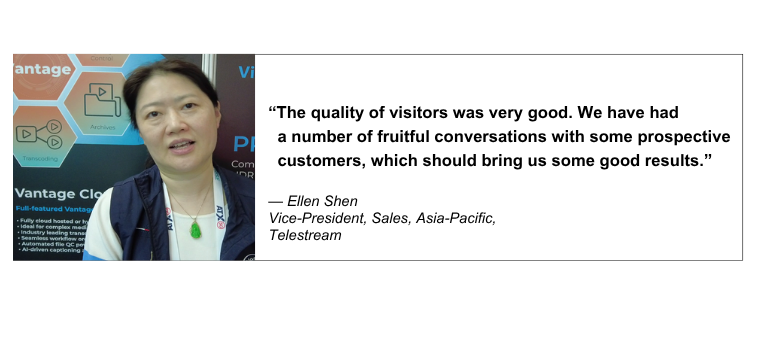
“Having said that, the quality of visitors was very good. We have had a number of fruitful conversations with some prospective customers, which should bring us some good results.”
Nino Pirtovsek, Vice-President, Sales, Uniqcast, said, “Ours is a company that builds turnkey IPTV, over-the-top (OTT) and DVB solutions in a cost-efficient way, delivering a unique TV experience to viewers.
“We were quite excited to meet existing clients as well as potential clients. We had a number of pre-scheduled meetings, which were very productive, so we are happy to have been back here for BroadcastAsia this year.”
Suresh Varghese, Head of Sales for Asia-Pacific, Middle East and SAARC, Planetcast, which provides innovative broadcasting and media solutions in the fields of cloud playout, OTT, media asset management (MAM), and more, said, “There are a lot of players from this part of the world, who have been with our company for the past six to seven years, and who came by to inspect our latest wares.
“When you have worked with big broadcasters, you always collect material that provides ammunition to talk to people about the various things that we have done. We had visitors who were talking about content and graphic management, live insert and switching management; others were talking about content delivery.
“Interestingly, there were a lot of people who were talking about scheduling software. All of which is exactly what Planetcast does, with its NEXC unified platform providing end-to-end solutions.”
Chong Kok Leong, Regional Sales Director, Asia Pacific, Net Insight, added, “The biggest live events have been delivered to audiences worldwide with our solutions for over 25 years.
“At this year’s show, we had very good quality meetings with all our global partners and key customers, of which we have more than 500.
“Our solutions are deployed by customers in over 85 countries to keep their mission-critical media networks running smoothly. We took the opportunity to show them some of our new innovations for media delivery of live content from anywhere to everywhere!”
As BroadcastAsia 2025 drew to a close, key stakeholders are already looking forward to next year’s show at Singapore Expo, but there is a growing concern over the scheduling of BroadcastAsia 2026, which is set to take place from May 20 to 22, clashing directly with CABSAT 2026, scheduled to be held on the same dates at the Dubai World Trade Centre.
Given the prominence of both events as leading B2B platforms for broadcast technology and media entertainment in the Asia-Pacific and MENA regions respectively, it is hoped that the organisers will engage in early dialogue to find a workable solution and avoid a clash that could adversely affect each other’s footfalls.