


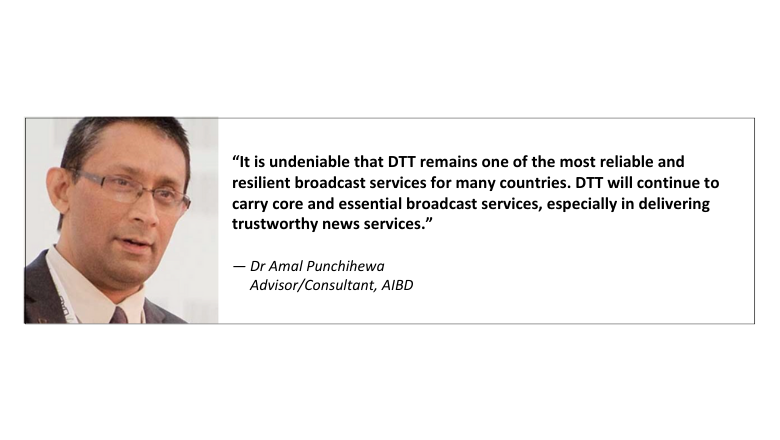
By Dr Amal Punchihewa
There have been many studies and research conducted into how audiences consume media content across various platforms using a wide range of devices. When discussing current and future trends and scenarios, the terms digital terrestrial television (DTT) and streaming come to mind.
DTT has its unique definition, which is a digital and terrestrial (ground-based) TV broadcasting service. Streaming media, especially in the context of this article, are television services that are served generally via the Internet (public internet) as linear or on-demand.
Food distribution is a useful analogy when discussing the consumption of content and when proposing possible approaches to serving audiences in different countries. This is particularly true in the Asia-Pacific region, where there is a higher degree of diversity in multiple facets of life. Hence, the approach needs to be tailor-made to suit each different country.
The next step is then to find appropriate levels of service for audiences who are still not embracing personal-casting. Personal-casting, or personalised digital television (PDTV), is not a new concept and could be an application that uses news-on-demand algorithms to deliver tailored broadcast news (from radio or television) leveraging a wide range of computing platforms including mobile phones and PDAs.
As previously highlighted, online consumption has been increasing in the last few years. In 2023, 17% of households in the UK relied on DTT while approximately 18% used the Internet exclusively as their TV access mechanism on their primary television set. This implies that an almost similar number of households watched TV exclusively on DTT and online. This means 35% of households in the UK depend only on one form of distribution, namely, either DTT or the streaming service.
DTT dependence can likely be attributed to a lack of broadband access and connectivity.
In many countries, the same content is distributed via multiple platforms, including analogue TV (ATV), DTT, satellite direct-to-home (DTH), and linear streaming. If the same service is carried on multiple platforms, it is called simulcast and service providers have to incur cumulative cost for each service distribution platform.
When countries made the transition from ATV to DTT, they simulcast for a short time. The time may vary from three to five years or beyond depending on the take up of DTT, receiver availability and affordability, as well as consumer awareness.
As DTH provides 100% geographical coverage, some countries use DTH as a means of attempting to reach every household. As DTH reception requires some additional investment in addition to the television receiver, as well as higher electricity consumption, DTH does not, in practice, provide 100% population (household) reception.
With easy-to-install digital reception, DTT is more affordable and compact, hence more popular. This is especially true for individual dwelling setups, where most houses installed rooftop antennas.
Some countries have already commenced linear streaming services of their main channels. In New Zealand, public service broadcaster TVNZ is offering three linear streaming services, while concurrently simulcasting their DTT programmes.
New Zealand, alongside countries such as the UK, Australia and Singapore, have also deployed integrated broadcast-broadband (IBB) systems through hybrid broadcast broadband TV (HbbTV), to offer catch-up and on-demand content, recommendations, alerts, and reminders.
Australia, New Zealand and the UK also provide free-to-access services on multiple platforms under Freeview. In New Zealand however, DTH and DTT offer differing quality. DTT services in the country started as a mixed service and today, all three TVNZ DTT channels are fully high definition (HD) while DTH is offered in standard definition (SD).
In all three countries, DTH Freeview will operate in the foreseeable future as per current commitments, although this is constantly under review.
A wide range of research has shown that too many content choices represent a waste of time. There has been plenty of discussion around binge-watching, and providing consumers with an almost endless amount of content to choose from. However, a reasonable amount of choice is arguably more manageable, and offers more efficiency and effectiveness. Audiences also enjoy localised content and broadcasters are responding to short-form content demand by serving news bites that can be expanded during news bulletins at a later time.
Realistically, it is not possible to serve the needs of all individuals. Broadcasters have been serving some elements of personalcasting using technologies such as IBB and other service discovery applications such as DVB-I. As the broadcast industry makes use of the Internet to enhance the broadcast and media experience, technologies have emerged and are being deployed.
In 2022, the BBC announced plans to cut both BBC Four and CBBC from traditional linear TV platforms by 2025. This has apparently been put on hold and both channels are likely to stay on-air, at least for now.
Both BBC Four and CBBC still attract viewers, although not to the large extent enjoyed in years past. For one thing, BBC Four’s budget has been cut steadily over the years, meaning dramas that once brought higher ratings are no longer aired on the channel. It is now largely reliant on repeats, an occurrence that is being seen in many APAC countries.
The BBC now faces a similar dilemma. Poorer households and homes in areas where internet infrastructure is lacking would lose access to CBBC programmes if the channel was removed from traditional broadcast platforms.
The Q2 2024 TiVo Video Trends Report United Kingdom reveals current video trends and highlights how the industry is utilising the latest video technologies to adapt to changing times.
Some key findings:
I. UK viewers use an average of 6.5 video services, with an average monthly spending of nearly £75.
II. 61% of consumers use more than one app in a typical viewing session.
III. Over 50% of respondents consider it a significant pain point to browse multiple apps to find something to watch.
IV. 28% of current pay-TV subscribers once cut the cord but later chose to re-subscribe.
V. 56% of UK consumers have a pay-TV subscription and 43% use advertising-based video-on-demand (AVoD)/free advertising supported television (FAST) services.
In summary, the future of TV broadcasting will be a mixture of multiple distribution platforms.
However, these platforms may not operate in the future as they do today. Depending on the availability and affordability of the Internet, linear streaming services can be expanded while some DTT services will be scaled down.
However, it is undeniable that DTT remains one of the most reliable and resilient broadcast services for many countries. DTT will continue to carry core and essential broadcast services, especially in delivering trustworthy news services.