


By Shaun Lim
As the world grows increasingly connected, the Asia-Pacific region (APAC) stands at a pivotal moment in its digital journey. GSMA, a non-profit organisation that represents the interests of mobile network operators worldwide, estimates that mobile connectivity already underpins more than 6% of APAC’s GDP in 2024, to the tune of US$950 million.
Propelled by increased productivity driven by 5G, the Internet of Things (IoT) and artificial intelligence (AI), this exponential growth is expected to reach $1.4 trillion, or 6.6% of GDP, by 2030.
Mobile connectivity continues to be a critical driver of economic growth and social progress across APAC, as countries in the region continue to make significant steps in closing the digital gap, said Julian Gorman, Head of Asia Pacific, GSMA.
Speaking to APB+, he said, “Mobile internet adoption now reaches 1.5 billion people – about 52% of the region and is forecast to grow to 1.8 billion (roughly 60%) by 2030. Coverage is equally strong, with more than 96% of Asia Pacific’s population served by mobile broadband networks.
“This near-universal reach underpins not only digital services and economic inclusion but also critical public safety systems such as cell broadcast, which deliver emergency alerts instantly and reliably.”
Beneath these strong headline figures, however, lies a more uneven reality. While advanced markets such as Singapore, South Korea, and Japan push towards mass-market 5G and IP-based services, many communities across Southeast Asia and the Pacific continue to face barriers of affordability, infrastructure, skills and policy alignment.
5G deployment, while quickly gaining momentum, remains uneven. As of mid-2025, APAC has 39 commercial 5G networks across 11 markets, including 17 5G standalone networks. These are dominated by advanced markets such as Australia, Japan, Singapore, and South Korea, which are approaching mass-market adoption, with 5G expected to represent more than half of connections by the end of 2025.
In comparison, 5G accounted for only 18% of connections across APAC in 2024, although this is expected to rise to 50% by 2030.
According to the GSMA Digital Nations Index, Singapore, Malaysia, Thailand, and the Philippines are all leading nations when it comes to digital readiness, although this is offset by several lower-income Southeast Asian and Pacific Island nations that lag significantly behind, said Gorman.
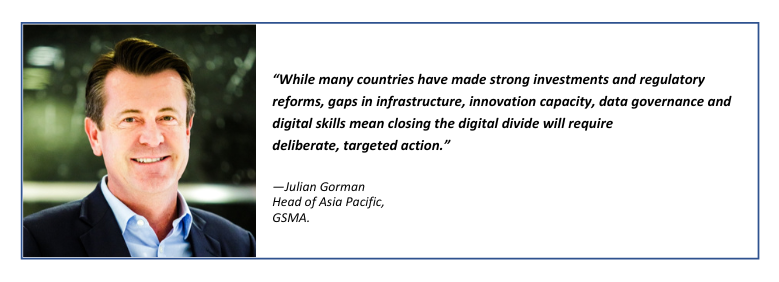
He added, “While many countries have made strong investments and regulatory reforms, gaps in infrastructure, innovation capacity, data governance and digital skills mean closing the digital divide will require deliberate, targeted action.”
This begins by identifying the most persistent barriers preventing digital inclusion in the region, or as Gorman postulated, the four interconnected barriers that shape digital exclusion in APAC.
- Infrastructure gaps: Despite strong regional coverage, more than 100 million people in APAC remain outside mobile broadband coverage, mainly in remote and sparsely populated areas where deployment is commercially challenging without public-private partnerships.
- Affordability constraints: For many households, the cost of devices and data remains prohibitive, especially in rural areas and lower-income markets. Fiscal policies such as import duties or sector-specific taxes often worsen affordability, highlighting the need for smarter tax policies and targeted subsidies.
- Digital literacy and skills: Skills are essential to meaningful use. Although the region scores relatively well on the “people” component of the Digital Nations Index, large gaps remain among older users, women, and rural communities, limiting uptake even where coverage and affordability improve.
- Fragmented policy and regulation: Divergent approaches to data governance, spectrum allocation and digital market rules increase compliance costs and discourage cross-border services and investment.
Gorman highlighted, “Because these barriers reinforce each other, sustainable digital inclusion requires coordinated action — combining targeted infrastructure investment, device affordability programmes, nationwide digital skills efforts, and more harmonised regulatory frameworks aligned to clear national digital ambitions.”
The real challenge, however, is arguably not technological but institutional: aligning stakeholders with divergent priorities and interests to accelerate digital inclusion. To reach rural and underserved communities where market forces alone cannot deliver universal connectivity, collaboration between mobile operators and governments is essential to close the digital gap, said Gorman.
He encouraged governments to unlock investment by providing targeted funding, leveraging universal service mechanisms effectively, and adopting policies that lower deployment costs, such as infrastructure sharing, streamlined permitting, and clear long-term spectrum roadmaps.
Mobile operators can then play the central role in extending coverage and affordability through initiatives such as partnerships with satellite providers, which can complement terrestrial networks to reach remote areas quickly and cost-effectively.
Broadcasters, while not responsible for broadband connectivity, can also play a key role in two important areas.
Gorman explained, “Integrating cell broadcast with mobile networks and traditional broadcast channels ensures timely early-warning alerts and strengthens disaster response, thus elevating public safety.
“Broadcasters can also build trust and awareness by running public information campaigns in local languages to provide digital literacy, online safety, and fraud prevention – helping communities adopt digital services confidently.”
Looking ahead, he stressed that collaboration alone is not enough. As APAC accelerates its transition to 5G and IP-based media delivery, governments and industry players must align around a clear set of strategic priorities to ensure advanced connectivity does not deepen existing divides.
These strategic priorities include making spectrum that enables investment available. “Clear, predictable roadmaps for low-, mid-, and high-band spectrum, combined with fair pricing, are essential to support rural coverage and high-performance networks,” said Gorman.
To close the infrastructure gap, targeted funding for underserved areas, infrastructure-sharing frameworks, and streamlined permits reduce deployment costs and accelerate rollout.
As AI and IP-based services grow, scaling cloud and data infrastructure becomes inevitable, with investment in data centres and edge computing becoming critical to ensure low latency, resilience, and local innovation.
Innovation must also be enabled through proportionate regulation, as Gorman explained, “Approaches such as regulatory sandboxes and interoperable AI frameworks can encourage experimentation while safeguarding users and promoting trust.
“Addressing online fraud and scams through industry-led APIs, cross-sector collaboration, and public-awareness campaigns, will also build digital trust and strengthen confidence in digital services.”
For emerging technologies such as 5G, continued education in the form of skills programmes, combined with viable use cases, will go a long way in helping communities understand the tangible benefits of advanced connectivity.
Communicating these benefits clearly and credibly is therefore just as important as deploying the technology itself. This is then a role where broadcasters remain highly relevant, even as they transition to IP-based delivery.
Unlike mobile operators, broadcasters shifting to IP-based delivery do not play a direct role in closing connectivity gaps. Their contribution lies in content distribution and public communication, including delivering trusted information and educational campaigns to build digital literacy and confidence. Broadcasters can also support emergency communication systems through integrated alerting (for example, cell broadcast plus traditional broadcast channels) for disaster resilience.
“If these priorities are pursued in an integrated manner and progress is tracked against clear national targets, APAC can ensure the transition to 5G and IP-based services delivers benefits to every community — not just the most connected ones,” concluded Gorman.