


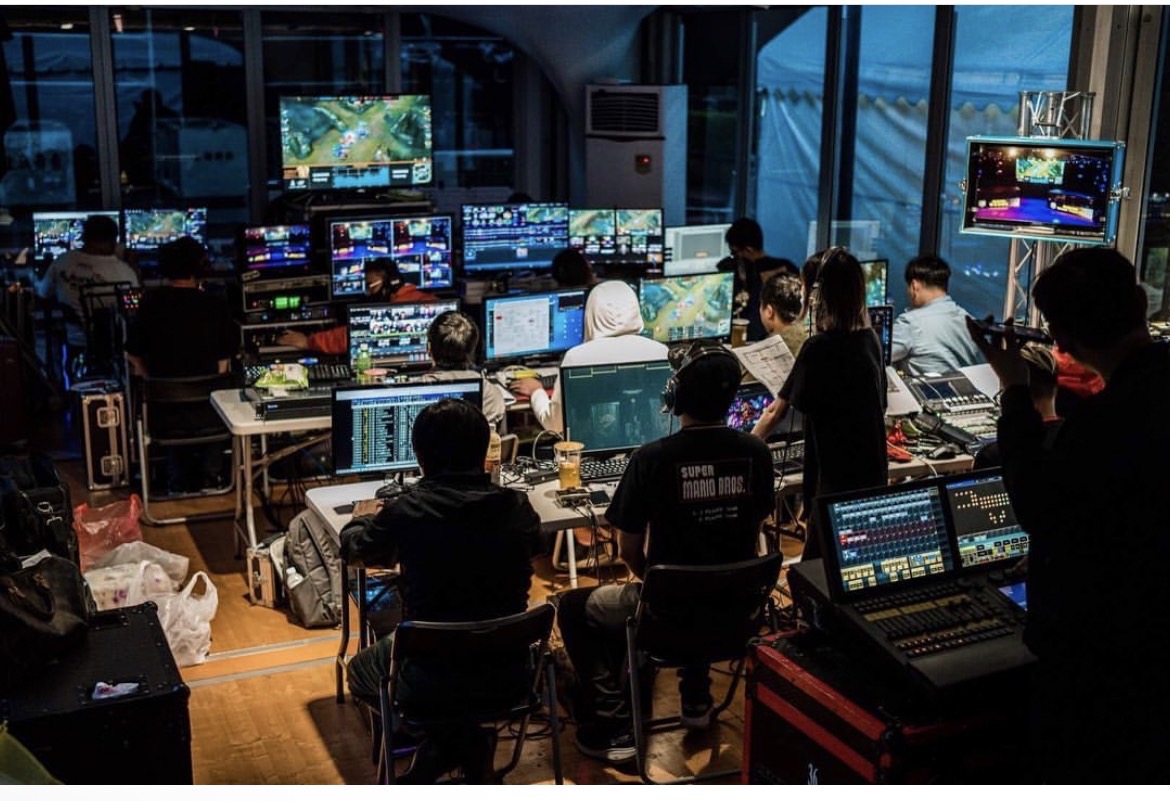
Carry Live, a Taipei-based planner and producer of eSports tournaments and content, has deployed the AJA BRIDGE NDI 3G to enhance its eSports production workflow.
Using the high-density gateway device for 3G-SDI/NDI conversion, the Carry Live team can now deliver more SDI and NDI sources for tournaments and games, and also to capture the strategy, reactions, and personalities of the players competing.
Across productions, Carry Live uses a NewTek TriCaster (TC1) as its primary video switcher but it quickly found it had extended its four physical SDI inputs with I/O expansion taking it to 16 input sources. Broadcast technology advancements and viewer demand were pushing against that capacity so Carry Live turned to Network Device Interface (NDI), a low-latency, high-performance transport layer designed for real-time applications, to overcome space limitations, extend workflows beyond traditional broadcasting setups, and support remote work.
Tim Liu, Programme Director at Carry Live, shared, “In the past, only one or two machines were needed to cover the battle rooms, but it’s not enough today.
“We may need to capture the reactions of the coaching team during breaks or the individual reactions of each player, which requires an increase in the numbers of cameras and input sources.”
AJA BRIDGE NDI 3G provided the solution to Liu’s challenge, offering high density conversion from 3G-SDI to NDI and NDI to 3G-SDI for both multi-channel HD and 4K/Ultra HD (UHD).
Additionally, with BRIDGE NDI 3G, the team can now separate its computer graphics (CG) processing, previously done on a single machine, onto two machines. It has enabled simultaneous content production and real-time processing. As BRIDGE NDI 3G has a channel specifically for CG with keying and video sources, the Carry Live team can directly output the combined result.
With Carry Live’s setup, two subtitle machines are connected directly to the BRIDGE NDI 3G, going through physical SDI first and then converting to NDI signals before being sent to the switcher. This process enables them to incorporate both the live game and player reactions during playback, just like other live sports events.