


By Shirish Nadkarni
Sports broadcasting in India is not what it used to be. The landscape of sportscasting in one of South Asia’s largest markets has experienced a major transformation in recent years, and its importance has risen exponentially with the advent of technology. Unencumbered access to sports has been permitted, even in the most rural and inaccessible areas of the country.
This was not always the case. In earlier years, sports broadcasting in India was a state monopoly, largely because access to modern transmission technology was still out of reach for much of the population. However, as state influence waned, its control over sports broadcasting eased, creating space for private players to step in and expand access to live sporting events.
Thus, the dilemma of managing commercial interests with the fundamental right to view sporting events of national importance emerged and remains an issue which continues to be debated upon.
Barely two years ago, India’s premier sportscaster, Star Sports, was grappling with significant financial losses. Formed in 1991 as Prime Sports, a joint venture between Star TV and Telecommunications, the Star Sports Network is a group of Indian pay-TV sports channels owned by JioStar, a joint venture formed in 2019 between Viacom18 (the media arm of the Reliance Industries group) and Disney India.
The network held the rights of flagship tournaments like Odisha Pro T20 League, International Cricket Council events, Indian Premier League, English Premier League, ONE Championship, Wimbledon, and Indian Super League, among others.
The financial challenges it faced included significant operating losses. Star India's operating loss from the sports business increased by 50% to US$342 million for the six months ended March 31, 2023, compared to $228 million in the corresponding six months of the previous fiscal year. Annual revenue dropped by 39% to $729 million.
The losses emanated from high-cost sports rights and production, and revenue drops linked to fewer broadcast matches and lower ad impressions. It also faced competition from illegal streaming, distribution issues due to channel segmentation, and viewer dissatisfaction with certain on-air programming choices.
“We had widening operating losses, particularly in periods with major events like the T20 World Cup and IPL, due to high costs for rights and production,” said Sanjog Gupta, who was the CEO of Star Sports from 2020 onwards, and then moved to become the CEO of JioStar Sports in November 2024.
“Revenue dropped due to a reduction in the number of broadcast matches, fewer advertising impressions, and unfavourable foreign exchange rates.”
Increased expenses were driven by the rising costs of rights for major tournaments such as the IPL (Indian Premier League) and ICC (International Cricket Council). Star committed close to $5 billion in sports rights investment in the two years 2022 and 2023 on properties like IPL, ICC and Cricket Australia. However, it lost IPL digital and BCCI media rights to Viacom18, while it sub-licensed the ICC TV rights to Zee Entertainment.
“In addition, we had distribution and viewership challenges, partly due to our policy of channel segmentation,” said Gupta. “We moved major events to specialised channels like Star Sports Select HD – which restricted access, alienating some viewers who may have turned to illegal streams. The strategy of restricting access to certain channels can hinder the ability to attract a wider audience, as some fans may not be able to afford or access the required subscriptions.”
There was also competition from unrestrained piracy. Illegal streaming platforms offered free, easy-to-access content, which posed a significant threat to legitimate broadcasters, especially when there were no definitive laws regarding liability for copyright violations in India.
Even loyal customers of Star Sports complained of programming and content issues. Some viewers found the coverage overly focused on specific players, creating what they perceived as excessive and unnecessary hype around certain individuals. There were complaints about the quality of pre- and post-match shows, with criticism regarding the hosting and a perceived lack of focus on in-depth cricket discussion, as well as bias in commentary.
“Star Sports had made a reputation over the years for bringing in unadulterated, classy sports coverage,” said Gupta. “We conducted surveys to find out why our revenues were dropping; we found that we were guilty of airing too many commercials between the overs of key international cricket matches.”
Star Sports’ key rival, Sony Set Max, drew comparable viewer feedback, with audiences noting that its pre-game programming often prioritised entertainment over in-depth commentary.
The company had tried widening the demographic base by introducing language channels and went on to operate 10 Star-branded sports channels in four Indian languages. These, and the introduction of captive sponsored programmes like the Pro Kabaddi League (PKL), shored up revenues to some extent. But the bleeding persisted.
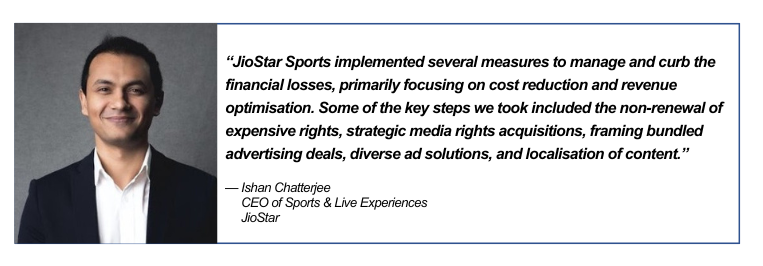
“JioStar Sports implemented several measures to manage and curb the financial losses, primarily focusing on cost reduction and revenue optimisation,” said Ishan Chatterjee, who took over as CEO of Sports and Live Experiences at JioStar, following the appointment of Sanjog Gupta as the CEO of the International Cricket Council (ICC) in July this year.
“Some of the key steps we took included the non-renewal of expensive rights, strategic media rights acquisition, framing bundled advertising deals, diverse ad solutions and localisation of content.”
A major step was the non-renewal of certain Board of Control for Cricket in India (BCCI) media rights, which significantly lowered programming and production costs and helped narrow operating losses in specific quarters.
While the company has invested heavily in properties like the IPL and ICC events, it has been strategic in how it acquires and monetises these rights, such as securing only the linear TV rights for the IPL's latest cycle, even as digital rights went to Viacom18, now part of the same merged entity.
JioStar offers bundled advertising packages that span both television and digital platforms - like Disney+ Hotstar - to maximise revenue potential and reach a broader audience.
It introduced varied advertising opportunities, including "bite-sized" assets and specific packages for regional channels, allowing a wider range of advertisers, including smaller retailers, to participate at different price points. JioStar is continuing to explore innovative advertising solutions, such as addressable ad capabilities on unconnected set-top boxes, to offer sharper, more targeted advertising opportunities on live TV.
“We tried to build a national sports network by localising content, including commentary in regional languages, like the national language Hindi, to deepen audience connection and attract more regional advertisers,” said Chatterjee.
“We invested in new formats and IPs, acquiring a majority stake in Mashal Sports, the company behind the highly successful Pro Kabaddi League (PKL), effectively owning intellectual property that had proven popular and a strong revenue generator, second only to the IPL in some metrics.”
These steps demonstrated a two-pronged approach of controlling the high costs associated with sports broadcasting rights, while simultaneously innovating revenue streams and expanding audience reach.
Also needed were improvements to the equipment and broadcast technology, to enhance both live sports broadcasting and studio production. JioStar’s primary tie-ups were with specialised broadcast technology firms, and not with consumer sports equipment brands like Nike or Adidas.
“We asked RGB Broadcasting to serve as the lead contractor and systems integrator for a major studio integration project, which involved installing advanced technology solutions from production to playout, including an audio-over-IP (AoIP) migration,” said Chatterjee.
“We utilised products from various vendors as part of this large-scale project. We joined hands with Dolby to deliver the Tata IPL in Dolby Atmos sound, providing an immersive audio experience for viewers with compatible systems. This involved configuring 40+ microphones in the stadium.”
Some of the technology products covering areas like graphics, IP audio automation, and post-production systems that have been used in the Star Sports studio integration project have come from big names in broadcast technology like Vizrt, Grass Valley, Imagine, TSL, EVS and Photon Beard.
Star Sports leverages ESPN Cricinfo's extensive statistical database to power real-time statistics and data for its on-demand features available to viewers on their set-top boxes.
The famous Hawk-Eye technology, specifically the "Hawkeye 4K Cam" and 3D cutouts, is used to provide enhanced coverage, detailed analysis and precise replays.
“We employ the ‘Xeebra Quad Replay’ system, allowing operators to capture key moments from multiple angles simultaneously for richer replays and analysis,” Chatterjee added. “We use technologies like the "Holobox", an interactive experience that allows fans and commentators to interact with virtual objects and people, and other augmented reality (AR)-powered solutions for innovative in-studio presentations.”
On the distribution front, Star Sports collaborates with direct-to-home (DTH) providers like Tata Play and Airtel Digital TV to deliver interactive viewing features like dedicated remote buttons for highlights and statistics, and 4K resolution services to consumers' homes. The network also uses artificial intelligence (AI) to power live commentary subtitles and automated robotic cameras in regional studios.
“All these collaborations focus on leveraging cutting-edge broadcast and digital technology to enhance production quality, fan engagement and the overall viewing experience,” Chatterjee concluded, quietly adding, “Our revenue and profit-and-loss figures for the ongoing financial year should reveal just how successful we have been in giving JioStar Sports a complete makeover.”