
Doc’s IN: Is it too late for the broadcast and media sector to act on sustainability? - APB+ News

APB+ News

APB AWARDS - NOMINATE NOW!

[master-leader-web]
[master-leader-mob]

Doc’s IN: Is it too late for the broadcast and media sector to act on sustainability?

Add Your Heading Text Here

By Dr Amal Punchihewa

In November 2022, COP27 (the annual United Nations climate summit) discussed the implementation of climate mitigation, adaptation, and net zero actions. In some countries, all business sectors are now legislated to address sustainability, making this a critical topic for the broadcast and media sector.

Sustainability in broadcast and connected digital media is not an easy concept to explain as it is a complex subject. Simplistically, it considers the life cycle from origin to consumption, from extracting raw materials to designing and manufacturing products and services that have value. It includes using components/products that do not pollute or damage the environment either in use or at end of use, and it considers the energy, materials and water used to make the products, as well as waste management.

In addition, human factors cannot be ignored, such as whether child labour was used in production and whether any landfill waste has contaminated water supplies that may in turn affect humans and our food chain.

I am proud that I could lead some sustainability work in the APAC region with the Asia-Pacific Institute for Broadcasting Development (AIBD) and as a member of the Sustainability Committee of the European Broadcasting Union (EBU) for the last three years, I have had the opportunity to share my experience, and learn about standardisation, measurements and metrics, as well as systems for mitigation and adaptations.

For the rest of this article, I will focus on the importance of what Asia-Pacific’s broadcast and media industry is doing when it comes to sustainability, compared to other regions.

With the environment sitting at the top of everyone’s agenda, the broadcast and media industry has a part to play in protecting it. The industry has looked at sustainable production models and discussed what more can be done to achieve more sustainability. One of the critical issues, I believe, is how organisations really measure sustainability against differing standards. 

The United Nations recently announced that 93% of the top 250 global companies are now reporting on sustainability. The 2020 Consumer Action report said that over 50% of consumers in the UK rated the green credentials of their suppliers as being “really important”.  Hence, sustainability is more than just a kind of social awareness and has a much higher business priority. 

Some organisations set sustainability as a priority and recruit specialised staff for full-time positions to make sure that corporate strategies are driven into production, both from a production operation and editorial perspective. Recently, New Zealand public TV broadcaster TVNZ advertised for the position of Head of Sustainability and many European and American broadcasters and media organisations have been for some time, employing dedicated staff to manage their sustainability strategies.

The supply chain constitutes a large portion of emissions in the media and entertainment (M&E) industry, and there must be a concerted effort to ensure that the supply chain is robust and sustainable. Net zero is now written into legislations of various countries, including the UK, where the Net Zero Strategy: Build Back Greener strategy sets out policies and proposals for decarbonising all sectors (including M&E) of the UK economy to meet their net zero targets by 2050.  

There are reporting requirements that will compel organisations and people to provide evidence for their sustainability claims and to ensure that sustainability is at the core of business continuity planning. With mandatory sustainability reporting in financial statements currently only required for large organisations, smaller entities can make the most of exemptions from carbon reporting at present. However, they should be mindful that they are not sheltered from the changes in stakeholder choice and the questions which may be asked by those with whom they wish to work. The training is becoming mandatory for many broadcasters, at least in the UK, for sustainable production and a legislative environment around sustainability.

UK public broadcaster BBC researched and developed a measurement scheme and metrics to keep track of the impact and mitigations of broadcast and media. Known as “Albert,” the project’s sustainability activities are now carried out by the British Academy of Film and Television Arts (BAFTA). 

Albert started life within the BBC as a tool to calculate a media programme’s carbon footprint, which BAFTA then adopted in 2011. This is widely used in the UK and many other countries. The understanding of carbon footprint is a good first step and Albert can work with productions to do that. The next step is to qualify for the certification scheme, where organisations get the Albert footprint logo to use on their banners. This highlights that the organisation has done what it can to reduce its carbon footprint and is offsetting any remaining emissions so that productions are carbon neutral.

Albert’s most significant development, however, is a certification system introduced in 2012. Productions can tout their sustainability credentials with an end board logo and a one-to-three-star rating. This depends on the percentage of sustainable actions taken, which Albert checks by requesting evidence for a random set of those actions. Every single media programme made in the UK by the BBC, ITV, Netflix, and Sky now goes through Albert’s certification process.

In Singapore, public broadcaster Mediacorp designed and commissioned its studio and main office complex in December 2015 around green environmental principles, which has since improved energy efficiency. One of the main areas that impacts carbon footprint is energy usage. While the broadcast and media industry is trying to use green or renewable energy for production and distribution, it is important to minimise the usage by smart design of buildings and infrastructures. 

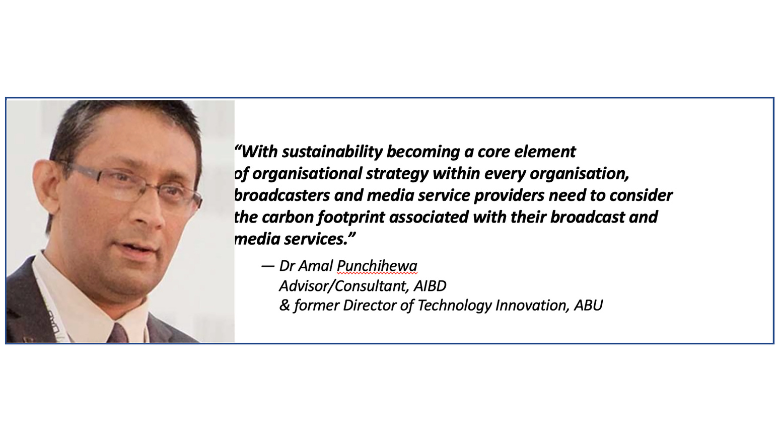
With sustainability becoming a core element of organisational strategy within every organisation, broadcasters and media service providers need to consider the carbon footprint associated with their broadcast and media services. They must also optimise processes to reduce the carbon footprint and impact on the environment by implementing best practices.

In ending this column, I urge all broadcast and media players, as well as consumers, to play their roles in achieving sustainability goals.

Dr Amal Punchihewa is an ITU expert and advisor/consultant to the Asia-Pacific Institute for Broadcasting Development (AIBD), and was formerly Director of Technology and Innovation at the Asia-Pacific Broadcasting Union (ABU). In a new monthly column for APB+, Dr Amal will discuss the latest trends and developments that are impacting the broadcast and media industry.

Join The Community

Join The Community

Doc’s IN: Is it too late for the broadcast and media sector to act on sustainability?

Add Your Heading Text Here

By Dr Amal Punchihewa

In November 2022, COP27 (the annual United Nations climate summit) discussed the implementation of climate mitigation, adaptation, and net zero actions. In some countries, all business sectors are now legislated to address sustainability, making this a critical topic for the broadcast and media sector.

Sustainability in broadcast and connected digital media is not an easy concept to explain as it is a complex subject. Simplistically, it considers the life cycle from origin to consumption, from extracting raw materials to designing and manufacturing products and services that have value. It includes using components/products that do not pollute or damage the environment either in use or at end of use, and it considers the energy, materials and water used to make the products, as well as waste management.

In addition, human factors cannot be ignored, such as whether child labour was used in production and whether any landfill waste has contaminated water supplies that may in turn affect humans and our food chain.

I am proud that I could lead some sustainability work in the APAC region with the Asia-Pacific Institute for Broadcasting Development (AIBD) and as a member of the Sustainability Committee of the European Broadcasting Union (EBU) for the last three years, I have had the opportunity to share my experience, and learn about standardisation, measurements and metrics, as well as systems for mitigation and adaptations.

For the rest of this article, I will focus on the importance of what Asia-Pacific’s broadcast and media industry is doing when it comes to sustainability, compared to other regions.

With the environment sitting at the top of everyone’s agenda, the broadcast and media industry has a part to play in protecting it. The industry has looked at sustainable production models and discussed what more can be done to achieve more sustainability. One of the critical issues, I believe, is how organisations really measure sustainability against differing standards. 

The United Nations recently announced that 93% of the top 250 global companies are now reporting on sustainability. The 2020 Consumer Action report said that over 50% of consumers in the UK rated the green credentials of their suppliers as being “really important”.  Hence, sustainability is more than just a kind of social awareness and has a much higher business priority. 

Some organisations set sustainability as a priority and recruit specialised staff for full-time positions to make sure that corporate strategies are driven into production, both from a production operation and editorial perspective. Recently, New Zealand public TV broadcaster TVNZ advertised for the position of Head of Sustainability and many European and American broadcasters and media organisations have been for some time, employing dedicated staff to manage their sustainability strategies.

The supply chain constitutes a large portion of emissions in the media and entertainment (M&E) industry, and there must be a concerted effort to ensure that the supply chain is robust and sustainable. Net zero is now written into legislations of various countries, including the UK, where the Net Zero Strategy: Build Back Greener strategy sets out policies and proposals for decarbonising all sectors (including M&E) of the UK economy to meet their net zero targets by 2050.  

There are reporting requirements that will compel organisations and people to provide evidence for their sustainability claims and to ensure that sustainability is at the core of business continuity planning. With mandatory sustainability reporting in financial statements currently only required for large organisations, smaller entities can make the most of exemptions from carbon reporting at present. However, they should be mindful that they are not sheltered from the changes in stakeholder choice and the questions which may be asked by those with whom they wish to work. The training is becoming mandatory for many broadcasters, at least in the UK, for sustainable production and a legislative environment around sustainability.

UK public broadcaster BBC researched and developed a measurement scheme and metrics to keep track of the impact and mitigations of broadcast and media. Known as “Albert,” the project’s sustainability activities are now carried out by the British Academy of Film and Television Arts (BAFTA). 

Albert started life within the BBC as a tool to calculate a media programme’s carbon footprint, which BAFTA then adopted in 2011. This is widely used in the UK and many other countries. The understanding of carbon footprint is a good first step and Albert can work with productions to do that. The next step is to qualify for the certification scheme, where organisations get the Albert footprint logo to use on their banners. This highlights that the organisation has done what it can to reduce its carbon footprint and is offsetting any remaining emissions so that productions are carbon neutral.

Albert’s most significant development, however, is a certification system introduced in 2012. Productions can tout their sustainability credentials with an end board logo and a one-to-three-star rating. This depends on the percentage of sustainable actions taken, which Albert checks by requesting evidence for a random set of those actions. Every single media programme made in the UK by the BBC, ITV, Netflix, and Sky now goes through Albert’s certification process.

In Singapore, public broadcaster Mediacorp designed and commissioned its studio and main office complex in December 2015 around green environmental principles, which has since improved energy efficiency. One of the main areas that impacts carbon footprint is energy usage. While the broadcast and media industry is trying to use green or renewable energy for production and distribution, it is important to minimise the usage by smart design of buildings and infrastructures. 

With sustainability becoming a core element of organisational strategy within every organisation, broadcasters and media service providers need to consider the carbon footprint associated with their broadcast and media services. They must also optimise processes to reduce the carbon footprint and impact on the environment by implementing best practices.

In ending this column, I urge all broadcast and media players, as well as consumers, to play their roles in achieving sustainability goals.

Dr Amal Punchihewa is an ITU expert and advisor/consultant to the Asia-Pacific Institute for Broadcasting Development (AIBD), and was formerly Director of Technology and Innovation at the Asia-Pacific Broadcasting Union (ABU). In a new monthly column for APB+, Dr Amal will discuss the latest trends and developments that are impacting the broadcast and media industry.

Join The Community

Stay Connected

Facebook

101K

Twitter

3.9K

Instagram

1.7K

LinkedIn

19.9K

YouTube

0.2K

Subscribe to the latest news now!


    Scroll to Top