
Doc’s IN:Why broadcast remains a critical platform for communicating disaster & emergency information - APB+ News

APB+ News

APB AWARDS - NOMINATE NOW!

[master-leader-web]
[master-leader-mob]

Doc’s IN:Why broadcast remains a critical platform for communicating disaster & emergency information

Add Your Heading Text Here

When disaster strikes, our first instinct as humans is to seek accurate and reliable information. We want to know what is happening or about to happen, and understand how we and our loved ones can stay safe. 

The public needs accurate information quickly in every kind of emergency, including natural disasters like tornadoes, hurricanes, tropical storms, floods, snowstorms, earthquakes, and tsunamis, as well as incidences of terrorist violence, mass transportation accidents, and industrial and/or technological catastrophes. All these situations call for informing people as quickly and comprehensively as possible.

We celebrated this year’s World Engineering Day for Sustainable Development, which is held on March 4 every year since 2019 — and the theme for 2023 is "Engineering Innovation for a More Resilient World". 

This is a very timely theme as we have been experiencing many disasters globally, including floods in New Zealand. We talk about the early warnings, the resilience of people and new innovative  approaches in the recovery process that can minimise risk. Never before has our resilience — globally, nationally and individually — been more important. Hence, the 2023 theme ‘Engineering Innovation for a More Resilient World’ is most appropriate and timely.

Both infrastructure and people need to have resilience. When the floods washed off fibre, flooded sub-stations that disconnected power to the cellular phone network in that particular area, the only reliable communication was through broadcasting, especially radio. People can use battery-operated radios or vehicle radios to get information in isolated areas. Broadcasting networks are inherently designed with redundancy; power backups such as batteries and generators providing more resilience and extremely high availability.

Robustness and resilience come at some expense, but the likelihood and cost impacts of unexpected events are frequently underestimated. It often takes a crisis to highlight how vulnerable individual distribution systems are. 

Hence, this is another reminder after COVID-19 of the value of traditional media, especially radio. TV broadcasting can further inform with more impactful visualisation of the anticipated disruptions from raging disasters. 

When it comes to climate change adaptation, early warning systems are relatively affordable as well as an effective way of protecting people and assets. With modern science, sustained systematic observing networks, and daily international exchange of quality data, people could have access to high-quality early warning products, including the translation of forecast into impact by making use of the advances in ICT (Information & Communication Technologies). Even though early warning systems can save lives, sometimes vulnerable communities have no way of knowing that hazardous weather or other disasters are on their way. 

According to the World Meteorological Organisation (WMO), countries with limited early warning coverage have disaster mortality eight times higher than countries with high coverage. Even though this trend is expected to continue, half of the countries in the world do not have early warning systems in place, and even fewer have regulatory frameworks to link early warnings to emergency plans.

Coverage is worst for developing countries on the front lines of climate change, namely the world’s Least Developed Countries (LDCs) and Small Island Developing States (SIDS).

The International Telecommunication Union (ITU) recognises the vital role of TV broadcasting in disseminating life-saving information during crises. Having access to free-to-air (FTA) TV through wide coverage and reaching over 1.72 billion households worldwide make TV broadcasting an especially reliable and trusted source of information in an emergency. FTA TV plays an important role in conveying emergency alerts; they can communicate critical facts like the nature and location of a hazard, as well as shelter and safety advice. TV also offers informative visual communications, from maps that give viewers context to on-scene videos that reinforce safety messages to be taken.

It is important to understand why terrestrial TV broadcasting is crucial in times of disaster. The ITU Radiocommunication Sector (ITU-R) recently updated a key report, Broadcasting for Public Warning, Disaster Mitigation & Relief (BT.2299), that highlights the resilience of TV distribution networks, which are less susceptible than other communication systems to failure at a single distribution point, especially as they are comprised of high-power terrestrial TV broadcasting transmitters that covers large geographical areas. To ensure no one is left behind, emergency broadcasts must be accessible to persons with disabilities and special needs.

ITU also recognises broadcast radio as a reliable medium for disaster updates. Indeed, ITU plays an important role in using ICTs for disaster risk reduction and management, through the design of national emergency telecommunication plans, the setting up of early warning and monitoring systems and the provision of emergency telecommunications equipment when disasters strike.

The United Nations (UN) recently announced an Early Warning target … and the plan is to address key gaps in understanding disaster risk, monitoring and forecasting, rapid communication, and preparedness and response. 

As the UN Office for Disaster Risk Reduction (UNDRR) reported, less than half of the LDCs and only one-third of SIDS have a multi-hazard early warning system. As a UN Early Warning System initiative, COP27 (27th annual UN meeting on climate held in November 2022) committed US$3.1 billion to achieve early warning systems for all (EWS4all) by 2027.

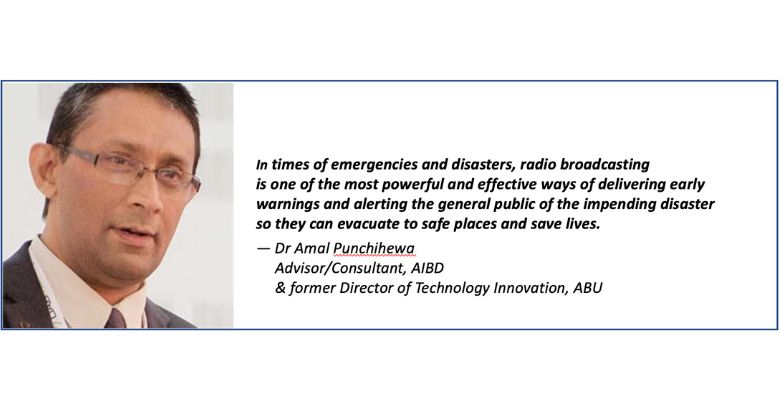
First invented in 1895, the radio is one of the first forms of mass communication that continues to play an important role in today’s increasingly digital society. In times of emergency and disasters, radio broadcasting is one of the most powerful and effective ways of delivering early warnings and alerting the general public by broadcasting before the disaster occurs so people can evacuate to safe places and save their lives. The broadcast infrastructure for radio is highly robust and usually remains operational even when other communications technologies fail. 

Radio is the mass media that reaches the widest audience in the world and is also recognised as a powerful communication tool and a low-cost medium. Radio is suited to reach remote communities and vulnerable people — the illiterate, the disabled, women, youth, and the poor, while offering a platform to intervene in the public debate, irrespective of people’s educational levels.

In the initial hours in the aftermath of a disaster, people want to be informed so that they can understand what is happening and assess how they, their families and friends can receive support.

The Australian Bushfire standard advice is that in an emergency, people should make sure they have got a transistor (pocket) radio with fresh batteries because the Australian Broadcasting Corporation, the Australian national broadcaster, also has an emergency broadcasting role. Throughout the bushfires, they will broadcast information regularly about where the bushfires are, and where the affected areas are or are going to be. They have been passing on information from the state’s fire agencies, advising people as to when they should leave or whether it is too late to leave and what precaution to take.

As soon as broadcasting became available as a mature technology, radio became part of governmental emergency plans more than a century ago. Since then, radio has proven agile and effective to spread information widely in critical situations. Radio broadcasting operates effectively even when other infrastructures are destroyed.

When emergencies occur, people expect and are prepared to receive broadcasts through small battery-powered radio receivers. Radio receivers are inexpensive and require no access fees. In many countries including New Zealand, radio is an essential part of the disaster management kit.

Hopefully, this article is providing some food for thought when formulating policies to secure  the future of broadcasting, the role broadcasting can play and the preparation required to minimise the damage caused by the impending  disasters. Next month, we will address the future of TV and other media can play as research and discussions coalesce around this topic.

Dr Amal Punchihewa is an ITU expert and advisor/consultant to the Asia-Pacific Institute for Broadcasting Development (AIBD), and was formerly Director of Technology and Innovation at the Asia-Pacific Broadcasting Union (ABU).

Join The Community

Join The Community

Doc’s IN:Why broadcast remains a critical platform for communicating disaster & emergency information

Add Your Heading Text Here

When disaster strikes, our first instinct as humans is to seek accurate and reliable information. We want to know what is happening or about to happen, and understand how we and our loved ones can stay safe. 

The public needs accurate information quickly in every kind of emergency, including natural disasters like tornadoes, hurricanes, tropical storms, floods, snowstorms, earthquakes, and tsunamis, as well as incidences of terrorist violence, mass transportation accidents, and industrial and/or technological catastrophes. All these situations call for informing people as quickly and comprehensively as possible.

We celebrated this year’s World Engineering Day for Sustainable Development, which is held on March 4 every year since 2019 — and the theme for 2023 is "Engineering Innovation for a More Resilient World". 

This is a very timely theme as we have been experiencing many disasters globally, including floods in New Zealand. We talk about the early warnings, the resilience of people and new innovative  approaches in the recovery process that can minimise risk. Never before has our resilience — globally, nationally and individually — been more important. Hence, the 2023 theme ‘Engineering Innovation for a More Resilient World’ is most appropriate and timely.

Both infrastructure and people need to have resilience. When the floods washed off fibre, flooded sub-stations that disconnected power to the cellular phone network in that particular area, the only reliable communication was through broadcasting, especially radio. People can use battery-operated radios or vehicle radios to get information in isolated areas. Broadcasting networks are inherently designed with redundancy; power backups such as batteries and generators providing more resilience and extremely high availability.

Robustness and resilience come at some expense, but the likelihood and cost impacts of unexpected events are frequently underestimated. It often takes a crisis to highlight how vulnerable individual distribution systems are. 

Hence, this is another reminder after COVID-19 of the value of traditional media, especially radio. TV broadcasting can further inform with more impactful visualisation of the anticipated disruptions from raging disasters. 

When it comes to climate change adaptation, early warning systems are relatively affordable as well as an effective way of protecting people and assets. With modern science, sustained systematic observing networks, and daily international exchange of quality data, people could have access to high-quality early warning products, including the translation of forecast into impact by making use of the advances in ICT (Information & Communication Technologies). Even though early warning systems can save lives, sometimes vulnerable communities have no way of knowing that hazardous weather or other disasters are on their way. 

According to the World Meteorological Organisation (WMO), countries with limited early warning coverage have disaster mortality eight times higher than countries with high coverage. Even though this trend is expected to continue, half of the countries in the world do not have early warning systems in place, and even fewer have regulatory frameworks to link early warnings to emergency plans.

Coverage is worst for developing countries on the front lines of climate change, namely the world’s Least Developed Countries (LDCs) and Small Island Developing States (SIDS).

The International Telecommunication Union (ITU) recognises the vital role of TV broadcasting in disseminating life-saving information during crises. Having access to free-to-air (FTA) TV through wide coverage and reaching over 1.72 billion households worldwide make TV broadcasting an especially reliable and trusted source of information in an emergency. FTA TV plays an important role in conveying emergency alerts; they can communicate critical facts like the nature and location of a hazard, as well as shelter and safety advice. TV also offers informative visual communications, from maps that give viewers context to on-scene videos that reinforce safety messages to be taken.

It is important to understand why terrestrial TV broadcasting is crucial in times of disaster. The ITU Radiocommunication Sector (ITU-R) recently updated a key report, Broadcasting for Public Warning, Disaster Mitigation & Relief (BT.2299), that highlights the resilience of TV distribution networks, which are less susceptible than other communication systems to failure at a single distribution point, especially as they are comprised of high-power terrestrial TV broadcasting transmitters that covers large geographical areas. To ensure no one is left behind, emergency broadcasts must be accessible to persons with disabilities and special needs.

ITU also recognises broadcast radio as a reliable medium for disaster updates. Indeed, ITU plays an important role in using ICTs for disaster risk reduction and management, through the design of national emergency telecommunication plans, the setting up of early warning and monitoring systems and the provision of emergency telecommunications equipment when disasters strike.

The United Nations (UN) recently announced an Early Warning target … and the plan is to address key gaps in understanding disaster risk, monitoring and forecasting, rapid communication, and preparedness and response. 

As the UN Office for Disaster Risk Reduction (UNDRR) reported, less than half of the LDCs and only one-third of SIDS have a multi-hazard early warning system. As a UN Early Warning System initiative, COP27 (27th annual UN meeting on climate held in November 2022) committed US$3.1 billion to achieve early warning systems for all (EWS4all) by 2027.

First invented in 1895, the radio is one of the first forms of mass communication that continues to play an important role in today’s increasingly digital society. In times of emergency and disasters, radio broadcasting is one of the most powerful and effective ways of delivering early warnings and alerting the general public by broadcasting before the disaster occurs so people can evacuate to safe places and save their lives. The broadcast infrastructure for radio is highly robust and usually remains operational even when other communications technologies fail. 

Radio is the mass media that reaches the widest audience in the world and is also recognised as a powerful communication tool and a low-cost medium. Radio is suited to reach remote communities and vulnerable people — the illiterate, the disabled, women, youth, and the poor, while offering a platform to intervene in the public debate, irrespective of people’s educational levels.

In the initial hours in the aftermath of a disaster, people want to be informed so that they can understand what is happening and assess how they, their families and friends can receive support.

The Australian Bushfire standard advice is that in an emergency, people should make sure they have got a transistor (pocket) radio with fresh batteries because the Australian Broadcasting Corporation, the Australian national broadcaster, also has an emergency broadcasting role. Throughout the bushfires, they will broadcast information regularly about where the bushfires are, and where the affected areas are or are going to be. They have been passing on information from the state’s fire agencies, advising people as to when they should leave or whether it is too late to leave and what precaution to take.

As soon as broadcasting became available as a mature technology, radio became part of governmental emergency plans more than a century ago. Since then, radio has proven agile and effective to spread information widely in critical situations. Radio broadcasting operates effectively even when other infrastructures are destroyed.

When emergencies occur, people expect and are prepared to receive broadcasts through small battery-powered radio receivers. Radio receivers are inexpensive and require no access fees. In many countries including New Zealand, radio is an essential part of the disaster management kit.

Hopefully, this article is providing some food for thought when formulating policies to secure  the future of broadcasting, the role broadcasting can play and the preparation required to minimise the damage caused by the impending  disasters. Next month, we will address the future of TV and other media can play as research and discussions coalesce around this topic.

Dr Amal Punchihewa is an ITU expert and advisor/consultant to the Asia-Pacific Institute for Broadcasting Development (AIBD), and was formerly Director of Technology and Innovation at the Asia-Pacific Broadcasting Union (ABU).

Join The Community

Stay Connected

Facebook

101K

Twitter

3.9K

Instagram

1.7K

LinkedIn

19.9K

YouTube

0.2K

Subscribe to the latest news now!


    Scroll to Top