


By Shirish Nadkarni
Software as a Service (SaaS) is simply a software distribution model in which a cloud provider hosts applications and makes them available to end-users over the internet; it’s SaaS applications run in the cloud and users subscribe to these solutions instead of purchasing them — and then access them over the Internet.
Today, more and more media operators are also pushing vendors to provide software-defined solutions on commercial-off-the-shelf (COTS) hardware, ripe for offloading ownership to the cloud. This is in part because the broadcast market size is around $50 billion compared to information technology's (IT) $5 trillion market size.
Traditionally, broadcasters needed complex on-premise servers and other equipment to stream video content to their consumers. Online software, communications tools and payroll processing software are examples of businesses that are shifting to the SaaS model; and, for many commercial applications, including cloud video streaming solutions, SaaS his becoming a popular delivery technique.
SaaS can cut down on equipment purchases
The mechanics and technicalities of media broadcasting are shifting drastically because of cloud and SaaS technologies. You no longer need to purchase all of the equipment for a live event. All you have to do now is place your cameras where you believe viewers would be interested in the area of play.
Without cloud technology, none of this would be possible. Videos take up a lot of storage space and use a lot of bandwidth when being transferred. Stores of video content are often calculated in zettabytes (1 trillion GB). Streaming sites now take a large portion of the internet’s bandwidth.
To stream movies to their audiences in the past, broadcasters needed complex on-premise servers and other gear. This infrastructure was expensive to build, challenging to maintain, and not a core strength for many businesses. As a result, many broadcasters turned to cloud video platforms, which offer simple and scalable video streaming and hosting services.
Conventional wisdom would suggest that larger R&D budgets for IT hardware would drive down costs and drive up innovation. These are all reasons why broadcast manufacturers like Grass Valley are looking at SaaS-based business models.
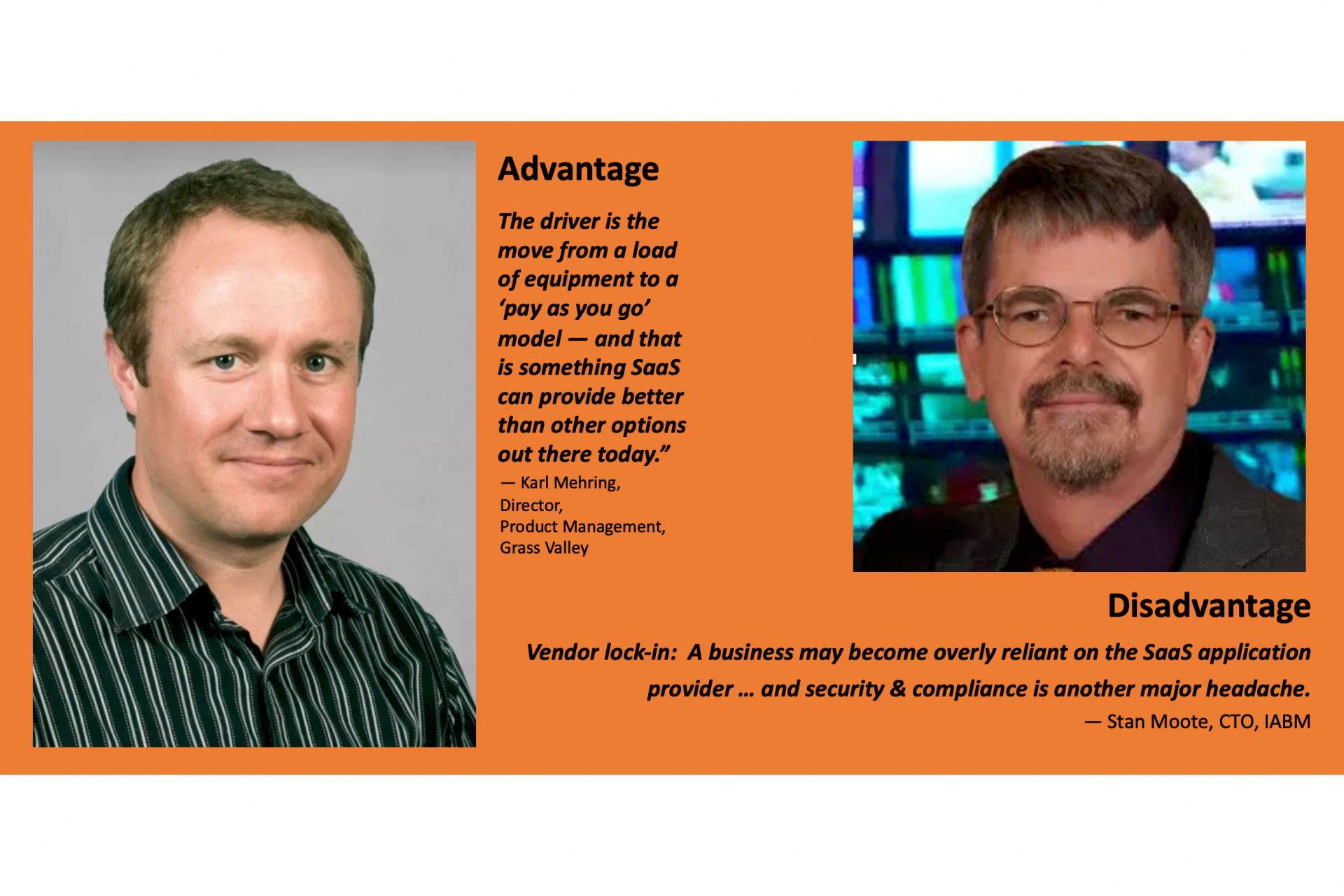
“We’re starting to see broadcasters appreciate the need for buying software in different ways,” says Karl Mehring, Director of Product Management for playout at Grass Valley. “The driver is the move from a load of equipment to a ‘pay as you go’ model — and that is something SaaS can provide better than other options out there today.”
Software that can be accessed through the internet is used for cloud video streaming. Broadcasters may access their information and processes from anywhere they have a computer and a good internet connection since files and data are saved in “the cloud”.
SaaS is more a service than a product
Traditionally, software vendors sold their software to users as a product. However, in the SaaS model they actively provide and maintain the software for their users, via the cloud. They host and maintain the databases and code necessary for the application to run, and they run the application on their servers. Thus, SaaS is more like a service than a product.
Online email providers fit into the SaaS category. Other well-known SaaS companies include Salesforce, Slack, MailChimp, and Dropbox, while some of the most popular SaaS streaming platforms available are Brightcove, Kaltura, IBM Cloud Video, Wowza and Vidyard.
IBM Cloud Video is an IBM-run video streaming platform that specialises in live streaming and video on demand (VOD).
Kaltura is an SaaS video solution developed by an Israeli firm, whose video platform supports both live and on-demand video. Because of its open-source nature, it is recognised for being completely configurable. As a result, it remains an excellent cloud streaming platform for massive institutions with complex broadcasting requirements.
Major advantages of SaaS
The SaaS model has a number of pros and cons, although for modern businesses and users the pros of SaaS often outweigh the cons.
The biggest advantage is access from anywhere, on any device. Typically, users can log into SaaS applications from any device and any location. This offers a great deal of flexibility – businesses can allow employees to operate all over the world, and users can access their files no matter where they are. There is no need for updates or installations. The SaaS provider updates and patches the application on an ongoing basis.
Another huge advantage is scalability. The SaaS provider handles scaling up the application, such as adding more database space or more compute power as usage increases. This results in substantial savings on internal IT costs and overheads.
“When we launched Media Shuttle, our first SaaS solution, more than five years ago, many in the industry weren’t ready for SaaS,” says Jon Finegold, Chief Marketing Officer for the Massachusetts-based Signiant.
“In fact, it was common to hear from top media and entertainment execs that ‘we will never use SaaS. However, by 2018, Media Shuttle had surpassed the 400,000-user mark and became the de facto standard in the industry for sending and sharing large files.”
The flip side of SaaS
On the flip side, however, there were some glaring disadvantages. “Broadcasters can be savvy about understanding the magnitude of the file size when it comes to transporting it, but there needs to be an understanding of the costs of putting it in storage and getting it back out,” says Stan Moote, CTO for the International Association of Broadcast Manufacturers (IABM).
“This is why statistics showed that 40% of companies that went into the cloud came back out.”
Among the disadvantages was the need for stronger access control. The increased accessibility of SaaS applications also meant that verifying user identity and controlling access levels became very important.
With SaaS, organisational assets are no longer kept within an internal network, separate from the outside world. Instead, user access is based on user identity: if someone has the right login credentials, they are granted access. Strong identity verification thus becomes crucial.
One consideration for broadcasters and production houses that are utilising SaaS along with the cloud for storage is that data is not entirely on-premise. This is a legitimate concern, given how Sony, HBO and others in the media and entertainment world have had content stolen or leaked.
However, security is something all industries should think about regardless of whether SaaS is part of daily operations.
Another disadvantage is vendor lock-in … a business may become overly reliant on the SaaS application provider. Security and compliance is another major headache: With SaaS applications, the responsibility for protecting the organisation’s applications and data moved from internal IT teams to the external SaaS providers. This can be a challenge if a large business faces tight security or regulatory data privacy standards.
“Cyber-security is absolutely critical and has not been taken seriously enough in the industry,” says Ian Fletcher, CTO for Media at Grass Valley. “It has actually gone backwards in many ways.
“We are used to systems that were disconnected, as for so long we worked on ‘air-gapped’ machines that weren’t connected online. Now with the move to SaaS every system is connected, but at the same time security isn’t always something that you can retrofit into existing infrastructures.”
Broadcast apprehensive to adopt cloud
While the IT world has embraced Software-as-a-Service and relied heavily on the cloud for offsite storage, the broadcast world has remained more apprehensive about moving away from on-premise hardware and onto cloud-based systems. However, the last several years have seen greater endorsement from the industry vendors in what SaaS can bring to broadcasters, who are now beginning to embrace the model.
“An important consideration for those looking at SaaS is how it will extend to on-premise operations,” says Shawn Carnahan, CTO of Telestream. “A lot right now is a hybrid. SaaS is increasingly driven by the workflow that often needs to be distributed via the cloud.
“Some of this may allow broadcasters to better utilise the on-premise resources or move the extra processing to the cloud.”
For some broadcasters the hardest part may be simply adjusting to SaaS and the cloud, even in this transition period.
Signiant’s Finegold says, “The biggest challenge with SaaS is always finding the 80/20 balance; it comes down to understanding which features and capabilities will add the most value to the most customers so that you can keep the balance of simple and powerful, which is key to a successful SaaS business.”
Treating data in the broadcast world with the same level of sensitivity as banking or health care is the logical next step.
Todd Kelly, Product Marketing Director at Aspera, a division of IBM, says, “SaaS offers the ability to set up the legitimate users for the particular content; as well as their level of permissions where specific control can be granted.
“Broadcasters simply need to organise the content so that they can make sure the right users have the right access. The user access model is the really important part. We’ve seen leaks, but most of it is due to operator error.”
The media industry remains in a dynamic stage right now, so there are always opportunities for new software and innovative services. The challenge is to focus on the things that matter most to the most number of customers — it’s a never ending battle in SaaS. Yes, there are still some holdouts among broadcasters, but in the short term, SaaS in the cloud is likely to co-exist with on-premise legacy systems.
Question: How prepared are you to embrace SaaS … within the year, next year or never? Please send you answer to maven@editecintl.com