


By Shirish Nadkarni
Broadcast TV viewing in the past couple of years has shown a worrying tendency to decline. If there has been a redeeming factor, it has been sports viewing, which was once the exclusive preserve of pay-TV, but has shored up broadcasters’ revenues, and has actually proved to be a game-changer on the video streaming platform.
Change appears to be the only constant when one examines the sports media sector, with streaming aggregators attempting to reconsolidate for greater efficiency, but still falling short of traditional broadcast models in reach and revenue.
At the NAB Show in Las Vegas in April this year, a conference session entitled “FAST Play: How free ad-supported streaming TV (FAST) is changing sports broadcasting”, attracted myriad eyeballs. The session was rife with references to the viewing habits of 20-somethings, and the ability of sports, particularly live sports, to draw an audience.
Among the speakers was Cathy Rasenberger, President of Rasenberger Media/Sports Studio, who has helped launch 28 cable networks and more than 20 FAST channels, and now is using an artificial intelligence (AI) tool to personalise the consumer Endpoint group (EPG)
“I started my career with ESPN, so I am seeing a full arc,” she said. “I know that live sports draws viewership and advertising, and it’s going to do the same thing for FAST.”
Rosenberger, however, cautioned that the lack of consistent data could be a problem. “The arrival of more live sports could be a sea change,” she said. “A new uniform standard of advertising will emerge.”
The lure of sports streaming did not bypass the movie and TV show giant, Netflix. After signing long-term rights with two large sports properties, World Wrestling Entertainment (WWE) and National Football League (NFL), Netflix blew away its pretence of being just a movie platform by broadcasting two NFL games on Christmas Day 2024.
At around the same time, Netflix announced that it had secured exclusive domestic rights to the quadrennial FIFA Women’s World Cup 2027 and 2031. The 2027 event will mark the first time the tournament will appear as a streaming service.
Having had issues with live piracy, and having invested in anti-piracy solutions with limited success (after they blocked access to legitimate providers along with illegal ones), Netflix made a daring move by throwing open its Mike Tyson versus Jake Paul fight in November 2024 to all subscribers without charge. While this maximised reach, it also deterred pirates.
Amazon and Disney+, however, are following a different route from Netflix and Apple (who signed up with Major League Soccer) to improve their bottom line. Disney has made investments in Denmark and Sweden, acquiring exclusive rights to broadcast the UEFA Europa League and Europa Conference League over the next three seasons.
These investments can be seen in the context of streamers starting to experience a slowdown in subscriber growth, together with market saturation, in some of their bigger territories, and that introducing sports content is one way to tap new potential audiences.
Disney’s major move in 2025 will be the launch of a standalone subscription video-on-demand (SVoD) service, informally called ESPN Flagship. The new direct-to-consumer (DTC) platform, with no publicly announced price, is expected to be launched in the next few months. The company is laying the groundwork to grab new viewers by offering ESPN content as part of a larger Disney entertainment bundle.
However, Ampere Analysis feels it is unlikely that there will be a scramble for rights. “Making these investments profitable has proved challenging to date, given the limitations around monetising the rights in the same way that traditional broadcasters have been able to, through higher-cost subscriptions and premium channel carriage fees,” said Ampere’s Dan Harraghy.
“With many streamers in the early stages of broadcasting sport and still developing an understanding of its strategic merits, the race for sports rights is likely to be a marathon, rather than a sprint.”
Scott Shapiro, Executive Vice-President of Corporate Development at Sinclair Broadcast Group, said he had been generally impressed with the younger skew of broadcast viewers, and mentioned cross-promotional tie-ins with local news. Nevertheless, he described the future of streaming as ‘TBD’ (to be decided) for now”.
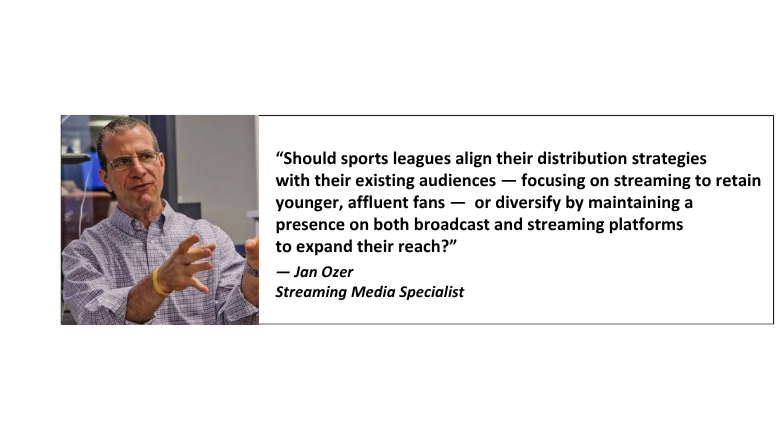
Streaming media specialist Jan Ozer feels that older and lower-income households stick to traditional TV, while younger, affluent audiences prefer streaming platforms. “This trend gives advertisers a clear roadmap for the placement of their ads,” he said.”They should go in for streaming platforms to net younger audiences, while using broadcast TV to reach older or less tech-savvy users.”
Audience sizes for streaming-only sports events vary widely. Industry studies suggest that even well-established leagues like the NHL face challenges in drawing large audiences for streaming-only events, especially when they are not available on national linear channels.
“For sports leagues, the implications are more complex,” added Ozer. “Should leagues align their distribution strategies with their existing audiences – focusing on streaming to retain younger, affluent fans – or diversify by maintaining a presence on both broadcast and streaming platforms to expand their reach?
“Balancing these priorities could be key to future growth.”
A survey carried out by Altman Solon claims that rightsholders risk undermining their future value with high fees and paywalls. “Younger fans may be keen on sports, but are unable or unwilling to pay for the live event,” said David Dellea, partner at Altman Solos in Zurich, and a global thought leader in sports business. “Short-form highlights are their preferred entry point.”
The survey also found that only two-thirds of sports fans watch live matches, due to the difficulty of accessing content and a lack of willingness to pay. A related survey says that 65% of global sports executives are concerned over the continued relevance of live broadcasts for sports fans.
“Short-form content cannot possibly replace the unique commercial value of live sports,” said Dellea. “We have reached the tipping point where content originally created to generate interest in the games has become as sought after as the games themselves.
“The critical question for rights holders is: How can we navigate challenges of discovery and access to funnel younger audiences to a live product that they want to watch. It is a serious problem.”
Predicting ample growth opportunities for the video industry in 2025, Michael Lantz, CEO of Accedo, wrote recently in a blog post, “Most of the larger streaming services have now managed to break even; a huge milestone after many years of investment. Even more impressively, many have done so by both increasing revenues as well as lowering costs.
“It’s encouraging to see that consumers seem more resilient than previously thought and despite significant price increases, most choose to keep their subscription services.
“At the same time, we are seeing that new advertising-funded business models for subscription video-on-demand (SVoD) services resonate with budget-conscious consumers and offer a good stepping stone into becoming full premium subscribers.”
Lantz added: “A healthy overall streaming business trend is providing grounds for optimism. I believe that many companies will see their advertising revenues start growing again. While the overall revenue growth won’t be material and likely to be in low single digits, it is a clear indication that the worst is behind us.
“Ad-funded broadcasters will have better opportunities for increasing investments and focus on growth rather than the cost-cutting we’ve seen over the last two years.”
FAST forward — can it really engage younger audiences and combat stagnating growth?