


By Shaun Lim
With the pandemic continuing to cause
disruption to the way people work, broadcasters and media companies are
constantly looking for more cost and operational efficiencies as they navigate
the ‘new normal’. Where remote
production is concerned, cloud solutions are proving to be both “feasible and
economical”, observed Yvonne Monterroso, Director of Product Management,
Dejero. She said: “Broadcasters are frequently integrating the cloud and
actually improving efficiencies without sacrificing the quality of their
content.”
Monterroso told APB+, “During the pandemic, many of our customers found that more
news and content can be generated with the same number of people by utilising
the Dejero LivePlus mobile app on smartphones.”
Solutions such as the Dejero EnGo mobile
transmitter and the Dejero Gateway network aggregation devices also allow
high-quality live video streams to be shared from any location in real-time,
thus reducing the number of people required to be physically present to cover
live events or be on set.
For instance, at the height of the pandemic
in 2020, systems integrator Ideal Systems powered its cloud-based remote
productions in Asia using Dejero connectivity solutions, including deploying
Dejero’s video transmission technology to produce ‘pop-up’ matches for the
Malaysian Football League (MFL).
As multiple and concurrent matches kicked
off in empty stadiums, Ideal Systems needed to avoid lengthy setup times or
restricted bandwidth when connecting to the cloud. With the Dejero EnGo mobile
transmitter as the production core, lightweight flyaway kits deployed to
stadiums were ready to broadcast within 90 minutes, sending high-quality,
low-latency video to the cloud by combining multiple network connections in
real-time.
Need
to control and manage systems remotely
“The pandemic has focused attention on the
need to control and manage systems from any location, and this applies not only
to remote production but also to playout and master control,” said Michael
Rebel, Director, Solutions Architecture, Imagine Communications.
Rebel shared with APB+, “A virtualised system, whether it is on your premises or in the cloud, is perfectly suited to remote production – master control and channel supervisors can work from home in exactly the same way that they would if they were on-site.”
One of the advantages the cloud offers,
Rebel said, is its neutrality in providing access to infinite amounts of
processing and storage space. “What you do with it is down to the broadcaster
and the systems architect. Good media software will run on standard platforms
and are built on a microservices architecture, so it is ideal to be hosted
cost-effectively in the cloud.”
As remote work becomes more prevalent because
of the pandemic, Rebel also sees a growing trend where on-site facilities are
being reduced by moving from hardware to the cloud, and by moving management to
remote operation. “This reduces the real estate required, as well as the power
consumption and air-conditioning, making a real environmental impact,” he
added.
Challenges
of adopting cloud solutions
Like any technology transition, the
adoption of cloud solutions will present challenges that need to be addressed.
Bandwidth and latency are obvious concerns, as are transmission costs, if cloud
storage is to be continually refreshed.
“But if you take cloud operations as part
of an overall view of broadcast operations, it becomes much more manageable,”
Rebel said. “Programme archives, for example, might be on LTO (linear
tape-open) tapes, which are a significant continuing expense and need regular
capital investment.
“Moving the archive to the cloud slashes
these costs – most broadcasters now insist on IP delivery of programmes and
commercials, and it is as easy for the producers to deliver it to your secure
cloud account as to your premises.”
Drawing on Imagine Communications’
experience of providing core infrastructure for a large-scale ST 2110 live
production centre for Sinclair Broadcast Group’s Tennis Channel, which featured
a cloud-based environment for pop-up events, Rebel also highlighted the
importance of minimum latency in sports, as quite understandably, “nobody wants
to hear their neighbours cheer and wait to find out why”.
Imagine Communications helped Sinclair to
design and build a complete operations architecture for the regional sports
networks (RSNs) they had acquired, and equipped a media operations centre
around a SMPTE 2110 IP network providing key functionality on premises. A cloud-based
disaster recovery solution was also added as a backup.
All
playout of top sporting events hosted in the cloud
During their coverage of the 2021 Miami
Open tennis tournament in March, Sinclair spun up a number of live channels.
All the playout, including the unpredictable live interventions associated with
fitting commercial breaks into the matches, was hosted in the cloud, with
operators sitting wherever was convenient and safe for them.
“With latency no different to what master
control operations’ experience with on-premises solutions, it had no impact on
Sinclair’s operations and distribution feeds,” said Rebel.
“Critically, for the operators, their
interactions are absolutely identical: they work in exactly the same way, with
the same screens and the same functionality, whether they are connected to the
primary system or the backup in the cloud. When something goes wrong, the last
thing you need is the operational team making errors because the backup systems
are unfamiliar.”
For Dejero, its Smart Blending Technology (SBT) is designed to provide reliable
connectivity, anywhere, and intelligently combines with multiple IP network
connections – from diverse network providers in real-time – to form a virtual
‘network of networks.’
Monterroso explained, “If a connection is
lost or becomes congested in highly populated areas, SBT automatically
re-routes packets in real-time across the connection paths to maintain a
seamless and reliable connection. This provides enhanced reliability, expanded
coverage and greater bandwidth capacity.
“Connection performance is assessed in
real-time and it incorporates dynamic recovery and use of connectivity,
supporting cloud, hybrid cloud and on-premises applications with delivery to
multiple, optimised end-points.”
By providing reliable high bandwidth
connectivity, SBT empowers those working in the field to take advantage of
cloud-based workflows to send and receive voice, video and data while in
challenging nomadic or mobile environments; access media management systems,
newsroom systems, data centres; and exchange information with studios.
Powered by
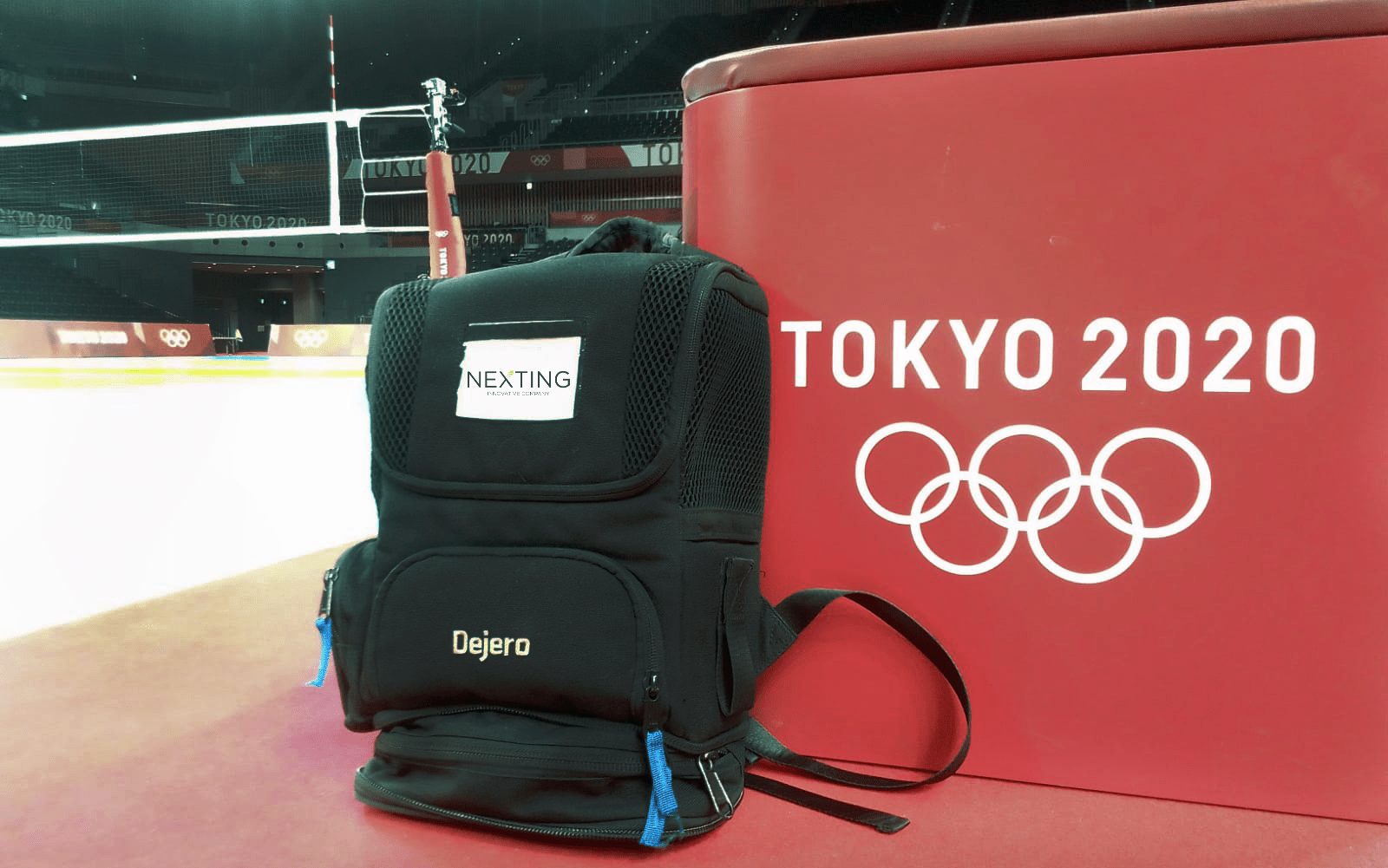
SBT, Dejero’s EnGo 260 transmitter also allowed Italian production company
Nexting to address the issue of low latency during the recently concluded Tokyo
Olympics. Nexting was able to send broadcast-quality live video via just
cellular networks at all of its broadcast clients in Tokyo during the Games,
with latency as low as 0.8, Monterroso reported.
She said, “SBT has also opened a new world
of opportunities in the media and film industry this year by helping to
establish ‘virtual video villages’ for multiple productions. Using the cloud,
it allows high-quality video and audio content on location to be transferred to
any destination across the globe. This empowers anyone involved in the creative
process to view, in real-time, what the camera is capturing, and provide
instant feedback.”
The
transition to cloud and IP continues ...
Since the SMPTE 2110 suite of standards was
introduced in 2017, the transition to IP and the cloud has been a priority for
broadcasters looking to streamline operations, decrease footprints and
effectively integrate with an industry in a rapid state of flux, Monterroso
observed.
She predicted that, as financial pressure
on broadcasters continues to increase, “essential transformation” will need to
happen for broadcasters to continue to transition towards IP and cloud
services. “Without the entrenched legacies of traditional broadcasters, digital
platforms can assist as well as disrupt, using cloud capabilities to provide
reliable and agile solutions.”
To continue to provide cloud-based tools
that untether production teams and pave the way for more innovation, Dejero
recently combined their remote contribution solutions with cloud-native live
production platforms Dazzl and Grabyo.
Users now need to access only a web browser
in order to produce, edit and distribute live streams from any location. A key
benefit of this partnership, said Monterroso, is that broadcasters can use a
cloud platform from a non-IP station and transport native SDI or IP content to
the station or directly to the cloud via the Dazzl and Grabyo customer portal.
Much like the company’s approach to the
transition to IP, Imagine Communications believes that the transition to cloud
should happen at broadcasters’ own pace.
“My number one piece of advice, however,
would be not to tackle too much at once,” Rebel said. “As existing systems
reach life expiry, have a debate with a trusted partner like Imagine about how
best to replace them.”
With disaster recovery a priority during
the pandemic, broadcasters need to have a strategy to stay on-air and to
broadcast billable commercial spots. “Equally, renting more premises and
building out a complete duplicate playout centre that will probably never go to
air is a huge financial commitment. So, many are looking to the cloud to
provide business continuity for traditional on-premises playout operations,” he
added.
In a “your
path, your pace” approach, all stakeholders within the organisation are also
allowed to build up knowledge and confidence, Rebel pointed out, before
concluding, “Backing up your legacy playout system with disaster recovery in
the cloud means that, whenever you rehearse a failure, everyone gets more
comfortable that the cloud is providing the response and the quality you
expect. In turn, that makes it easier to move to the cloud for the next step,
or the next legacy sub-system that is due for replacement.”
Question:
Working in the cloud is no more an option but a matter of survival. How best
can broadcasters migrate to the cloud without junking their legacy systems and
yet build a playout system with a robust disaster recovery in the cloud?
To share your challenges or experiences working in the cloud, please send them to maven@editecintl.com