


By Shirish Nadkarni
Traditional advertising revenues for the media and entertainment (M&E) industry have been declining in recent years, even as costs of operations go up. After being at their wits’ end as to how content can be monetised, it has become all-important for M&E companies to find profitable business models.
“IP and cloud technologies have changed the way thriving media companies make TV,” said Jeff Burkett, Vice-President of Ad Innovations with USA Today Networks. “A wait-and-watch approach is no longer an option if you want to stay in the game.”
Burkett feels that a lot of digital advertising products were created without considering the user’s experience. “We believe you must lead with the user, which in turn delivers greater results for the marketeer,” he said.
These concepts were the centre of attention at the Imagine Communications’ booth at the IBC2024 trade show in Amsterdam, which showcased the company’s new collaboration with Google Ad Manager. It was described by Imagine Communication’s Glodina Connan-Lostanlen, Chief Process Officer, as “a complete platform to grow ad revenue and protect your brand wherever people are watching, playing or engaging”.
Imagine Communications, which provides ad tech solutions for broadcast TV, has collaborated with Google Ad Manager to develop converged linear, streaming, and video on-demand (VoD) solutions across both live and non-live content, accelerating the industry’s transitional shift towards Total TV.
“On the connectivity front, we have brought in our SNP-XL, which is our new, next-generation 2RU Selenio Network Processor (SNP),” said Connan-Lostanlen. “It allows us to do more in one box – higher density, lower power consumption, lower space consumption.
“It really is the number of personalities that the platform delivers, all the way from SDI to IP transformation, multi-viewers, master control light. It does all sorts of software applications that, once you buy the box, you can decide what to do with it.”
Connan-Lostanlen continued, “On the playout front, we have products that allow you to deliver playout in on-prem situations as well as in the cloud, and that provides geo-diversity, so you can run playout operations from different sites, and back each other up instantaneously.
“It is this ability to manage master control operations wherever you are located geographically. This is the key element of playout today.”
The partnership between Imagine Communications and Google Ad Manager bridges the gap between traditional linear TV sales and dynamic programmatic sales in the expanding digital landscape. The collaboration integrates Imagine’s widely used Landmark Sales ad-management platform with Google Ad Manager, enabling a converged linear and digital monetisation workflow.
The new bi-directional integration allows campaigns to be entered into Imagine’s Landmark Sales ad management platform and sent securely to Google Ad Manager with all relevant details, including campaign headers, order lines, targeting criteria, delivery, impression targets, and rates, while respecting user privacy.
Media companies can efficiently manage various campaign types – such as video, display, and programmatic guaranteed/direct – while also revising campaigns originating from Landmark Sales and retrieving delivered impression data from Google Ad Manager for campaign pacing and billing.
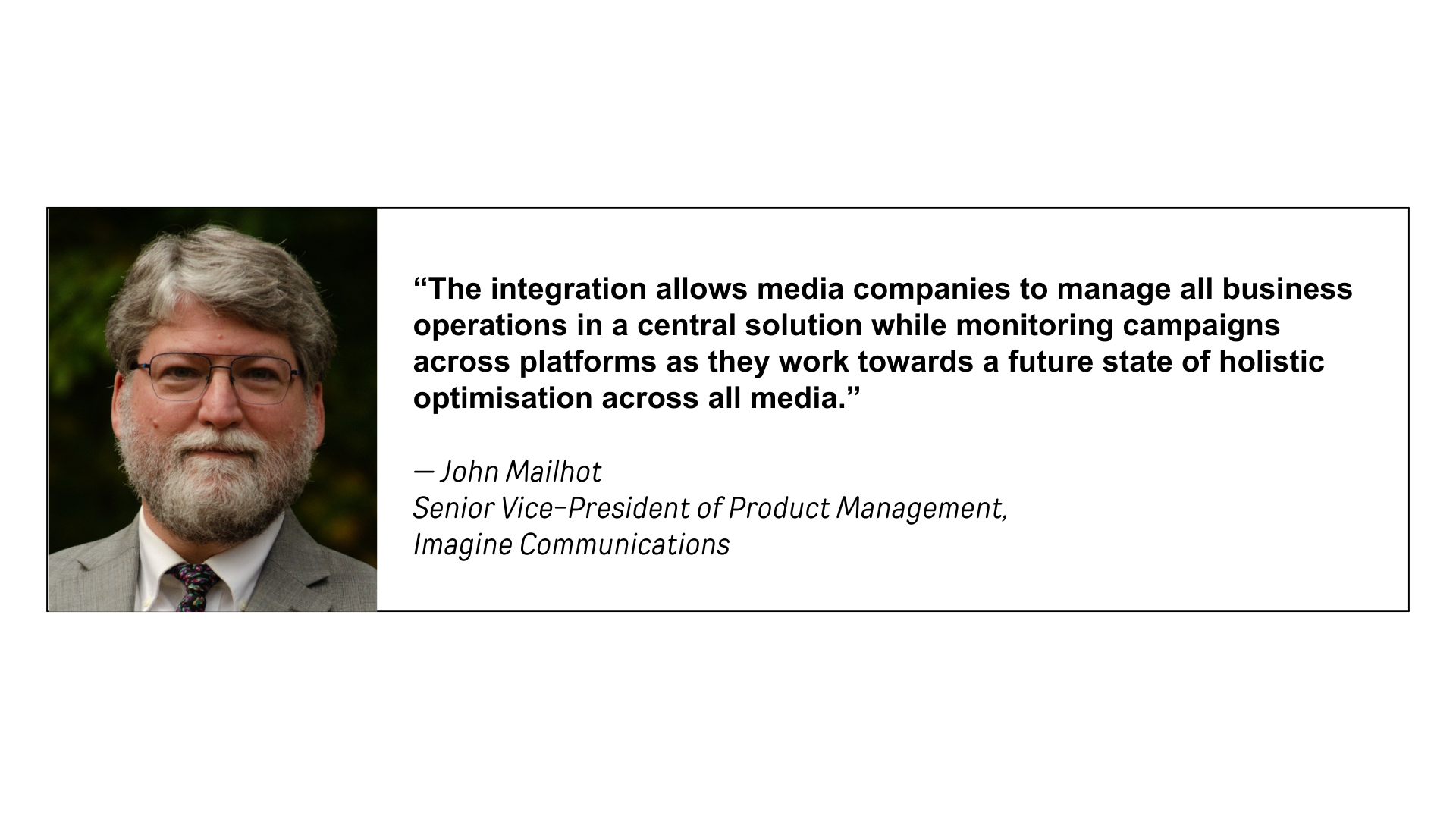
“The integration allows media companies to manage all business operations in a central solution while monitoring campaigns across platforms as they work towards a future state of holistic optimisation across all media,” said John Mailhot, Senior Vice-President of Product Management at Imagine Communications, whose customers include such names as Sky, Disney, Discovery and ITV.
Mailhot was awarded the prestigious 2024 David Sarnoff Medal during SMPTE’s annual Awards Gala for his exceptional contributions to the development and promotion of the SMPTE ST 2110 standard for media transport over IP networks.
“Television is evolving rapidly,” said Mailhot. “With Imagine, you will gain the strategies and tools you need to keep pace with ongoing changes. Together, we will develop a plan to grow your audience and your revenue by mapping your path to a thriving future.”
Mailhot suggested the creation of a flexible infrastructure -- a cost-effective move to IP and the cloud, where SDI assets are protected, and hybrid workflows used with Imagine’s standards-based production and playout solutions.
“You could take a converged approach to ad sales, combining the quality of linear with the efficiency of digital for optimum results,” he said. “You could deliver TV to audiences everywhere, since we provide a seamless migration path to the innovative platforms of tomorrow, tailored to your business needs and timelines.”
Obviously, linear TV is not going away any time soon. But as digital continues to grow, thriving requires finding a cost-effective way to re-aggregate and monetise an increasingly fragmented audience.
“With our modern, cloud-based platforms, you can take a converged approach to ad sales that combines the quality of linear with the efficiency of digital,” said Mailhot. “Our SureFire broadcast-quality video ad server is an ad decisioning solution for streaming TV, leveraging linear-like ad placement control and broadcast rules for superior ad decisioning across connected TV (CTV), free ad-supported streaming TV (FAST) and addressable linear platforms.
“You can sell ad campaigns across linear and digital, or direct-sell high value FAST inventory, using schedule-aware precise ad placement and brand quality to increase revenue through higher cost per mile (CPM). And it is compatible with existing programmatic ad server.”
Connan-Lostanlen added, “Our GamePlan award-winning optimiser and spot placement engine for linear TV helps to increase linear TV ad revenue and achieve up to 20% additional revenue from optimised inventory.
“GamePlan is a modern cloud-based solution that easily integrates with existing scheduling and traffic systems with open APIs. You can reduce up to 80% of the workload involved in trading linear TV.”
Apart from the collaboration with Imagine Communications, Google Ad Manager demonstrated the ease with which YouTube could be monetised, with content creators earning money from the videos they upload on the platform. This income is generated through various channels, primarily advertisements, which are displayed before, during, or after the video playback.
Multiple YouTube channels can be monetised under a single Google AdSense account. This means if you are a Jack or Jill of all trades, passionate about different niches, say, cooking, tech reviews, and gardening, you do not need to pick just one. However, channels where content is only slightly different from video-to-video are not allowed to be monetised.
Another of Google Ad Manager’s premium offerings, Programmatic Guaranteed, is used by Spotify, one of the world's most popular audio streaming subscription services. Spotify’s extensive music library, personalised recommendations, and user-friendly interface make it a popular choice for music listeners globally.
With the rise of podcasts, Spotify’s presence in the audio space continues to grow. This makes their loyal fan base an attractive audience to many advertisers who want to reach listeners at scale and cut through the noise. Spotify uses Programmatic Guaranteed for the majority of their programmatic ad campaigns, bringing speed and efficiency to their ad campaigns.
Programmatic Guaranteed campaigns can be launched quickly and easily, without the need for lengthy negotiations over contract language or extensive publisher ad trafficking. The deals are set up by buyers in advance, so advertisers can simply start delivering their ads as soon as the campaign is launched.
“On average, we saw Programmatic Guaranteed campaigns take 70% less time to launch, with campaign setups taking as little as two days,” said Emma Vaughn, Global Head of Advertising Business Development & Partnerships at Spotify. “By making podcasts available via Programmatic Guaranteed we allowed programmatic advertisers to connect with free and premium users on Spotify.”
Another notable user of Google Ad Manager’s services is symplr, one of the largest ad monetisation service providers in Germany. symplr considers revenue generated through header bidding to be a very important part of its adtech monetisation solution for publishers. However, the process of setting up and managing header bidding was resource-heavy and time-consuming.
“We needed to set up and manage up to thousands of line items, placements and ad creatives in Google Ad Manager,” said Christoff Schwartz, Strategic Lead for symplr. “Additionally, reporting on revenue generated via header bidding was neither intuitive nor precise.
“The header bidding trafficking feature on Google Ad Manager enabled us to significantly improve the efficiency and effectiveness of our header bidding setup. This resulted in substantial revenue growth for the entire network.
“We were surprised how easy and uncomplicated the settings could be made in the Google Ad Manager UI. In this way, we were able to achieve an enormous overall revenue uplift for our customers with little time expenditure.”
There can be no doubt that Google, one of the world’s most omnipresent digital companies, has created a product – Google Ad Manager – that will help all stakeholders in the broadcast industry to thrive by monetising their assets effectively while slashing operational costs.