


By Shirish Nadkarni
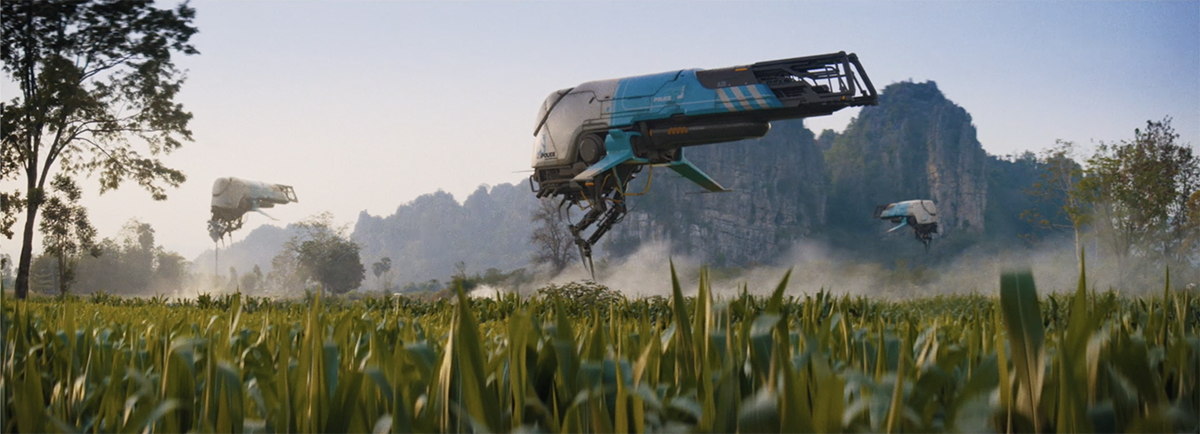
Plugging the concept of peaceful coexistence with Artificial Intelligence (AI); and, in fact, harnessing its benefits. At a time when most schools of thought in the world continue to express apprehension that AI might end up enslaving Mankind, the just-released Gareth Edwards’ sci-fi film The Creator doles out a unique concept that does not paint AI as the villain being presented for decades on the silver screen.
Even more important for Hollywood’s film-makers is the fact that use of generative AI can slash production costs to a fraction of their projected budgets based on the traditional style of film-making. Edwards – who has such big-budget epics as Rain Man, Apocalypse Now, Monsters, Godzilla and Baraka to his credit – believes that AI will fundamentally change filmmaking, allowing anyone to make big budget looking visions at a fraction of their originally projected cost.
The film depicts half of the world having developed AI and the other half being actively against it, following a catastrophic malfunction. Interestingly, it is the West (read: the USA) that has been projected as the villain that wants to ban AI, while a region of Southeast Asia fights to keep it as a force for good. It is not difficult to work out which side triumphs in the end.
Distributed by 20th Century Studios, The Creator itself was shot on a relative shoestring budget of US$80 million, when original cost estimates had pegged the film’s costs at over $200 million.
The studio bosses were resigned to the fact that giant, expensive sets would have to be built in a green studio. “What we told them was that we would go shoot the movie in real locations, in real parts of the world closest to what the final images were,” Edwards recalled. “Then afterwards, when the film was fully edited, we would get the production designer and other concept artists to paint over those frames and put the sci-fi on top.”
So, they did exactly that, and the crew went to 80 locations, which is far more than one would normally use for a movie of the size of The Creator.
“We didn’t really use any green screen,” Edwards said. “There was occasionally a little bit here and there, but very little. If you did the maths, if you kept the crew small enough, our theory was that, against the cost of building a set, which is typically like $200,000 a pop, you can fly everyone to anywhere in the world for that kind of money. We simply kept the crew small, and flew to all those amazing locations.”
Edwards shot the film using Sony FX3 cameras, a budget choice but, as he pointed out, one that was barely distinguishable in performance from far more expensive so-called cine-style cameras.
“The difference between the greatest digital cinema camera you can buy and a camera like the FX3 is minute, hardly anything,” he said. The big advantage for the production was the camera’s ability to record in different light scenarios, including the capability of shooting 12,800 ISO, so we could shoot under moonlight.”
That, in turn, enabled the production team to shoot with fewer lights, cutting costs and increasing mobility. The filmmakers developed a lightweight lighting rig that a crew member could move in seconds, rather than minutes.
“I could move and suddenly the lighting could re-adjust,” he reminisced. “And what normally would take ten minutes to change was taking four seconds. You can imagine the savings in production costs.”
Edwards’ pointers on how AI can help slash production costs have been strongly endorsed by a study conducted recently by Harvard Business Review (HBR) and Boston Consulting Group (BCG) on how readily available AI tools affected productivity and work quality.
“What new tech, including AI, should do is pull more of the creative process up front and streamline production and post production,” the study advised. “Used appropriately, generative AI and other new tech can, at a far lower cost, improve content quality with new creative possibilities and more efficient production, without replacing creative talent.”
The study laid out three scenarios for films with budgets of varying size:
- The first was a comedy movie with a $50 million budget that used limited visual effects. Using generative AI before filming, for instance to block out scenes, and in post production, could reduce costs by 5% to 10%, including cutting four weeks off production time.
- For a movie with a larger budget, like a $100 million family movie, using game-engine tools in pre-production and during filming could streamline the process and shave 20% off time and budget.
- The savings got greater for bigger, blockbuster-type films. A $200 million sci-fi sequel, for example, could slash costs by $30 million to $40 million, including reducing production time by 25%, using AI and other tech-based tools throughout the process.
“Our estimates on the potential of generative AI are conservative, based on today’s technology and our current benchmarks,” the researchers wrote. “Generative AI is already being worked into game engines and LED wall technology, however, and its evolution should turbocharge these savings, especially once IP issues are solved and the tech is adapted more widely for production use.”
Another study conducted by the consulting firm Bain & Co. revealed that studios should “spurn” the idea that AI tools can replace writers, actors and visual artists, and instead embrace the technology’s ability to shave tens of millions off the cost of the production process.
“Don’t replace creatives with robots,” the consultancy warned, calling the people behind films ‘the heart’ of the business.
“Creative industries are built on art, and any technology should support that art, not try to supplant the creative process,” the report stated. “Generative AI can technically be used to draft and edit a script, for example, but doing so puts you at dangerous risk of alienating the very people your business relies on.
“Online buzz and ongoing strikes highlight fears of how AI could replace our writers, actors, and visual artists, but generative AI shouldn’t replace our creatives — not if we want quality content,” said the report. “But use AI judiciously to save millions from the cost of the production process.”
But here is the most important part to internalise: “Regardless of the philosophic and technical debates over the nature and future of AI, it must be accepted that it is already a powerful disrupter to how we actually work,” wrote Ethan Mollick of HBR.
“This is not a hyped new technology that will change the world in five years, or that requires a lot of investment and the resources of huge companies — it is here, now! And we have to live with it, and harness it so that it works for us, instead of it being the other way round!”