


By Dr Amal Punchihewa
In research, finding new knowledge and insights, and making inferences require relevant data appropriately gathered for the purpose. Data analysis and techniques have been in use for years. Today, we have the ability to acquire data within the permissible limits observing ethics and privacy, while gaining enormous capacity and capability to store, process and crunch data for insightful information. Data acquisition (mining) and processing can be improved through the use of appropriate Artificial Intelligence (AI) technologies in an ethical, responsible and explainable manner.
Scientific research requires a clear definition of a problem, defining terms and concepts based on state-of-the-art methodology suitable for the research. Unless we follow a well-planned and designed research process, we cannot expect reliable results, outcomes, insights and inferences.
If data is collected properly by having a clear explanation of what is expected from each question in a questionnaire for example, then data could provide provisions to reach some reliable conclusions. Care should be taken to identify the sensitivities and correlations among variables that are being studied according to the sample size. Samples studied should be adequate in size for the selected technique and samples should be representatives of the global topic that is being studied for generalisation.
With many articles providing predictions and forecasts for 2024, or analysis of the performance of the broadcasting, media and entertainment industries in 2023, I would like to see broadcasters, and stakeholders in the media and entertainment industry define the future they wish to create by articulating aims and objectives honestly and clearly and then working collectively with the industry at large to achieve individual organisational goals and global aspirations. Organisations cannot act selfishly by focusing on themselves while trying to portray that they serve a global audience.
All broadcasters and media players operate as a business. Their performance is evaluated against cost benefits if the broadcaster is a public service (PSM) broadcaster and profits if the broadcaster is a commercial broadcaster or media operator.
The World Economic Forum recently released a forecast of the ranking of global risks over the next two to 10 years. Most relevant to our industry are extreme weather events (where PSM broadcasters generally ensure timely information to the public and provide early warnings for all with a high degree of resilience), misinformation and disinformation (where PSM broadcasters enjoy the trustworthiness of traditional over-the-air broadcast services against online content), and cybersecurity.
In recent times, we have heard a lot about AI, the use of AI in broadcasting and media industries, its impact on jobs, and so on. Recently, APB+ dedicated an article to discuss the impact on jobs within the broadcast and media industry. Despite some victories for artists and the media industry in the US from the Hollywood screenwriters strike, there are no protections for some other job roles.
There has also been a lot of discussion around the personalisation of media and broadcast services. Theoretically, it looks possible and serves a diverse audience. AI has been chosen as a tool that can be used to generate analytics, make recommendations, and improve engagement and loyalty.
However, the approach is based on several assumptions which are not adequately considered for various markets and countries. Connectivity and affordability are two key factors that can impact service viability.
It is alarming and unpleasant to hear about employee layoffs and job cuts among several media and broadcasting organisations such as Amazon, and Channel 4 in the UK. Some streaming companies have been laying off staff without providing an explicit and clear rationale. Some reports say Google has laid off hundreds of employees in several areas of their business to further reduce cost. Amazon’s online audiobook and podcast service will lay off about 5% of its workforce. Comcast’s NBC News has undergone a series of layoffs.
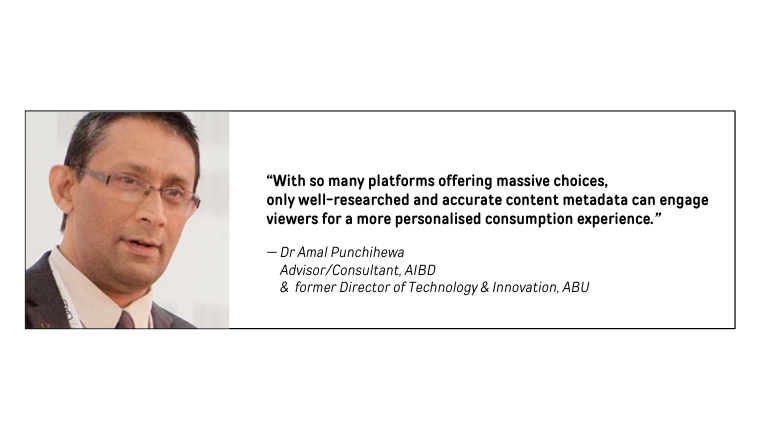
With so many platforms offering massive choices, well-researched and accurate content metadata can engage viewers for a more personalised consumption experience.
Broadcast and media systems can deliver the metadata and images needed to enhance the appeal of linear and on-demand content to meet the expectations of increasingly discerning audiences. From simple electronic programme guides to advanced interfaces, these would help content reach its widest possible audience, supporting increased consumption and audience satisfaction, and driving increased revenue potential.
Appealing content requires considerable investments in producing them, followed by affordable and reliable distribution mechanisms. Given the global inflation, people have limited capacity to spend on their media consumption, either subscription-based or ad-supported. Recent research in the US revealed that the average number of subscription services per audience is just over five. Even with a low subscription per month, the total subscription to be paid will be fivefold of a low value.
We also hear more collaboration among service providers. This is not a new phenomenon and we have experienced such bundling known as triple play or quad play over the last two decades. Collaboration may happen among heterogeneous service providers, namely, Internet Service Providers (ISPs), power utility providers, and mobile or telco service providers.
Streaming may bring some changes to the content distribution industry. A lot of discussion is taking place around ad-supported, free-to-access streaming services known as Free Advertising Supported Television (FAST). Technically, many organisations can embark on FAST services. However, they have to compete for limited advertising budgets that exist at a given time. Based on economic principles, they will not be able to enjoy limitless growth.
Both inflation and sustainability present constraints that may challenge the viability of FAST services for some operators. Public service broadcasters’ FAST services need to serve poorly connected rural populations. Special live content, especially sports programmes, requires robust networks that are adequate and affordable.
After switching off its analogue terrestrial broadcasting signal, countries such as Indonesia in South-east Asia reported an increased consumption rate of over-the-top (OTT) video. Also, it was reported that approximately one in three Indonesians are using streaming services, resulting in a remarkable 40% annual growth in hours watched.
The above analysis shows the uncertainty, complexity and dynamic nature of the broadcasting and media sector. 2024 will be another challenging year for the industry to navigate within the constraints presented by climate change actions, and the requirement to work towards net-zero targets within the time frame. However, broadcasters and media, especially public service media, need to survive and serve the public by providing reliable and trustworthy information, affordable entertainment and complimenting education needs of the day.