


By Shirish Nadkarni
Helping creators earn money from their content — whether they are making videos, writing articles, recording podcasts, or creating digital art and software — has become big business in recent years. The creator economy market, which had crossed US$250 billion in 2023, is expected to nearly double to $480 billion by 2027.
Companies and platforms that help monetise content include major social media sites like YouTube and Instagram, dedicated platforms like Patreon and Vimeo, advertising networks such as Google AdSense and PubMatic, and affiliate marketing networks like ShareASale and Amazon Associates.
These companies offer various monetisation models, from ad revenue and subscriptions to direct fan support and affiliate partnerships, helping creators earn money from their content.
“Creators can earn money from ads displayed on their content through platforms' built-in partner programmes, or through subscriptions and memberships by engaging their audience with offers of exclusive content or benefits to paying members, or even allowing viewers to send paid messages or virtual gifts during live streams,” said Selva Paneerselvam, Director – Solution Engineering at Kaltura, a company that offers a suite of monetisation initiatives for its customers across the media, telecom, enterprise, and education sectors.
Kaltura's advertising initiatives include a comprehensive suite of tools for delivering and optimising ad-based revenue models for both live and on-demand content for a range of customers that includes advertising, subscriptions, pay-per-view, and e-commerce. Many of these initiatives are now enhanced with artificial intelligence (AI) to create more personalised and effective revenue streams.
“Take dynamic ad insertion (DAI), for example,” said Aymeric Legal, Vice-President, Sales & Marketing, Media and Telecom, Kaltura. “We use server-side ad stitching to seamlessly insert pre-, mid-, and post-roll ads directly into the video stream. This method bypasses ad blockers, improves playback, and provides a TV-like ad experience on any device.
“The platform enables targeted ad campaigns using data-driven insights about user profiles, viewing habits, and social activity to deliver personalised ads. Kaltura uses AI to provide dynamic ad placements and predictive recommendations to anticipate viewer preferences, increasing engagement and ad visibility.”
For media and telecom clients, Kaltura supports a range of premium content business models like subscription video-on-demand (SVoD) and transactional video-on-demand (TVoD). The former enables users to offer recurring subscription plans for access to the company’s entire video library or specific content, while the latter allows customers to sell content on a pay-per-view basis, such as for live events, new releases, or special programming.
“We have brought in ‘Freemium models’ that help create blended monetisation strategies, where some content is free (ad-supported) and other content requires a subscription or one-time purchase,” said Legal.
“Kaltura integrates with popular payment gateways like Stripe to offer seamless and secure online payment processing for subscriptions and transactions. For telecom and service providers, we support bundling video content with other services like broadband or mobile plans, and offer dynamic pricing based on user segments or devices.”
Paneerselvam added, “We support the syndication of video content to expand audience reach and tap into new revenue streams beyond a brand's owned properties. By distributing content to social networks and other video destinations, customers can increase ad monetisation and improve overall brand recognition.”
AI content can be monetised by using it to enhance human creativity and deliver value through platforms like blogs, social media and YouTube by leveraging strategies like advertising, affiliate marketing, sponsorships, and selling your own products or services.
Success depends on creating original, high-quality content, adding a unique human touch through editing, narration, or commentary, and adhering to platform-specific policies, such as those on YouTube for AI-generated videos.
It is essential to provide services like AI blog generation, social media marketing, website building, or even AI graphic design for clients. A key consideration for AI content monetisation is human value and originality, where the creator needs to add unique human elements like their own voiceovers, personal commentary, or strategic editing to AI-generated content to provide real value.
A company that created waves at the recently concluded IBC convention in Amsterdam was Harmonic, whose product lines for the broadcast industry focus on video streaming and delivery, with solutions spanning both traditional broadcast and modern over-the-top (OTT) streaming workflows. A key element is the company's software-as-a-service (SaaS) and cloud-native solutions, which provide flexibility for media companies and service providers.
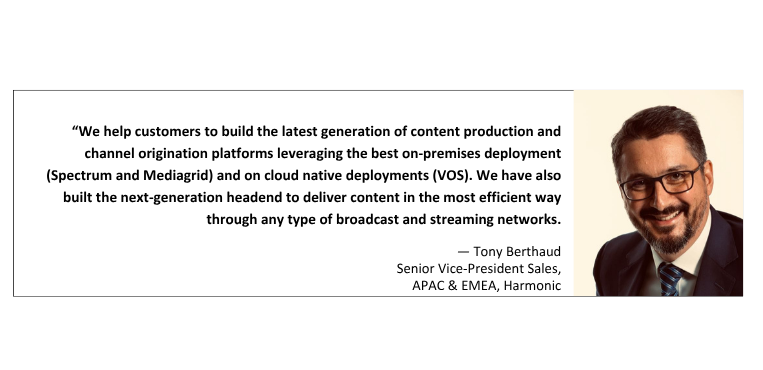
“Our solutions address four fundamental pillars – Production and Playout, Content Delivery, Live Sports Streaming and Monetisation,” said Tony Berthaud, Senior Vice-President Sales, APAC and EMEA at Harmonic.
“We help our customers to build the latest generation of content production and channel origination platforms leveraging the best of on-premises deployment (Spectrum and Mediagrid) and on cloud native deployments (VOS). We have built the next-generation headend to deliver content in the most efficient way through any type of broadcast and streaming networks.
“We also help our customers to deliver the best user experience for demanding live sports streaming applications, optimising the video quality, bit rate, latency and security. And most importantly, we help our customers to generate new revenue streams leveraging targeted ads and the newly launched InStream advertising.”
More than an encoder, XOS (a media processor platform) and VOS (virtual operating system) is an all-in-one platform collapsing features from playout to encoding up to the origin.
“This is the only proven and commercially playout-to-delivery solution available on the market,” added Berthaud, who believes this solution will be of incalculable use in the Asia-Pacific market. “It provides premium quality driven video compression leveraging our in- house AI technology (EyeQ), allowing a significant reduction of the bandwidth used to deliver channels. This leads to cost savings on content delivery networks (CDN) and storage.”
The Harmonic system allows for new and innovative revenue stream generation, typically with its VOS360 ad for Instream advertising, a new and highly efficient way of inserting ads without interrupting the content.
“This is typically a great application for live sports events,” Berthaud said. “Our solutions are the most agile and scalable on the market; as cloud native solutions, they can easily be deployed on-premise or in the cloud without compromising on performance or feature set.”
Berthaud insisted that these are not “me-too” products. “Our solutions are natively hybrid — we have been developing a Common Software Foundation that covers from ingest/playout to media processing and delivery,” he said.
“This software can be deployed either on-premises or in the cloud; and, in addition, we have launched at IBC a newly centralised management that facilitates the operations of hybrid infrastructures. This is important as it helps our customers to deploy their workflows in the best possible environment, either on-premise or in the cloud, and eventually this optimises the total cost of ownership for our customers.”
As experts and leaders in both playout and headend, Harmonic is empowering the deployment of unified, cost-effective and highly efficient playout-to-delivery workflows.
“This helps our customers to break the silos they have between the production, the playout and the headend delivery platforms, optimising the cost of operations and maintenance for broadcasters and operators,” said Berthaud. “We leverage AI to optimise cost of operations and support the launch of new services.
“Our own EyeQ AI technology for video compression helps to significantly reduce the bandwidth used to deliver linear channels, resulting in great savings on CDN and storage, but also helping to improve the quality of experience as more users will be able to receive higher resolutions through streaming delivery.”
Another company that provides a comprehensive suite of video content monetisation solutions for streaming platforms is Bitmovin, which enables advertising-based, subscription-based, and hybrid business models. By integrating ad insertion technology and advanced analytics into its video encoding and player products, Bitmovin helps content providers maximise revenue while delivering a high-quality viewer experience.
“We provide the video infrastructure that allows content providers to implement various monetisation strategies, primarily focusing on advertising (advertising-based video-on-demand), subscriptions (SVoD), and hybrid models,” said Christopher Mueller, Co-founder & Chief Technology Officer of Bitmovin. “With Streams, our end-to-end streaming solution, you can deliver the highest quality live and on-demand video streaming experience to audiences globally across any device.”
The company's tools are designed to facilitate uninterrupted ad integration, maximise revenue, and reduce costs throughout the video delivery pipeline. Bitmovin helps content publishers to generate revenue through AVoD, client-side ad insertion (CSAI), server-side ad insertion (SSAI) and server-guided ad insertion (SGAI).
“This new approach combines aspects of both CSAI and SSAI, where the server provides ad scheduling information, but the client makes the ad requests. This enables personalised ads and interactive, rich experiences while allowing for dynamic ad formats like picture-in-picture,” said Mueller.
“Our AI Scene Analysis generates scene-level metadata to enable more relevant and effective advertising. Ad servers can use this information to place ads contextually — for example, placing a holiday ad during a scene set at a luxury hotel — while also ensuring brand safety.”
Many content providers use a combination of business models. Bitmovin's platform supports hybrid monetisation workflows that blend AVoD and SVoD strategies, giving publishers the flexibility to adapt to audience preferences and market demands.
“Bitmovin's Analytics tool provides data to help businesses understand viewer behaviour and ad performance, allowing for more effective monetisation strategies,” said Mueller. “It can track how ads are performing to refine campaigns and maximise revenue from advertising.
“You can monitor playback behaviour, such as pausing, seeking, and replaying. This data can inform content strategy and improve viewer engagement, leading to higher retention rates.”
Bitmovin's technology integrates with a wide ecosystem of partners, including Akamai, Google Ad Manager, and AIP, which enables broadcasters and OTT providers to use their preferred tools for monetisation and content delivery.
In a world where anyone can publish content online, monetisation is the key differentiator that can turn a passion project into a profitable venture. It allows creators to earn a living from their craft, provides businesses with an avenue for additional revenue, and even offers educators a platform to reach more students. In addition, the process becomes easier and more efficient with the best monetisation platforms at our disposal.