


By Shaun Lim
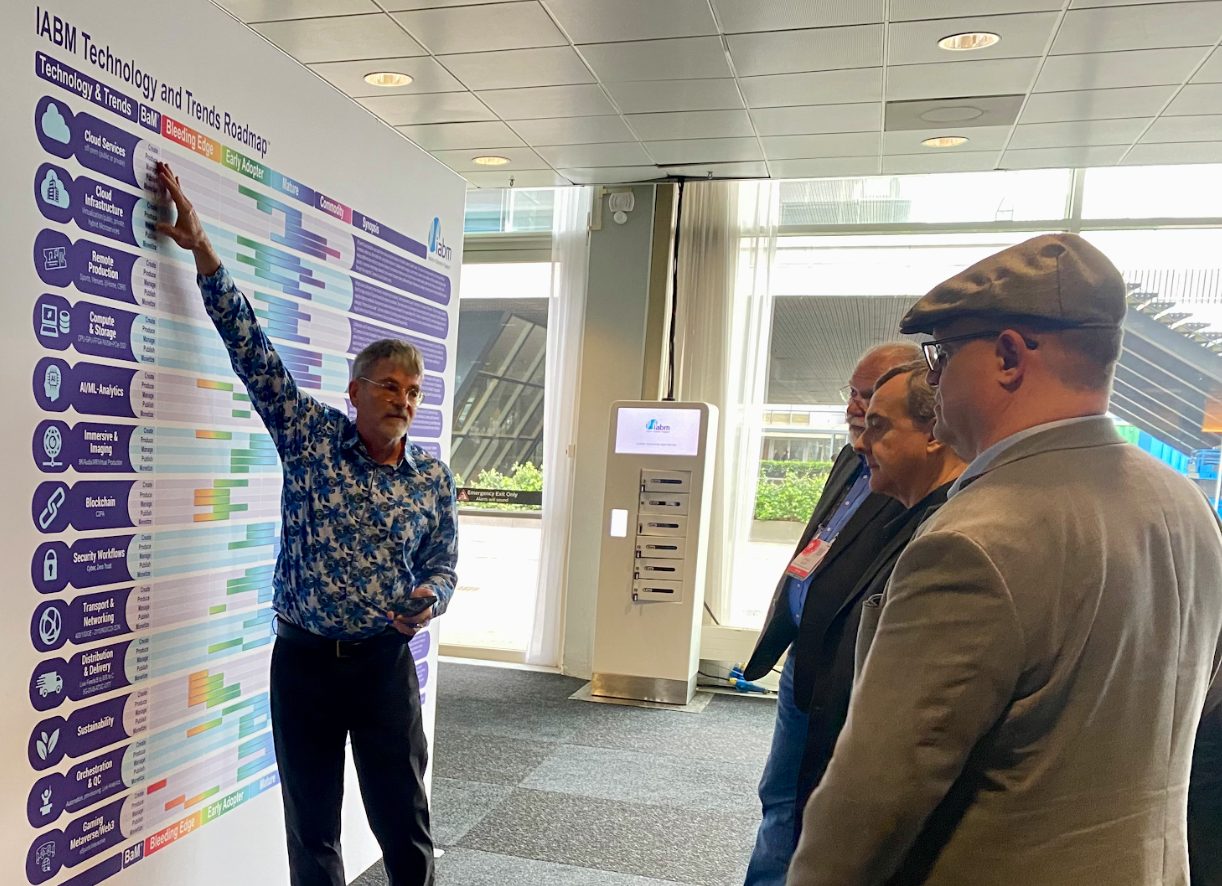
A year can make a big difference in the fast-evolving broadcast and media industry. As broadcasters continue to recover from the impact of the pandemic, and as technologies such as AI and the Cloud continue to reshape the way the industry operates, APB+ caught up with Stan Moote, CTO of IABM, for an exclusive chat on the key learning points from the IABM’s Technology & Trends Roadmap 2024.
Can you talk us through some of the key findings from this year’s roadmap and what are the emerging or developing trends that APAC broadcasters should pay particular attention to?
Stan Moote: Before I get into some of the key findings, I want you to note that the IABM Roadmap working group felt best to change the groupings of major technology and trends to better reflect the current condition of the industry in 2024. As always, this activity draws on strong industry collaboration between end-users, vendors and competitors alike, hence it created a lot of discussion, debates and controversies, yet the final outcome is a remarkable example of teamwork.
I like to start with security as it is super important and believe it or not is far too often neglected, not due to technology, but mainly on the implementation and budget sides.
Due to various attacks in the past, content security is reasonably strong which were key areas invoking workflows. This year we moved from security workflows to security architectures.
While security frameworks and standards (such as Zero Trust) exist, they are still not broadly adopted in the broadcast domain despite the fact this technology is mature and well used on the IT side of media operations.
On the distribution side, content delivery network (CDN) leaching continues to be a streaming content security issue. Some newer CDN architectures yield more effective and secure delivery but may not be scalable.
The word “cloud” itself often lacks a distinct meaning. A couple of decades ago, a “cloud” was put in a drawing to indicate a WAN or possibly even the Internet. Today cloud has multiple meanings, such as a bank of local or remote virtual machines, or large arrays of storage, or even a generic label for various public cloud service providers.
Important trends such as microservices could become discounted by simply using “cloud”. Additionally, both the advantages/disadvantages of public/private off-prem cloud operations would not be highlighted if we had a single cloud grouping, hence we broke it down into:
- Cloud services – Off-prem (public or private)
- Cloud infrastructure – Virtualisation (public, private, hybrid), microservices
Edge computing has become very significant, as customers will not be moving huge media content into and between cloud services, have it processed and then moving it back again. The one qualification is when a sudden burst of compute power is required and this fits well within cloud Infrastructure. This being said, one of the debates the group had was: do we keep cloud or discreetly move the various functions of cloud into each group individually?
Getting into your APAC question, I would say it is more about not being new but about being actively tested, experimented with and actually being implemented. Remote production is a key example of this. Requests for proposal (RFPs) do not typically specify remote production anymore; it is just expected and assumed to be the norm.
This has led to new options for production and sports commentary across the region. It is less about the technology as conductivity for remote productions widely uses the public internet with an added transport layer to provide added resilience to combat network limitations.
The same goes for bonded cellular techniques. Private 5G deployments have different regulations country to country, however are rapidly being adopted for larger venue activity. It is really the switch to IP for sports contribution that makes this all possible and not just for audio/video feeds, but also for talkback systems, interruptible foldback (IFB), and so on.
AI has had a defining impact over the last 12 months, from production through to how content is consumed. How do you see AI, and accompanying technologies like machine learning (ML), continuing to transform and impact the broadcast and media industry?
Moote: As Head of Judges of the IABM BaM awards, I have had the opportunity to review all the entries, many of which featured AI and ML this year. Amazingly, there were not really any that had an only AI or ML feature. The main focus of AI and ML was adding these technologies into improving and speeding up current products and workflows. This clearly shows that AI/ML will and is impacting the industry, albeit in a more controlled manner by vendors.
We all have seen personal AI recommendation engines from the main over-the-top (OTT) providers for years. What is new is how the industry has turned the tables around. These technologies are now being used by the content distribution companies to obtain greater customer retention rates and reduce churn. AI is figuring out the customers at risk, by analysing the content they are watching compared to their regular patterns and flagging sales reps to be proactive with the customers.
On the production side, newer single unit multi-cams with AI lead the way for more automated sports productions. While perhaps not for full-blown events, this nevertheless strengthens the market for lower tier sports.
As for GenAI, the worry is how it can create new content. AI looks backwards, not forward, so the content it creates may be a different approach to something old, but does not produce groundbreaking ideas.
What is good about AI for creatives is two-fold. It can help stimulate new ideas and thoughts, similar to what web searching can do, but in a more direct and narrow manner. The other aspect is reducing repetitive workflow tasks and checks.
As for APAC, AI is constantly improving for subtitling, dubbing and anything to do with language, which is key in multi-language areas. This can directly relate to more revenue opportunities with existing content and faster content releases.
Sustainability was added to the IABM Roadmap in 2023, yet according to this year’s roadmap, sustainability is the least important factor driving investment in 2024. Can you explain what is causing this divide and what can be done to achieve tangible sustainability?
Moote: When we added sustainability to the roadmap in 2023, the hope and promise was to highlight the importance of this within the industry. We quickly realised there is a lot of greenwashing going on, so we decided to move towards tangible sustainability; which allows us to cover the specifics (either happening now or planned) within each area of the content chain across Create, Produce, Manage, Publish and Monetise.
I think this greenwashing is to meet promotional needs because we discovered during IABM research that sustainability is the least important factor driving investment in 2024. Sustainability is much more important to specific types of buyers such as public broadcasters, where it is the third most important driver. There is still a misconception that moving to public clouds means there is an improvement in sustainability. That is not always accurate.
As expected, cost improvement and public pressure are the main drivers of sustainability. We see that many RFPs are looking for carbon footprint details, however the focus of the industry should be more about reducing carbon emissions rather than hoping that all the new trees being planted will survive. Do not get me wrong, planting trees is good but the offsets should not outweigh the benefits of reducing carbon emissions.
One clear example of tangible sustainability within APAC is the move to digital transmitters that shows specific maturity in carbon reduction.
As with crypto-currency mining, red flags are popping up. The building of massive AI-focused supercomputer data centres will require millions of chips and huge amounts of electricity. No doubt they will get used within the media, which again points to the fact that being in the cloud does not mean you are sustainable by using an “AI factory”.
Moreover, “right-to-repair” laws are encouraging the repair of electronic goods instead of replacement, which leads to a reduction in electronic waste.
You will also be attending IBC2024. What are you most excited to check out and how would you expect one of the biggest broadcast shows in the world to set the stage for what is to come in 2025 and beyond?
Moote: I am excited to see how many improvements are underway with camera to cloud and for that matter cloud collaboration. When COVID hit the focus was work-from-home, which opened the door for many new services running in public clouds and having users globally working on the same projects.
How will hybrid work models continue to fit in, not just from the cloud (on or off-prem) point of view, but where employees actually work? Many of the improvements we see for remote activities are becoming key for collaboration, whether people are in the same building or across the globe.
With “quality” going downhill during the pandemic, IBC2024 gives us an opportunity to see improved QC products that relate to quality of experience and redundancy or backup strategies.
Trade events like IBC showcase collaboration, whether vendor-to-vendor or end user-to-vendor, and provide colleague-to-colleague networking opportunities to improve the industry through the sharing and stimulation of ideas. They also motivate newer entrants into the industry, which in turn attracts younger audiences and keeps the media and entertainment industry resilient.