


By Shaun Lim
In a rapidly evolving media landscape where digital performance and security are non-negotiable, Akamai’s evolution from being a content delivery network (CDN) pioneer to a full-fledged cloud platform provider marks a strategic shift.
Jay Jenkins, CTO, Cloud Computing, Akamai Technologies, declared to APB+, “At Akamai, we’ve evolved from a CDN pioneer to a cloud platform provider that powers and protects businesses online. In particular, our cloud-native and edge-optimised platform enables customers to keep pace with the changing nature of video streaming.”
Leveraging its edge infrastructure, Akamai has redefined what it means to deliver content and applications at scale, offering businesses a unique blend of speed, resilience, and protection closer to their users.
With higher-resolution formats like 4K and 8K, along with live and interactive content, Akamai has also had to manage customers’ increasingly high expectations for speed, reliability, and quality.
That, Jenkins maintained, is where Akamai Cloud comes in. “As the world’s most distributed cloud computing platform, Akamai Cloud brings together compute, storage, and delivery across thousands of locations globally,” he explained. “This helps us deliver smoother, low-latency video experiences — even in areas with limited infrastructure.”
In March 2025, Akamai also introduced Akamai Cloud Accelerated Compute Instances, which the company says makes it the first to offer video processing units (VPUs) in the cloud to efficiently handle complex video workflows.
For live or interactive formats, Akamai’s Media Services Live platform offers a range of features, including low-latency delivery, dynamic ad insertion, and real-time analytics.
“All of these capabilities are designed to help our customers scale their video delivery, reduce buffering, and create seamless, high-quality viewing experiences for audiences everywhere,” said Jenkins.
As audiences increasingly demand more interactive and personalised content, Akamai has also focused on moving compute power to where viewers are. This largely explains why edge computing lies at the heart of how Akamai approaches video delivery today and into the future.
Jenkins highlighted, “By processing needs like dynamic ad insertion, content personalisation, and access control right at the edge, there is a reduced need for data to travel back and forth to a central cloud. That means lower latency and a smoother streaming experience overall.”
Akamai offers tools like EdgeWorkers and EdgeKV to enable developers to run custom logic at the edge, helping to create localised, real-time experiences. Whether it is delivering a targeted ad or managing playback rights by region, this model makes it possible to respond quickly and efficiently.
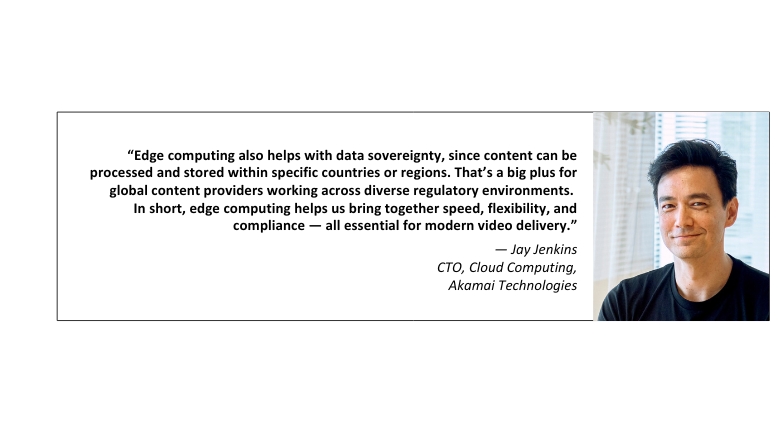
Jenkins added, “Edge computing also helps with data sovereignty, since content can be processed and stored within specific countries or regions. That’s a big plus for global content providers working across diverse regulatory environments. In short, edge computing helps us bring together speed, flexibility, and compliance — all essential for modern video delivery.”
In emerging markets, many operators are grappling with the dual challenge of managing rising content demands with the need to keep costs and latency under control. The key, said Jenkins, is to find ways to deliver great-quality content without driving up costs or creating performance bottlenecks.
With Akamai Cloud, a globally distributed platform, operators can deploy workloads closer to their audiences and devices. “This helps reduce latency and the need for expensive centralised infrastructure, which is often a hurdle in less-connected regions,” said Jenkins.
Akamai also offers features like intelligent traffic routing, edge caching, and localised compute, which work together to keep streaming smooth while controlling operational costs. In areas with limited infrastructure, these capabilities are especially valuable, since they allow operators to deliver reliable video without large capital investments.
“We’re also expanding our footprint in underserved areas so customers can continue to scale their delivery and reach new viewers without compromising on performance. Ultimately, what we’re trying to achieve here is to help content providers grow in the smartest way possible by combining global reach with local efficiency,” said Jenkins.
As for the future of video delivery, Akamai believes it will continue to transcend beyond simply delivering video. Instead, it is about instantaneously delivering the right content, in the best format, for each viewer.
“Audiences are expecting more immersive and interactive experiences, so content providers need more flexible and responsive infrastructure,” explained Jenkins.
Perhaps inevitably, AI will play a bigger and rapidly evolving role in how content gets delivered, whether through powering real-time recommendations or enabling smarter ad targeting.
He continued, “To scale these experiences, you need a setup that’s fast and secure. That’s where Akamai’s distributed infrastructure really makes a difference, and that’s why we’ve built Akamai Cloud to bring compute, storage, and delivery closer to users.”
Akamai is also continuing to invest in developer-friendly tools and APIs to make it easier to build cloud-native video workflows and the accompanying flexibility to adapt quickly to new formats and viewer behaviours.
Another priority is security.
Akamai is building protection into every layer, from the origin to the edge, to enable content to be delivered safely and reliably.
“Looking ahead, video delivery will be defined by speed, intelligence, and resilience. Akamai is helping our customers to stay ahead of that curve by building the tools and infrastructure to power the next generation of viewing experiences,” said Jenkins.
Sustainable streaming at scale: Why efficiency matters more than ever
For myriad reasons, including cost efficiency, sustainability goals and regulations, as well as network scalability and efficiency, reducing energy consumption in video delivery continues to be a formidable challenge for many operators.
Broadpeak, a global specialist in software-defined video streaming solutions, believes the answer lies in multicast adaptive bitrate (ABR).
Damien Sterkers, Video Solutions Marketing Director, Broadpeak, told APB+, “Multicast-ABR has a massive impact on reducing energy consumption. The principle of multicast-ABR is to send just one single stream shared among everyone watching the same content. Rather than sending separate video streams to each viewer, multicast-ABR sends just one stream that is shared among everyone.
“This is especially effective during major live events, like sports, which tend to create huge traffic spikes. By eliminating these peaks, operators can significantly cut back on the network capacity they need — leading to lower energy use, and also reduced infrastructure costs, and a smaller carbon footprint overall.”
Broadpeak’s nanoCDN, a multicast ABR solution, empowers operators to deliver ultra-low latency, scalable, high-quality live video without overloading their networks. Top-tier operators like BT, Orange, Claro, and DAZN, are using multicast-ABR to replace unicast traffic with multicast traffic.
DAZN specifically, is using multicast-ABR via Orange and TIM to stream Spain’s and Italy’s national football championships.
Sterkers reported, “According to DAZN’s own data, multicast streaming reduces playback issues — like startup failures, buffering, or interruptions — by 80% - 90% compared to unicast. In summary, implementing multicast-ABR roughly results in 10 times less network load and 10 times less user-facing streaming problems.”
Operators are also increasingly repositioning their streaming infrastructure as revenue-generating assets, and CDN-as-a-Service is at the heart of this evolution.
Concurring, Sterkers said, “Telecom operators are increasingly exploring how to turn their streaming infrastructure into a service they can offer to third-party platforms. This shift is largely driven by changing viewing habits — more people are watching content on streaming platforms rather than traditional linear TV.
“The move makes a lot of sense for both sides: operators save on infrastructure costs by pushing content from the edge of their networks, and streaming platforms benefit from improved quality of experience for their users.
“It’s a clear win-win that could lead to deeper collaborations in the future.”
With demand for ultra-high-resolution video continuing to grow, smarter and not necessarily bigger infrastructure, could be key for operators to balance performance, monetisation, and sustainability.
Operators, Sterkers suggested, will need to juggle all three aspects simultaneously; on the flip side, these goals can work to support each other.
He explained, “For instance, making a network more efficient typically means better performance and lower power usage, which also helps reduce costs and environmental impact. Also, scaling up a system, to support 4K resolution or other bandwidth-intensive innovations, doesn’t have to come at additional infrastructure cost if deployed smartly, in particular with technologies like multicast-ABR, or edge caching associated with fibre-to-the-home.
“Dynamic ad insertion impact can also be kept in check with the proper technologies. Moving forward, faster adoption of these smart, efficient solutions will be key to keeping streaming both innovative and sustainable.”
As video delivery becomes more distributed and dynamic, monetising it through advertising must keep pace. This in turn, is leading to a need for deeper orchestration between ad tech systems and CDNs to avoid latency, ad stitching errors, and revenue loss, especially during unpredictable live events.
The priority for dynamic ad insertion today, said Paul Davies, Head of Marketing, Yospace, is to maximise revenue opportunities while maintaining a premium viewer experience. “The key to achieving this is to remove as many points of friction as possible,” he told APB+. “That means working closely with a CDN to ensure a seamless viewer experience.”
There are several important steps he recommends operators to take, starting with ensuring ABR profiles of video and audio are matched between the main content and ads. Then, audio must be normalised to avoid sudden jerks to and from ads. Ad content should be placed on the same CDN as the main content wherever possible, to avoid unnecessary loading issues and buffering.
Davies continued, “Multi-CDN strategies must be supported, with the correctly prepared ad copy being present across all the CDNs the broadcaster is using for delivery at any one time.
“Live events can be very unforgiving. If there is an issue with delivery from one CDN in a certain region at a certain time, the broadcaster must have the ability to switch to another CDN very quickly. The dynamic ad insertion system must support that and ensure that ad stitching and the ad experience remains completely seamless.”
It goes without saying that advertisers expect not just delivery, but measurable impact. To meet these expectations, broadcasters are leveraging dynamic ad insertion (DAI) to gain deeper analytics and real-time visibility.
Besides adding value, addressability in digital advertising tools also offers greater insight into ad views and performance, observed Davies, who believes that these insights are critical to advertising success in the streaming era.
He explained, “Advertisers are dependent on them and have expectations for reliable, real-time insights based on what they get elsewhere. Broadcasters must provide trusted and certified measurement solutions to create and grow trust with advertisers. That is how you get advertisers to spend more on CTV.
“Also, deep analytics of factors such as ad server performance and ad timeouts will help broadcasters alter their campaigns on the fly to improve fill-rates and overall ad performance.”
In an increasingly complex streaming landscape, technologies like multicast-ABR and advanced DAI are proving essential to delivering high-quality, low-impact video at scale. From reducing energy consumption and infrastructure load to improving monetisation and ad performance, operators now have a roadmap that aligns sustainability with profitability.
The future of video delivery lies not just in bigger networks, but in smarter, more adaptive infrastructure built for scale, resilience, and uninterrupted viewer experiences.