


By Shirish Nadkarni
On-prem or cloud — or hybrid? This has become such a conundrum for the broadcast industry that several of the big players have actually reversed their migration to the cloud, and gone back to storing their precious data on premises.
Safety, cost and accessibility … these are the main factors that broadcasters have to weigh when deciding on the ideal model for their data storage. In the past, the far higher costs of parking data in the cloud was proving to be the main deterrent, but this is no longer so.
“The toughest question for broadcasters to sort out is whether to remain on-prem or go the whole hog into the cloud,” said Sima Levy, President & CEO of Actus Digital, a company that provides an intelligent broadcast media platform for recording, monitoring and compliance.”
She told APB+, “As far as we are concerned, we support both, and don’t bother too much whether pricing is the issue. But I can see that more and more customers are concerned about the cost of cloud-based solutions.
“Most of our customers want an on-prem AI solution where they buy one strong GPU machine that costs them money. But they consider this a one-time expense, and don’t worry about having to make continuous ongoing payments for cloud-based processes.”
An opposing view is presented by Cameron Smith, Chief Technology Officer of Dejero, a company that delivers real-time video and networking solutions that provide resilient, uninterrupted internet connectivity for critical communications.
The shift towards remote production and a virtualised work environment took place in the wake of the COVID-19 pandemic. It is a trend that has been sustained as decentralised workflows continue to be the norm for many broadcast productions.
“This stems from the industry realising that decentralisation of workflows provides more flexibility and mobility for teams to work and collaborate from anywhere across the globe, whilst still being connected to people and systems,” said Smith.
“In addition, organisations have discovered that the cloud is a ‘feasible’ option for remote production and an economical solution too. Browser-based software deployment is easily done, and hardware upgrades are rarely needed. This results in reduced capital expenditure as less equipment and less staff are physically required onsite, be it at the station, studio or at an event.”
Smith claimed that the pandemic has also accelerated the demand for on-the-fly collaboration and the shift to remote, virtual and cloud production, particularly for sports coverage, where events require complex infrastructure to connect multiple venues, even when challenging terrains can make the job even harder.
“When it comes to the full adoption of cloud-based workflows, connectivity remains a concern, especially for live content,” he noted. “The key is the ability to move live content securely and quickly to the cloud where it can be managed, processed, and distributed anywhere.”
To help broadcasters fully utilise cloud production tools, Dejero is making it easy to stream high-quality video in and out of the cloud, with support for the formats they need to integrate with their preferred post-production tools.
A common challenge associated with the cloud is security and data privacy. Smith believes that this can potentially be improved due to centralised security expertise and large investments leading to state-of-the-art underlying physical and infrastructure security practices.
Pay-TV providers and over-the-top (OTT) platforms are particularly vulnerable to data theft and privacy attacks; and there are companies which have come up with anti-piracy solutions that protect their clients holistically.
“We have brought a brand-new, totally innovative OTT solution which protects you in a future-proof manner against piracy,” said Maria (better known as ‘Mascha’) Malinkowitsch, Director, Product Management, at Verimatrix, which was acknowledged at IBC2024 with an award as the best anti-piracy solution.
“What we are doing totally different from everyone else in the industry is that we are combining our well-acknowledged in-house competence in content protection, for which we have been known for decades, with our knowhow in cybersecurity — protecting banks, healthcare companies, and so forth.”
Malinkowitsch says that the OTT market has to respond to totally different challenges than those that cropped up with the old set-top box in the DVB world.
“You are now out there in the wild, wild Web, where every single phone, tablet and browser can be under attack,” she pointed out. “We therefore have a suite which has the good old encrypting, plus watermarking, to find pirates when content is leaking.
“We also have something which protects your app — it’s called Counterspy.
“We also have a strategy which enables you in four simple steps to have a future-proof armour against piracy. Our solution is particularly interesting for sports and live content because this is the first time that it enables you to holistically approach and stop piracy where it happens, when it happens – and not days later!”
Wasabi Hot Cloud Storage addresses the question of expensive cloud storage by offering a solution that is “infinitely affordable and predictably priced”.
“We offer secure, reliable and low-cost solutions,” says Gary Ng, Wasabi’s Media & Entertainment Sales Director for APAC. “Pricing is always a consideration when you want to put your content in the cloud. So we remove every complexity, and offer the customer just a single tier, so he pays for the capacity that he requires.
“No fees for API or egress calls; and it is scalable to an unlimited extent.”
Wasabi claims that it costs up to 80% less than the hyperscalers. Its unique selling points are its unique identity and access management policies as well as its enterprise-level single sign-on options, plus multi-factor authentication and multi-user authentication for storage account security.
Among companies that have built their reputation on playout systems that are built to be on-prem, but are now scrambling to introduce relatively low-cost cloud-based systems so that they can cater to all types of customers, is Pebble, which provides content management, automation and channel solutions for broadcasters, cable and satellite operators.
“Pebble is undoubtedly the most feature-rich playout system in the market; it is very robust, and yet very stable,” said Sally Wallington, Senior Vice-President of Sales for Pebble.
“Our products are designed for news, sports and entertainment channels, and can support a range of applications from single channels to large numbers of concurrent channels. Our main system is Windows-based and mainly built to be on-prem, though it can also be in the cloud, which would make it very costly.
“Prima is our latest offering, and it is a very different technology. Prima is conceived as a cloud-native platform. It is built on Linux, and could be a lot more cost effective. Over time, it will have all the features that we have in our standard products, but initially, it is the technology that is different.”
When one examines the broadcast firmament closely, one finds that there is a distinct regional bias in broadcasters deciding whether to remain fully on-prem, migrate to the cloud, or maintain a balance between the two modes of data storage.
Alexandre Paugam, Senior Director – Business Development & Global Strategic Accounts for Harmonic, noted that in North America, most of the big names have taken to the cloud, but in Europe, EMEA (Middle East) and APAC (Asia Pacific) regions, there were waves of cloud adoption, while some companies have abandoned the cloud and have come back on-prem.
“The key differentiator for a data storage company is to be able to deal with all of these client requirements,” said Paugam. “If we go back in time, nine years ago, we decided to develop everything we do into a single software foundation. We can put the software that is cloud-native either on appliances that are on-prem, on the private cloud or on the public cloud.
“That covers the entire video pipeline — the entire video plumbing, from source to screen, end-to-end. Having the video pipeline that is cloud-native and in a single library really gives us the capability to go on-prem and in the cloud, both at the same time, and build hybrid architectures.
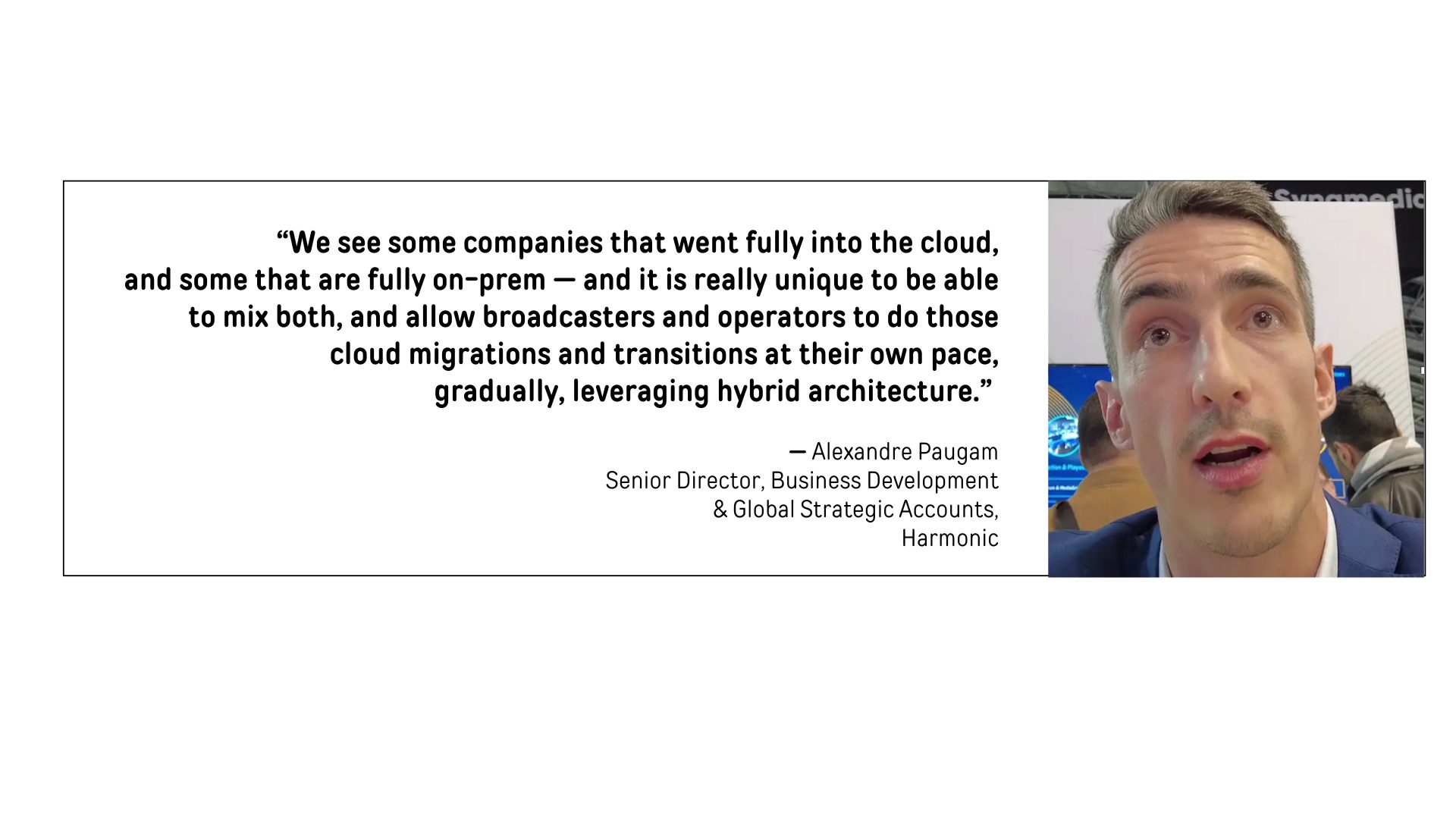
“We see some companies that went fully into the cloud, and some that are fully on-prem — and it is really unique to be able to mix both, and allow broadcasters and operators to do those cloud migrations and transitions at their own pace, gradually, leveraging hybrid architecture. Also the end-to-end capability, from playout to processing, delivery and monetisation is quite complete.”
Paugam claims that 95% of all video channels in French television have been created with Harmonic’s playout. The company’s biggest success has been its focus on sports, and working with the biggest sports platforms in France.
It is clear that the broadcast and media industry can no longer deny the prominence of the cloud, and how cloud-based video productions are retaining almost all of their creative and flexible aspects.
Cloud simply cannot be ignored; and, dictated by a cost-benefit analysis and the requirements of data safety, most broadcasters appear to be settling on a hybrid mode.