


By Shaun Lim
Caught in a cost-of-living conundrum that seems to go on and on, a new underconsumption trend has begun to gain traction. Championing minimalism and frugality, underconsumption encourages people to maximise the utility of their purchases and buy only what they truly need.
Where entertainment is concerned, while consumers continue to seek comfort through the consumption of quality content to escape the mundanity of life, more are now looking for cheaper alternatives to satiate their content fix.
This in part, is compelling more content providers, like Netflix, to offer ad-supported streaming service at a reduced subscription fee to appeal to the budget-conscious consumer. Yet, in the Asia-Pacific region, these efforts may be falling short, and may be going beyond the mere desire to gain access to free content.
According to the annual piracy consumer survey conducted by YouGov for the Asia Video Industry Association’s (AVIA) Coalition Against Piracy (CAP), while there has been a decrease in piracy on pirate TV boxes, pirate apps, and streaming or torrent websites, the incidence of piracy across the region climbed from 52% in 2023 to 59% in 2024.
What then, are the root causes of this increase?
There have been two drivers of online piracy in APAC in recent years, and they are often linked, said Matt Cheetham, General Manager, CAP, AVIA.
Speaking to APB+, he explained, “Firstly, we have seen a rapid growth in piracy on social media and messaging platforms. The ease of accessing these platforms via a mobile device facilitates the ease in which consumers can also access pirate content if it is made easily available on the platform via the same device.
“There is no need to log on to another device — it’s all there in your hand.”
The second reason stems from a more insidious nature, and should be of immediate concern to authorities in the region.
“Moreover, the last few years has seen an exponential increase in gambling being connected with piracy and, in particular, piracy of live sports. Many of these gambling operations are run via social media and messaging platforms, and the pirated content can be viewed either on the platform or outside, but via a link shared on the platform.
“The criminals are deliberately targeting consumers through the offering of pirated content, but it’s not only illegal gambling on offer, malware, viruses and other online nasties are often transmitted to unsuspecting consumers via pirate services.”
Combating piracy calls for a united front
In South-east Asia, the Philippines and Vietnam are the two countries recording the highest incidences of piracy amongst their populations, at 70% and 71% respectively.
To effectively combat piracy in the region, stakeholders will need to understand how gambling is underlining the growth of online piracy in Asia. For rights holders, this means being aware of emerging trends and developing close relationships with platforms to both heighten the awareness of piracy on their platforms, and ensure adequate measures are put in place to counter it.
Cheetham also urged for a tougher clampdown on unregulated online gambling, which is driven by criminal networks operating in the region. “In addition to working with the platforms, rights holders must ensure they work closely with governments and enforcement agencies in the region to combat piracy that is linked to online gambling.”
As content piracy continues to evolve, strategies that can disrupt and curb content piracy must also follow suit, and collaboration is likely to be the key on the long and challenging road to eventually eradicate content piracy.
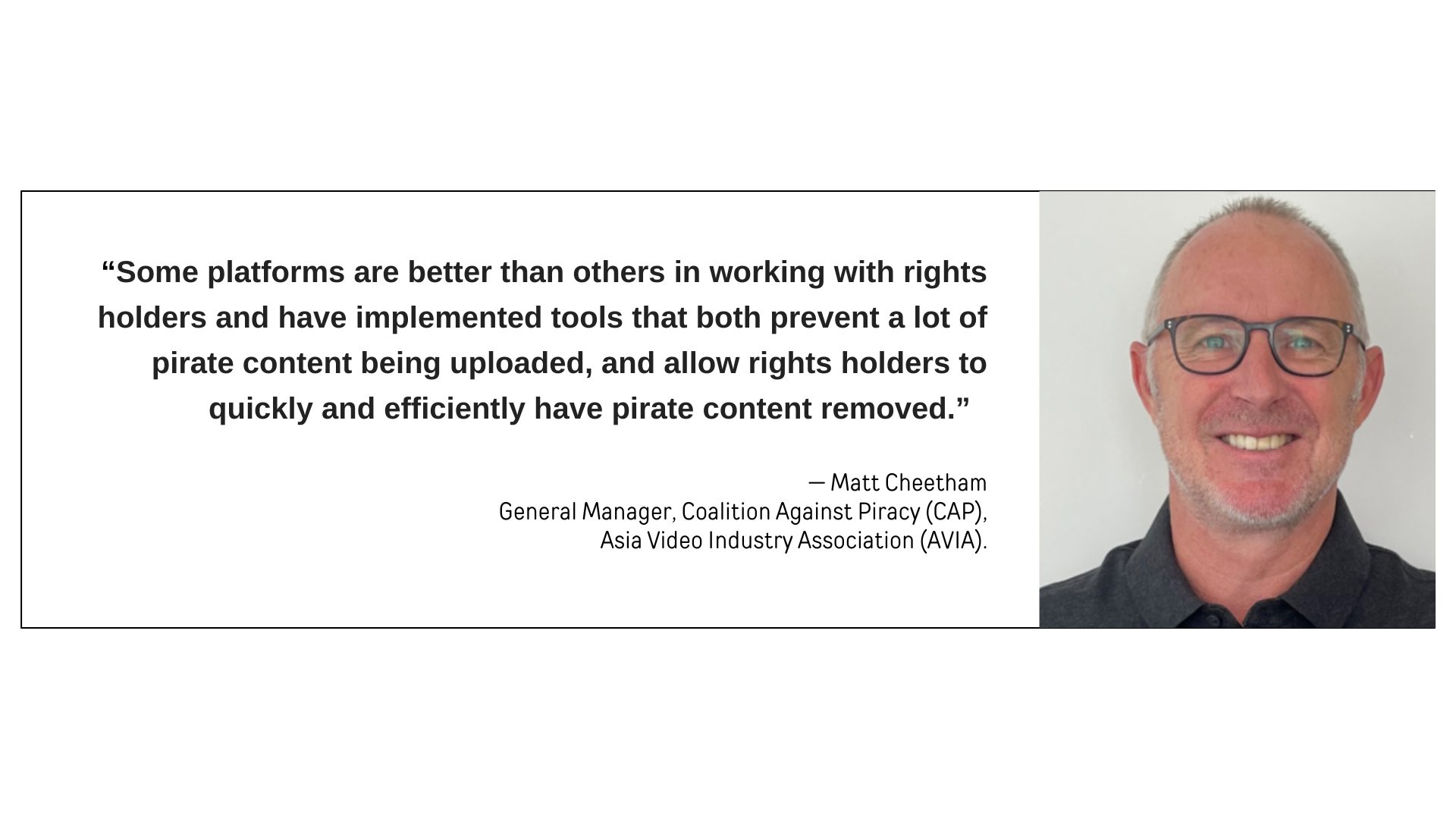
Cheetham said, “Some platforms are better than others in working with rights holders and have implemented tools that both prevent a lot of pirate content being uploaded, and allow rights holders to quickly and efficiently have pirate content removed. Many of these platforms work closely with rights holders and the benefits are mutual.”
In addition to working with platforms, governments and enforcement authorities, AVIA’s CAP employs a number of strategies to combat online piracy in Asia. Blocking of pirate sites remains a core component of CAP’s strategy in fighting piracy around the region as it is the most effective means of stopping access to pirate sites – where many of the links shared on social media and messaging platforms ultimately lead.
“We block on a regular basis in Malaysia, Singapore and Indonesia, and CAP members are also blocking in Vietnam. CAP also advocates for effective and efficient blocking around the region, including in the Philippines where proposed amendments to the Philippines IP Code will shortly allow for regulatory blocking.”
Slowly but surely, these efforts are starting to bear fruit. Consumers in Indonesia (59%), Vietnam (54%), Malaysia (42%), and Singapore (28%) say they have either entirely or rarely access pirate sites as a direct result of these sites being blocked.
To counteract against an increasing number of consumers in APAC searching for and accessing pirate content via social media or messaging services, CAP is continuing to work with the major platforms across the region to address this issue.
Cheetham said, “We are greatly encouraged by the continuing downward trend of consumers accessing pirate content from illegal websites, which reflects the work done over many years in the region by industry and governments. However, it is clear that social media and messaging platforms must do more to prevent their services being used to find and access pirate content.”
To provide a wider platform for key stakeholder in the region to discuss content piracy in their countries and share insights, AVIA is also organising State of Piracy in Ho Chi Minh City on 8 October 2024. The one-day, in-person event will focus on streaming piracy, particularly on social media and messaging platforms, and the ways to combat it in the Asia Pacific region and Vietnam.
Encouraging the APAC community to come together and show unity in the fight against content piracy, Cheetham concluded, “CAP will provide an overview on piracy in the region, and in particular Vietnam. We will have both local and international industry players in the room to discuss piracy and the various challenges they face, and how best to overcome them.
“We will also hear from leading technology vendors on what they can offer to assist in the fight against content piracy – we cordially invite you to be part of the conversation.”