
Strength & ability of staff + agility & flexibility key attributes to succeed and thrive in 2023 and beyond - APB+ News

APB+ News

APB AWARDS - NOMINATE NOW!

[master-leader-web]
[master-leader-mob]

Strength & ability of staff + agility & flexibility key attributes to succeed and thrive in 2023 and beyond

Add Your Heading Text Here

BY SHAUN LIM

Whisper it softly but the Covid-19 pandemic may turn out to be transformational for many organisations around the world. Beyond the disruptions and uncertainties, the pandemic compelled organisations to reinvent the way they work by improving on work processes and overhauling previously entrenched ideas of working.

For Australian media company Seven West Media, the pandemic has reshaped the way the broadcaster operates, said Andrew Anderson, Director of Broadcast Operations, Seven Network.

Speaking to ABP+, he reflected, “Like many industries, TV broadcast is a combination of desktop-based staff, on-air presenters, floor crew, journalists, and operations staff who simply have to ‘come to work’.

“So, while adapting to a remote workforce, Seven also had to adapt the workplace to handle protocols and procedures to protect people against infection and to allow them to continue to work effectively.

“In addition, many new production techniques were introduced that allowed a hybrid of remote operations that were unheard of or simply rejected as ideas before the pandemic. The obvious example is the continued and heavy use of FaceTime, Teams, and other digital interview platforms.

“Remote commentary from IP hubs has also become a continued feature of Seven’s operations.”

Owned by Seven West Media, Seven Network is one of Australia’s three metropolitan commercial free-to-air (FTA) TV networks, operating channels including 7, 7TWO, 7Mate, 7Flix and Racing.com.

Late last year, Seven West Media completed the acquisition of Prime, an Australian TV network with commercial FTA TV broadcasting licences covering regional northern and southern New South Wales, the Australian Capital Territory, regional Victoria, the Gold Coast area of Queensland and all of regional Western Australia.

The acquisition was then described by Seven West Media’s CEO James Warbuton as a “real game-changer” for both companies and the Australian media sector, a point Anderson was keen to echo.

“The acquisition of Prime has allowed Seven to become the largest commercial broadcaster in Australia, reaching over 90% of the population,” he said. “This one transaction has created a scale that enables aggregating the biggest audiences and offering our advertisers the chance to sell to large numbers of eyeballs at a pace that cannot be achieved on any other platform.”

With Seven West Media now offering content on multiple platforms to so many viewers in Australia, Anderson also revealed that vigilance against potential cyberattacks will be a priority for Seven in 2023 and beyond, particularly after what befell Nine Network.

Last March, the largest cyberattack on a media company in Australia’s history brought Nine Network’s news production systems to a standstill for more than 24 hours, causing several shows to go completely off-air.

“The cyberattack on Nine was a terrible situation and one that no broadcaster, or any industry, should face,” Anderson lamented. “Seven has continued to strengthen its already robust systems. Our protocols, systems, training and redundancy plans are continuously monitored, reviewed and updated as and when appropriate.”

Seven gears up for 2023 and beyond

In the various positions he has held at Seven Network through his 42-year career, Anderson has been a stalwart of the traditional broadcast and media industry, upholding its relevancy in the face of increased competition.

While linear TV is not going away any time soon, it is arguably a case of the unstoppable force meeting the immovable object when it comes to pitting linear TV against video-on-demand (VoD) services such as Netflix and Disney+, as well as short-form content platforms such as TikTok.

To exacerbate the challenge facing traditional broadcasters in the battle for eyeballs, sports is shaping to be a game-changer.

In Singapore, for example, Singapore pay-TV operator StarHub marked its first exclusive broadcast rights to the English Premier League (EPL) win in 12 years by allowing football fans in Singapore to stream matches live on the StarHub TV+ over-the-top (OTT) service.

This deviates from what has traditionally been offered in Singapore, where fans had to pay substantial subscription fees to access EPL matches via a traditional pay-TV package.

StarHub’s move is a clear indication that the game has changed, as Anderson described, “No rights package is complete today without the ability to stream live sports and broadcast. The monetisation on both platforms not only creates extra revenue but again enables an advertising pace to be created and available on a single platform.”

Looking ahead to 2023, he expects agility and flexibility to be key words for the broadcast and media industry.

“Events in 2022 have put pressure on our operations and our people.  The challenges for 2023 will be no different, other than to approach every operation with agility and the ability to flexibly change how we operate either as events unfold, or technology pushes us further into automated and cloud-based systems and operations.”

One technology upgrade that Seven has already implemented sees employees now having the option to use embedded captioning to search extended video archives, after the broadcaster signed a five-year contract renewal with Ai-Media, a provider of technology-driven captioning, transcription and translation services.

Implemented across Seven, the SubSilo solution uses Ai-Media’s captioning to power automated search across Seven’s extensive media archive.

Anderson elaborated, “We have partnered with Ai-Media since 2016 and have ensured that our captioning is the best possible quality for all of our viewers who rely on this important service. Our focus is on tight integration between our systems, Ai-Media and our playout operations.

“This renewal further enhances the ability to deploy accurate automated captions across more content, as well as improved media search for Seven’s internal teams.”

Clearly, while technology will continue to serve as a key enabler for Seven to reach out to audiences in Australia and beyond, the pandemic has also served up a reminder of why organisations need to prioritise their people if they are to achieve long-term success.

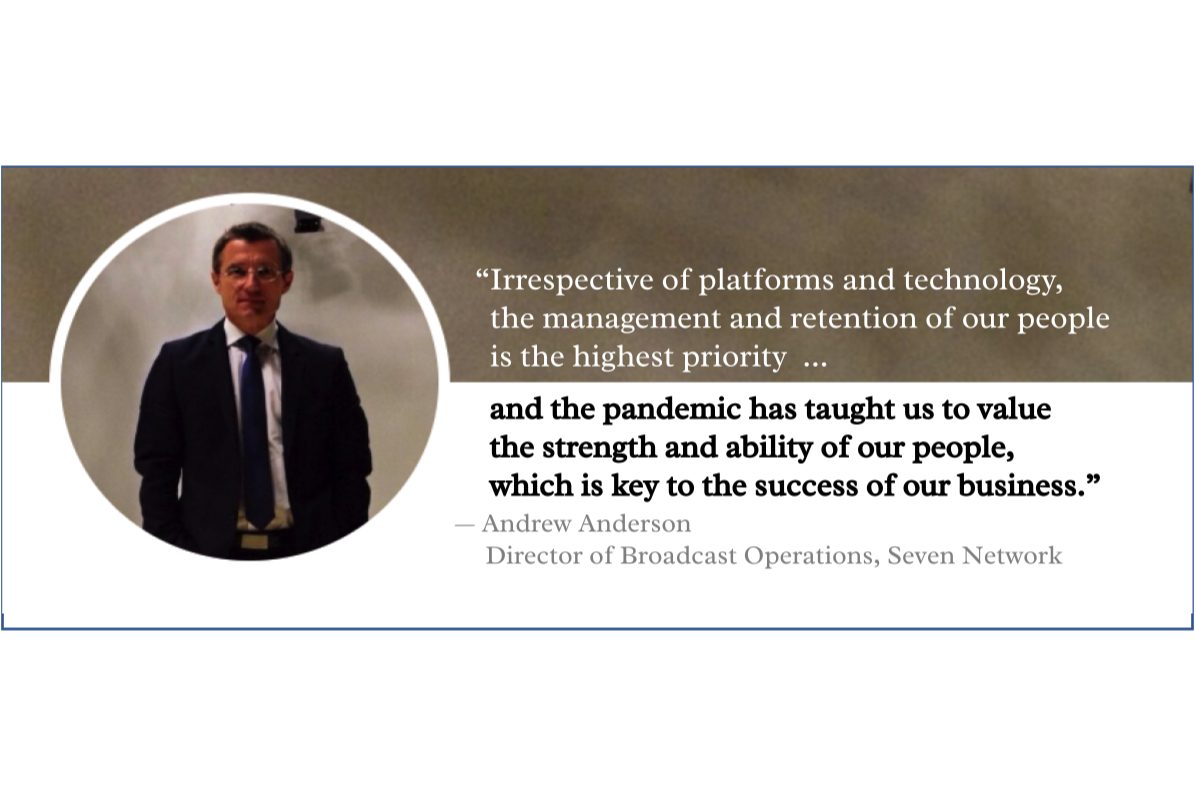
Anderson concluded, “Irrespective of platforms and technology, the management and retention of our people is the highest priority.

“Quite simply, we cannot operate without our people and the pandemic has taught us to value the strength and ability of our people, which is key to the success of our business.”

Join The Community

Join The Community

Strength & ability of staff + agility & flexibility key attributes to succeed and thrive in 2023 and beyond

Add Your Heading Text Here

BY SHAUN LIM

Whisper it softly but the Covid-19 pandemic may turn out to be transformational for many organisations around the world. Beyond the disruptions and uncertainties, the pandemic compelled organisations to reinvent the way they work by improving on work processes and overhauling previously entrenched ideas of working.

For Australian media company Seven West Media, the pandemic has reshaped the way the broadcaster operates, said Andrew Anderson, Director of Broadcast Operations, Seven Network.

Speaking to ABP+, he reflected, “Like many industries, TV broadcast is a combination of desktop-based staff, on-air presenters, floor crew, journalists, and operations staff who simply have to ‘come to work’.

“So, while adapting to a remote workforce, Seven also had to adapt the workplace to handle protocols and procedures to protect people against infection and to allow them to continue to work effectively.

“In addition, many new production techniques were introduced that allowed a hybrid of remote operations that were unheard of or simply rejected as ideas before the pandemic. The obvious example is the continued and heavy use of FaceTime, Teams, and other digital interview platforms.

“Remote commentary from IP hubs has also become a continued feature of Seven’s operations.”

Owned by Seven West Media, Seven Network is one of Australia’s three metropolitan commercial free-to-air (FTA) TV networks, operating channels including 7, 7TWO, 7Mate, 7Flix and Racing.com.

Late last year, Seven West Media completed the acquisition of Prime, an Australian TV network with commercial FTA TV broadcasting licences covering regional northern and southern New South Wales, the Australian Capital Territory, regional Victoria, the Gold Coast area of Queensland and all of regional Western Australia.

The acquisition was then described by Seven West Media’s CEO James Warbuton as a “real game-changer” for both companies and the Australian media sector, a point Anderson was keen to echo.

“The acquisition of Prime has allowed Seven to become the largest commercial broadcaster in Australia, reaching over 90% of the population,” he said. “This one transaction has created a scale that enables aggregating the biggest audiences and offering our advertisers the chance to sell to large numbers of eyeballs at a pace that cannot be achieved on any other platform.”

With Seven West Media now offering content on multiple platforms to so many viewers in Australia, Anderson also revealed that vigilance against potential cyberattacks will be a priority for Seven in 2023 and beyond, particularly after what befell Nine Network.

Last March, the largest cyberattack on a media company in Australia’s history brought Nine Network’s news production systems to a standstill for more than 24 hours, causing several shows to go completely off-air.

“The cyberattack on Nine was a terrible situation and one that no broadcaster, or any industry, should face,” Anderson lamented. “Seven has continued to strengthen its already robust systems. Our protocols, systems, training and redundancy plans are continuously monitored, reviewed and updated as and when appropriate.”

Seven gears up for 2023 and beyond

In the various positions he has held at Seven Network through his 42-year career, Anderson has been a stalwart of the traditional broadcast and media industry, upholding its relevancy in the face of increased competition.

While linear TV is not going away any time soon, it is arguably a case of the unstoppable force meeting the immovable object when it comes to pitting linear TV against video-on-demand (VoD) services such as Netflix and Disney+, as well as short-form content platforms such as TikTok.

To exacerbate the challenge facing traditional broadcasters in the battle for eyeballs, sports is shaping to be a game-changer.

In Singapore, for example, Singapore pay-TV operator StarHub marked its first exclusive broadcast rights to the English Premier League (EPL) win in 12 years by allowing football fans in Singapore to stream matches live on the StarHub TV+ over-the-top (OTT) service.

This deviates from what has traditionally been offered in Singapore, where fans had to pay substantial subscription fees to access EPL matches via a traditional pay-TV package.

StarHub’s move is a clear indication that the game has changed, as Anderson described, “No rights package is complete today without the ability to stream live sports and broadcast. The monetisation on both platforms not only creates extra revenue but again enables an advertising pace to be created and available on a single platform.”

Looking ahead to 2023, he expects agility and flexibility to be key words for the broadcast and media industry.

“Events in 2022 have put pressure on our operations and our people.  The challenges for 2023 will be no different, other than to approach every operation with agility and the ability to flexibly change how we operate either as events unfold, or technology pushes us further into automated and cloud-based systems and operations.”

One technology upgrade that Seven has already implemented sees employees now having the option to use embedded captioning to search extended video archives, after the broadcaster signed a five-year contract renewal with Ai-Media, a provider of technology-driven captioning, transcription and translation services.

Implemented across Seven, the SubSilo solution uses Ai-Media’s captioning to power automated search across Seven’s extensive media archive.

Anderson elaborated, “We have partnered with Ai-Media since 2016 and have ensured that our captioning is the best possible quality for all of our viewers who rely on this important service. Our focus is on tight integration between our systems, Ai-Media and our playout operations.

“This renewal further enhances the ability to deploy accurate automated captions across more content, as well as improved media search for Seven’s internal teams.”

Clearly, while technology will continue to serve as a key enabler for Seven to reach out to audiences in Australia and beyond, the pandemic has also served up a reminder of why organisations need to prioritise their people if they are to achieve long-term success.

Anderson concluded, “Irrespective of platforms and technology, the management and retention of our people is the highest priority.

“Quite simply, we cannot operate without our people and the pandemic has taught us to value the strength and ability of our people, which is key to the success of our business.”

Join The Community

Stay Connected

Facebook

101K

Twitter

3.9K

Instagram

1.7K

LinkedIn

19.9K

YouTube

0.2K

Subscribe to the latest news now!


    Scroll to Top