
‘Super trends’ Broadcast to go beyond the second screen paybacks and embrace a third-dimensional interface? - APB+ News

APB+ News

APB AWARDS - NOMINATE NOW!

[master-leader-web]
[master-leader-mob]

‘Super trends’ Broadcast to go beyond the second screen paybacks and embrace a third-dimensional interface?

Add Your Heading Text Here

BY SHAUN LIM 

As the world continues to gradually recover from the prolonged COVID-19 pandemic, the broadcast and media industry, like many other industries, is looking to successfully transition into a post-pandemic future.

Keeping track of emerging technologies will be a priority, although a more focused approach is likely to be required. As Stan Moote, Chief Technology Officer (CTO) of IABM, pointed out, “One of the constantly moving challenges in our industry is not only keeping up with all the new technology trends, but also having a deep enough dive to understand what is truly relevant and not simply just a ‘fad’.”

Earlier this year, IABM released its updated Technology and Trends Roadmap, which addressed the fundamental technology and business questions facing stakeholders in the broadcast and media industry. These included an in-depth analysis into topics such as remote production, distributed infrastructure, cloud, and analytics, and identification of ‘super trends’ that are likely to reshape the consumer experience.

A new consumer experience paradigm

Smart media devices pioneered the Internet-of-Things (IoT) when devices like smart TVs were produced. Today, ‘smart speakers’, enabled by Amazon, Google and Apple technologies, have matured and evolved as a centralised point of co-ordination, control and consolidation of increasingly large numbers of diverse consumer IoT home automation devices.

This, Moote told APB+, is creating a significant paradigm for aggregation, control, and monetisation of consumer experience. He urged broadcasters to keep ahead of this by creating new and innovative monetisation models.

He explained, “Churn is one of the largest issues subscription services fear, and the same goes for viewership with advertising-based programming. Looking ahead, the metaverse coupled with IoT will change the consumer experience by giving the consumer more control.”

Describing the metaverse as a third-dimensional interface, as opposed to two-dimensional tablets, smartphones and laptops, Moote highlighted how augmented reality (AR) and virtual reality (VR) have taken the industry beyond what is seen as the second screen paybacks – or when events use mobile devices as a second screen to sell products – on a monetisation level.

“Tie this together with blockchain, artificial intelligence (AI)/machine learning (ML) and IoT, and broadcasters can lock in a wider viewership audience as new monetisation models can be created for those with shorter attention spans.”

These tools are also assisting with cybersecurity, which should be considered at all stages of product development, deployment and operation, and be a concern for everyone in the industry, Moote emphasised. 

As he also attested to, audiences today have increasingly short attention spans, which is leading to the rise of super short-form content that is multi-faceted. This can mean frivolous content that gives people joy by having a break from their day-to-day lives; beyond this, it is all about consistent messaging that ties into branding and programming.

Moote highlighted, “Looking back more than a decade ago, research showed that good programming drove Tweets, and contrariwise, lots of Tweets about a programme drove viewership. The use of social media needs to be always considered when delving into a broadcaster’s options.”

Drawing on the example of how the movie industry has for years used trailers to get viewers excited about a soon-to-be-released film, he urged broadcasters to use social media to identify the feeds that viewers care about, and link them directly to the appropriate content source or distribution app/feed.

Bridging the divide between understanding and accepting new technologies

With the sheer amount of content options available to viewers today, the challenge of attracting eyeballs has arguably never been steeper. 

Beyond sports, news, and some very strong live entertainment programmes, many linear services are repeatedly struggling to attract a full demographic range of viewers, Moote acknowledged.

Attributing this to the ‘great divide’ between understanding and accepting new technology, he said, “Bridging this gap appears to be both geographically and organisation dependent. Many organisations still have silos, meaning one group looks after linear, another looks after digital. Our business is media and having walls between these groups only fosters duplication of effort and lack of targeting to a more blended audience.”

While linear groups and digital groups typically require different technologies, the differences are “quite minor” beyond distribution, said Moote, before adding, “I am certainly not suggesting moving everything suddenly into the cloud to force the groups to work together. It really comes down to blending into a single group on both the business and technical sides.”

While linear has traditionally been more conservative to embrace new technology due to the expense of changing out hardware within a facility, the over-the-top (OTT) side of the business has tended to stream out linear feeds without taking advantage of targeted options. 

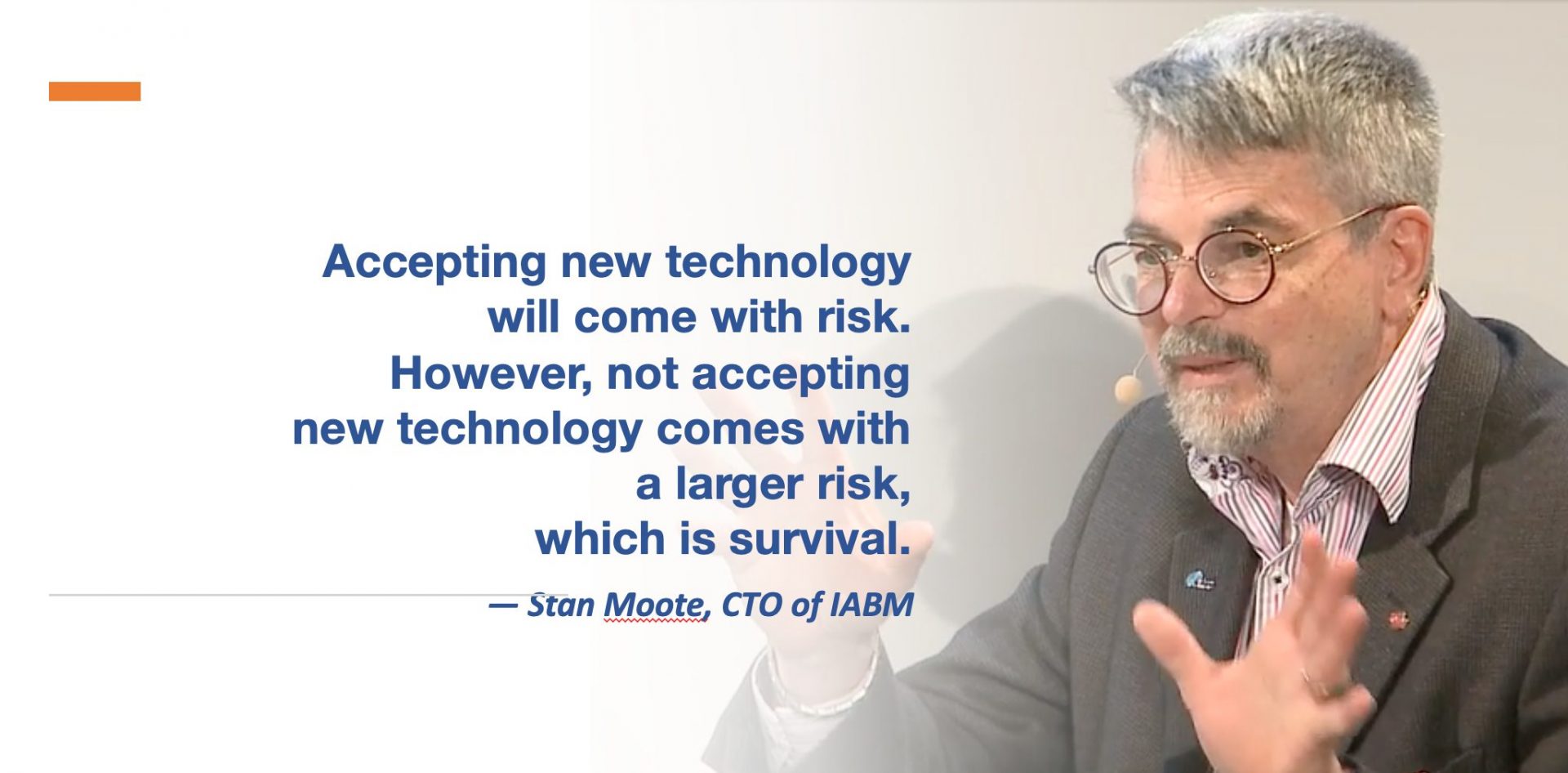
Reiterating the need for more inter-organisational collaboration and a change in mindsets, Moote cautioned, “Accepting new technology will come with risk. However, not accepting new technology comes with a larger risk, which is survival.” 

Where production is concerned, newer technologies are being deployed to produce and publish compelling programmes that offer viewer interactivity. “It’s about embracing newer, advanced production technologies, stimulating new workflows, as well as generating new ideas to make productions that can be tailored to work across all platforms,” he added.

When it comes to new ideas and technologies, Moote was also keen to point out the implications that a new, albeit controversial, social phenomenon might soon be invading the entertainment world.

“Non-fungible tokens (NFTs) can give content creators new ways to interact with their audiences, raise money, create new distribution windows, and turn all of it into a proof of concept to sell their movies and TV shows.”

He cited the example of IABM member Eluvio, who worked with FOX to put together the MaskVerse online community – built on NFT and art collections - for fans of The Masked Singer.

Fans can also potentially collect NFTs from series characters of a scripted animation series, Moote suggested. “Buying these gives them a stake in how the storyline evolves and also provides a constant source of funding for the project.”

However, he is quick to highlight that many people still do not know the specifics of NFTs and how they work, and only time will tell if they turn out to be a fad, or will help to tie together the demographic divide in the future.

Meet IABM at NAB Show 2022

To find out more about Eluvio’s NFT work with FOX, join the fireside chat that the blockchain media startup will be having with IABM at the latter’s BaM! Live session at the NAB Show 2022 on April 25.BaM! Live is part of the IABM BaM Zone at the NAB Show 2022, which will feature new product/service introductions, presentations, and streaming of live content throughout the show, which is taking place at the Las Vegas Convention Centre from April 24-27.

Join The Community

Join The Community

‘Super trends’ Broadcast to go beyond the second screen paybacks and embrace a third-dimensional interface?

Add Your Heading Text Here

BY SHAUN LIM 

As the world continues to gradually recover from the prolonged COVID-19 pandemic, the broadcast and media industry, like many other industries, is looking to successfully transition into a post-pandemic future.

Keeping track of emerging technologies will be a priority, although a more focused approach is likely to be required. As Stan Moote, Chief Technology Officer (CTO) of IABM, pointed out, “One of the constantly moving challenges in our industry is not only keeping up with all the new technology trends, but also having a deep enough dive to understand what is truly relevant and not simply just a ‘fad’.”

Earlier this year, IABM released its updated Technology and Trends Roadmap, which addressed the fundamental technology and business questions facing stakeholders in the broadcast and media industry. These included an in-depth analysis into topics such as remote production, distributed infrastructure, cloud, and analytics, and identification of ‘super trends’ that are likely to reshape the consumer experience.

A new consumer experience paradigm

Smart media devices pioneered the Internet-of-Things (IoT) when devices like smart TVs were produced. Today, ‘smart speakers’, enabled by Amazon, Google and Apple technologies, have matured and evolved as a centralised point of co-ordination, control and consolidation of increasingly large numbers of diverse consumer IoT home automation devices.

This, Moote told APB+, is creating a significant paradigm for aggregation, control, and monetisation of consumer experience. He urged broadcasters to keep ahead of this by creating new and innovative monetisation models.

He explained, “Churn is one of the largest issues subscription services fear, and the same goes for viewership with advertising-based programming. Looking ahead, the metaverse coupled with IoT will change the consumer experience by giving the consumer more control.”

Describing the metaverse as a third-dimensional interface, as opposed to two-dimensional tablets, smartphones and laptops, Moote highlighted how augmented reality (AR) and virtual reality (VR) have taken the industry beyond what is seen as the second screen paybacks – or when events use mobile devices as a second screen to sell products – on a monetisation level.

“Tie this together with blockchain, artificial intelligence (AI)/machine learning (ML) and IoT, and broadcasters can lock in a wider viewership audience as new monetisation models can be created for those with shorter attention spans.”

These tools are also assisting with cybersecurity, which should be considered at all stages of product development, deployment and operation, and be a concern for everyone in the industry, Moote emphasised. 

As he also attested to, audiences today have increasingly short attention spans, which is leading to the rise of super short-form content that is multi-faceted. This can mean frivolous content that gives people joy by having a break from their day-to-day lives; beyond this, it is all about consistent messaging that ties into branding and programming.

Moote highlighted, “Looking back more than a decade ago, research showed that good programming drove Tweets, and contrariwise, lots of Tweets about a programme drove viewership. The use of social media needs to be always considered when delving into a broadcaster’s options.”

Drawing on the example of how the movie industry has for years used trailers to get viewers excited about a soon-to-be-released film, he urged broadcasters to use social media to identify the feeds that viewers care about, and link them directly to the appropriate content source or distribution app/feed.

Bridging the divide between understanding and accepting new technologies

With the sheer amount of content options available to viewers today, the challenge of attracting eyeballs has arguably never been steeper. 

Beyond sports, news, and some very strong live entertainment programmes, many linear services are repeatedly struggling to attract a full demographic range of viewers, Moote acknowledged.

Attributing this to the ‘great divide’ between understanding and accepting new technology, he said, “Bridging this gap appears to be both geographically and organisation dependent. Many organisations still have silos, meaning one group looks after linear, another looks after digital. Our business is media and having walls between these groups only fosters duplication of effort and lack of targeting to a more blended audience.”

While linear groups and digital groups typically require different technologies, the differences are “quite minor” beyond distribution, said Moote, before adding, “I am certainly not suggesting moving everything suddenly into the cloud to force the groups to work together. It really comes down to blending into a single group on both the business and technical sides.”

While linear has traditionally been more conservative to embrace new technology due to the expense of changing out hardware within a facility, the over-the-top (OTT) side of the business has tended to stream out linear feeds without taking advantage of targeted options. 

Reiterating the need for more inter-organisational collaboration and a change in mindsets, Moote cautioned, “Accepting new technology will come with risk. However, not accepting new technology comes with a larger risk, which is survival.” 

Where production is concerned, newer technologies are being deployed to produce and publish compelling programmes that offer viewer interactivity. “It’s about embracing newer, advanced production technologies, stimulating new workflows, as well as generating new ideas to make productions that can be tailored to work across all platforms,” he added.

When it comes to new ideas and technologies, Moote was also keen to point out the implications that a new, albeit controversial, social phenomenon might soon be invading the entertainment world.

“Non-fungible tokens (NFTs) can give content creators new ways to interact with their audiences, raise money, create new distribution windows, and turn all of it into a proof of concept to sell their movies and TV shows.”

He cited the example of IABM member Eluvio, who worked with FOX to put together the MaskVerse online community – built on NFT and art collections - for fans of The Masked Singer.

Fans can also potentially collect NFTs from series characters of a scripted animation series, Moote suggested. “Buying these gives them a stake in how the storyline evolves and also provides a constant source of funding for the project.”

However, he is quick to highlight that many people still do not know the specifics of NFTs and how they work, and only time will tell if they turn out to be a fad, or will help to tie together the demographic divide in the future.

Meet IABM at NAB Show 2022

To find out more about Eluvio’s NFT work with FOX, join the fireside chat that the blockchain media startup will be having with IABM at the latter’s BaM! Live session at the NAB Show 2022 on April 25.BaM! Live is part of the IABM BaM Zone at the NAB Show 2022, which will feature new product/service introductions, presentations, and streaming of live content throughout the show, which is taking place at the Las Vegas Convention Centre from April 24-27.

Join The Community

Stay Connected

Facebook

101K

Twitter

3.9K

Instagram

1.7K

LinkedIn

19.9K

YouTube

0.2K

Subscribe to the latest news now!


    Scroll to Top