


By Shaun Lim
“AI and machine learning are tearing down the old boundaries of broadcast and media, unleashing a new age of intelligent storytelling, limitless creativity, and audience experiences once thought impossible.”
While ChatGPT may have been encouraged to provide a rather grandiose outlook on how artificial intelligence (AI) is revolutionising the broadcast and media industry, the above statement is not without basis.
From streamlining post-production workflows, powering real-time content recommendations, and enabling innovations like virtual news anchors and automated highlights, AI is becoming increasingly ubiquitous in its deployment across the broadcast and media landscape.
Peter Docherty, CTO & Co-Founder, ThinkAnalytics, told APB+, “The adoption of AI for personalisation, content discovery, and targeted advertising, as well as optimising editorial workflows, is continuing apace as content owners, broadcasters and streaming providers look to increase engagement with viewers and monetise their investments in content and rights.”
A global leader in AI and data-driven solutions driving content delivery, viewer insights, and targeted advertising strategies, ThinkAnalytics’ AI portfolio was further boosted with the addition of ThinkMediaAI in February 2025, which offered solutions across advertising, content understanding, AI-driven free ad-supported streaming television (FAST) channels scheduling and connected TV (CTV).
Building on over 20 years of expertise in data driven and algorithmic innovation and insights from the real-time behaviour of 500 million viewers in 47 languages around the world, ThinkMediaAI provides tools for users to understand content, enhance monetisation opportunities and optimise workflows using state-of-the-art Natural Language Processing (NLP), AI, and generative AI technologies.
Docherty added, “This holistic platform tackles video providers’ critical challenges from discovery and personalised recommendations to search, voice, editorial and automated curation, A/B testing, actionable business insights, advertising and metadata enrichment.
“It drives ROI with increased viewer engagement, productivity gains, reduced churn, upsell and monetisation opportunities.”
With the competition to attract and retain eyeballs being fiercer than ever, broadcasters such as Astro, Tata Play, Mediacorp, and BritBox are leveraging ThinkMediaAI to deliver a personalised viewing experience with recommendations.
“Our broad customer base gives us an unrivalled understanding about how 500 million viewers find and consume content, across family viewing on shared devices and personal handheld devices,” Docherty explained.
“Importantly, the solution operates in real time to engage the viewer from his or her first interaction because once a viewer churns, it’s too late to get the viewer back.”
Customers using ThinkAnalytics’ content delivery solution have seen a significant uptick in engagement, longer viewing hours, and a reduction in dormant users, who are returning more frequently to content platforms.
Using A/B testing, customers have also achieved gains such as 100% increase in video-on-demand (VoD) and a 35% increase in time spent watching content, thus reducing churn and driving higher value from audiences.
While there may be understandable concern over AI’s impact on human jobs, the use of AI and job security need not be mutually exclusive.
It is about finding the optimal balance, as Docherty described, “The unique combination of AI and human expertise working together can deliver significant benefits across many different business areas.
“These include personalising editorial selections where the editors can select the list of titles that they want to promote, and the personalised algorithms make sure the best of these titles is at the start of the list for each individual viewer.”
Algorithms can also help editors select content for editorial campaigns or produce an initial editorial campaign list for editors to make the final selection.
For those looking to quickly jump on the FAST bandwagon, AI can be used to create FAST channels automatically but still give the human curation team the ability to enter the business rules that they want to be applied, and/or alter the schedule before it is pushed into production, Docherty said.
As to how bias in recommendation engines can be reduced, he replied, “Our customers know it is a priority to monetise all their investments in content, however niche it might be, but also balance marketing and commercial promotions with consumer-friendly recommendations, as well as ensuring a wider variety of the catalogue is being watched.
“ThinkAnalytics’ content discovery platform enables that balance to be achieved through multiple user experiences, carousels/rails that deliver different types of content to the viewer for example, encouraging binge viewing versus exposing the viewer to titles that they have never watched before.
“There is no single best way of presenting content to viewers and the key is having a variety of techniques which can help deliver the best experience to the viewer while also meeting the commercial and business objectives of the operator.”
Looking ahead, Docherty also predicts generative AI playing an increasingly key role in the content personalisation space.
This includes offering additional dimensions to personalisation such as natural language conversational voice/chatbots and other solutions that combine generative AI, personalised recommendations, enriched content metadata and natural language interaction.
Through solutions such as ThinkMediaAI, broadcasters can personalise the viewer experience from initial content delivery through customer retention and churn prevention.
Docherty elaborated, “Using generative AI, combined with content metadata and ThinkAnalytics’ ontology of over 40,000 content DNA elements, ThinkMediaAI adds additional personalised explanations or summaries that can be used as part of the user experience — for example, explaining why you might like a movie because it features one of your favourite actors, or it contains moods, themes, and subjects that match other content you have already watched.”
AI a key focus of Avid innovation to transform media workflows
For Avid, AI has long been a cornerstone of its innovation strategy, as the company continues to reimagine media workflows for a global industry in transformation. Rather than focusing solely on AI-generated content, Avid is leveraging AI to enhance efficiency, streamline processes, and unlock new creative potential within existing production environments.
Shailendra Mathur, Vice-President of Architecture & Technology, Avid, told APB+, “Media companies are increasingly prioritising business efficiency over AI-generated content. AI is providing creative assistance to speed up the creative flow and enable tasks that were previously impossible.
“Instead of creating separate processes, AI is being incorporated within existing workflows.”
Over the past few years, Avid has focused on automating the most time-consuming and high-cost media creation manual processes based on a study of workflows. The AI-based solutions provided, Shailendra identified, include text-based editing, multi-lingual dialogue-based search with highly scalable collaborative architecture, automated captioning, and metadata enrichment.
He added, “Avid is focused on tools that provide creative assistance with a human in the loop and with creative control, following responsible AI tenets that respect various compliance laws, regulations, and ethics. The implementation is done through a common shared technology framework called Avid Ada, which is exposed to users in products using persona-based design.
“Additionally, Avid is opening up new APIs to integrate unique third-party offerings that augment the workflows. Working in collaboration with third parties brings AI innovations to our customers at a much more rapid pace.
“The goal is to operate the AI processes close to the data and application for practical reasons, but where it makes sense, make secure calls to external services if that technology is not available to run close to the data.”
Having been involved in AI for a decade, Avid has witnessed the possibilities offered by AI, as well as experienced the challenges in bringing AI into established newsroom and editorial workflows.
The latter include change management within enterprises to adopt and trust new technology. For instance, executing AI processes at scale on desktops and on-premise servers is much harder than in the cloud. People need to be convinced that this is necessary when lots of content needs to be processed on premises or enterprise policy prevents content from being sent.
Other challenges include providing creative control to users in the face of black box operations of machine learning models, and addressing customer-specific customisation needs to suit linguistic and cultural contexts.
While these challenges remain to be solved, Avid’s AI tools have also allowed broadcasters to go on-air faster and more efficiently.
For instance, Wolftech News allows a single operator, in a few minutes, to create news stories in multiple languages. Previously, before assisted story writing tools were available in Wolftech News, it could take 30 minutes to hours for multiple translators to read a full story for breaking news, rewrite it in a new language, summarise, QC, and get sign-off.
Shailendra also highlighted how some unscripted productions have an extreme shoot ratio, including an Avid customer, who claimed a 2000:1 shoot ratio.
He suggested, “It is practically impossible to log, sift, and search that amount of content using traditional metadata logging techniques. For that extreme shoot ratio, it would take approximately one person a year to log that footage, or 67 people one week, for it to be searchable.
“With metadata enrichment and semantic search, that indexing can be performed within a week – basically fitting the timeframe over which camera feeds are acquired and ingested for one particular show.”
Having referenced Avid’s human-in-the-top approach to AI previously, Shailendra was quick to reiterate how this is tied in with responsible AI practices that govern the development of Avid solutions.
“All results of AI assistance are provided back to our creative users in our tools to modify, correct, and own,” he declared. “This philosophy is understandable when considering the fundamental nature of new Deep Learning and Generative AI technologies to be probabilistic in nature.
“This is unlike traditional AI that was based on deterministic rules and pattern matching. Hence, human oversight for QC and creative control is needed when the answers obtained from are not guaranteed to be the same and deterministic.”
Upcoming tools in Wolftech News allow journalists to check facts before publishing and to prove the authenticity and trust in the received content by checking C2P2 credentials.
“In Avid’s editing tools, capability provided from third-party partners enable users to insert invisible watermarks to prove provenance and detect any downstream manipulation.”
As AI becomes more embedded in the news production process, these safeguards serve to uphold one of journalism’s most important pillars: TRUST.
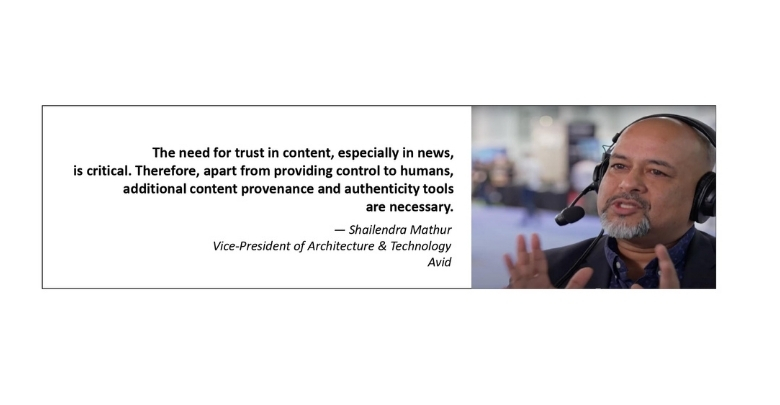
“The need for trust in the content, especially in news, is critical. Therefore, apart from providing control to humans, additional content provenance and authenticity tools are necessary,” Shailendra concluded.