


The Asia-Pacific Institute for Broadcasting Development (AIBD) and its members, partners and collaborators in the Asia-Pacific region (APAC) were urged to ‘walk the talk’ in their digital transformation by having a strategic ambition of leading the future of television and other media to enable economic recovery and sustainable development. It is time to act responsibly, ethically and sustainably to serve our broadcast and media audiences, engaging with them without leaving anyone out using relevant technologies such as Artificial Intelligence (AI).
This year’s Asia Media Summit (AMS2023) was held from May 21 - 24 in Bali, Indonesia, and brought together innovators and thought leaders to share insights on the trends and developments taking place in the fast-paced TV industry.
The International Telecommunication Union (ITU) urged regulators and policy-makers to understand the fast-moving digital landscape and shape regulatory change in the quest for sustainable digital transformation for all. ITU says almost a third of humanity still remains unconnected, which is a gentle reminder of the work that lies ahead of us, especially for countries requiring universal connectivity.
Currently, broadcasting services are universal. However, rapid technological advancements and the presence of larger platforms and media providers have been posing a wide range of threats to traditional broadcasting.
AMS2023 of AIBD discussed the future of TV and other media, and the challenges of adopting streaming services. The inability of one-third of humanity to access content may lead to an information divide, including education and entertainment.
Some points arising from the deep discussions to understand the challenges confronting broadcasters when embarking on streaming services included views from various speakers on opportunities and threats that AI presents, the need for green technologies for sustainability and technologies supporting accessibility services.
The broadcast and media (B&M) industry has been talking about cord-cutting for some time now and it has reached record levels as more TV viewers have decided that the more affordable on-demand streaming video is what they want. Various personalities have been warning of the death of ‘traditional TV’ for years. A two-day, pre-summit workshop with the theme, Future of TV, concluded that content distribution will be over a mixture of multiple platforms. As APAC is highly diverse, those proportions will depend on each country, audience, and infrastructure availability.
Twitter Spaces is a feature that allows Twitter users to have live audio conversations on the platform. Users can host these conversations in an audio chat room called a “Space” and invite other users to participate.
The recent Twitter event to launch the presidential campaign for Florida Governor Ron DeSantis proved that when it comes to live, nothing beats broadcast. Minutes into the Twitter Spaces with DeSantis, the site was reportedly breaking down due to technical glitches while more than 600,000 people tuned in. Then users were dropping off, including DeSantis himself. This was just audio. What would have happened if the event had included video?
Thus, traditional TV is not dead yet. As confirmed during AMS2023, AIBD members are already on multiple platforms that can be accessed anytime, anywhere and on any device.
Traditional broadcasters are required by regulation to provide a dependable signal to viewers. Broadcasters, in particular, have a crucial responsibility to their communities to keep citizens informed, especially in times of emergencies.
Combined with the recent YouTube TV failure, which caused many basketball fans to miss the final moments of the Celtics-Heat National Basketball Association (NBA) playoff game and the recent Twitter disaster are just the latest reminders that, when you are planning for major events, nothing beats traditional TV.
The digital revolution has the potential to transform our economic and social model far more intensely than any previous technological revolution. One of the differentiating aspects of this transformation is the adoption of a new paradigm based on decarbonisation, sustainability and the circular economy.
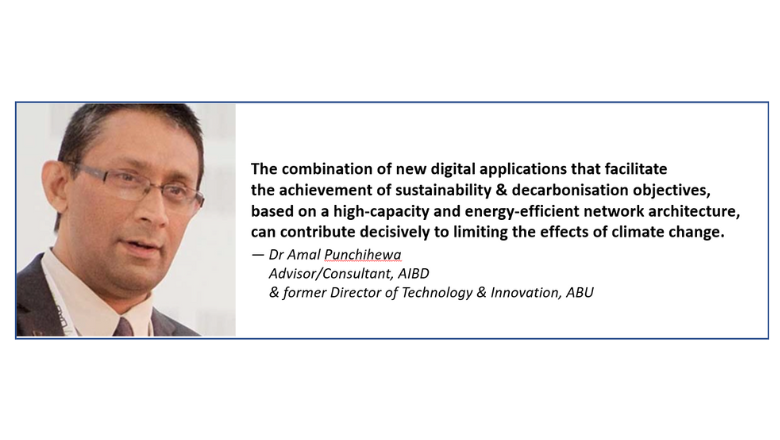
Digital and green transitions go hand-in-hand. Digitalisation is a key enabler for the B&M sector on its way to a green transition. They have a key role to play in keeping emissions reflected in climate targets. The combination of new digital applications that facilitate the achievement of sustainability and decarbonisation objectives, based on a high-capacity and energy-efficient network architecture, can contribute decisively to limiting the effects of climate change.
The digitalisation process requires reliable, resilient and efficient broadcast and media networks. During the last decade, the traffic in online media networks has increased exponentially, which may have resulted in both increased energy consumption and carbon emissions derived from the use of online distribution networks. Hence, it is imperative to deploy more efficient technologies and the use of renewable energies.
Digitalisation is also essential to make the most of the scarce resources we have. It is necessary to accelerate the dual digital and ecological transition to move towards an energy-efficient transmission.
The B&M sector must take firm steps in this direction. I believe that moving towards greater efficiency through an energy transition that promotes the use of clean energies, and the implementation of a circular and sustainable economy that allows better use of resources, should not be seen as a risk but as an opportunity for digitalisation to curb climate change.
According to S&P Global Market Intelligence, streaming media companies struggle to produce profits, and private equity investments in the sector have also slumped, with private equity and venture capital firms investing only US$370 million into streaming media companies worldwide in 2022, down 73% from $1.38 billion of investments in 2021.
YouTube TV's streaming of the NBA match suffered buffering issues during NBA playoffs that outraged sports fans. YouTube TV's NBA glitches show that the platform may not be really ready as the most popular virtual multi-channel programme distributor in the US. Sports fans are concerned about the service’s ability to handle mega live sporting events.
US National Football League (NFL) games shown on Amazon Prime over the past two seasons have also suffered from quality issues. With the latest announcement that Peacock would broadcast the first-ever NFL playoff game next season, the pressure is on to resolve such issues before the Fall as viewership will skyrocket past the already massive regular season numbers.
CNN has launched a free ad-supported streaming TV (FAST) channel, CNN Fast, in Europe. Targeted at younger audiences, CNN Fast offers short-form, internationally focused CNN content delivered via three-to-six-minute clips.
CNN Fast short-form videos will feature international stories across major news events, business, entertainment, sports and the environment. CNN Fast was launched across several European countries on Rakuten TV and will be made available on LG Channels from the end of May 2023, followed by Samsung TV Plus in June. The channel’s mix of news and lifestyle content complements the existing ways that people can consume CNN content via online, linear (satellite and cable), audio and social media platforms.
Comcast in the US is also launching a new US streaming offering, NOW TV. According to Comcast, the service includes over 40 live channels from A+E, AMC, Hallmark and Warner Bros Discovery, plus around 20 integrated FAST channels from NBC, Sky and Xumo Play, with a subscription to Peacock Premium at no additional cost.
NOW TV is the first streaming offering in the market to combine a live TV streaming service, FAST channels, and a subscription video-on-demand (SVoD) service.
It is good to go fast but one must always be prudent to make haste slowly … and remember to walk the talk.
Dr Amal Punchihewa is an ITU expert and advisor/consultant to the Asia-Pacific Institute for Broadcasting Development (AIBD), and was formerly Director of Technology & Innovation at the Asia-Pacific Broadcasting Union (ABU).