


By Shaun Lim
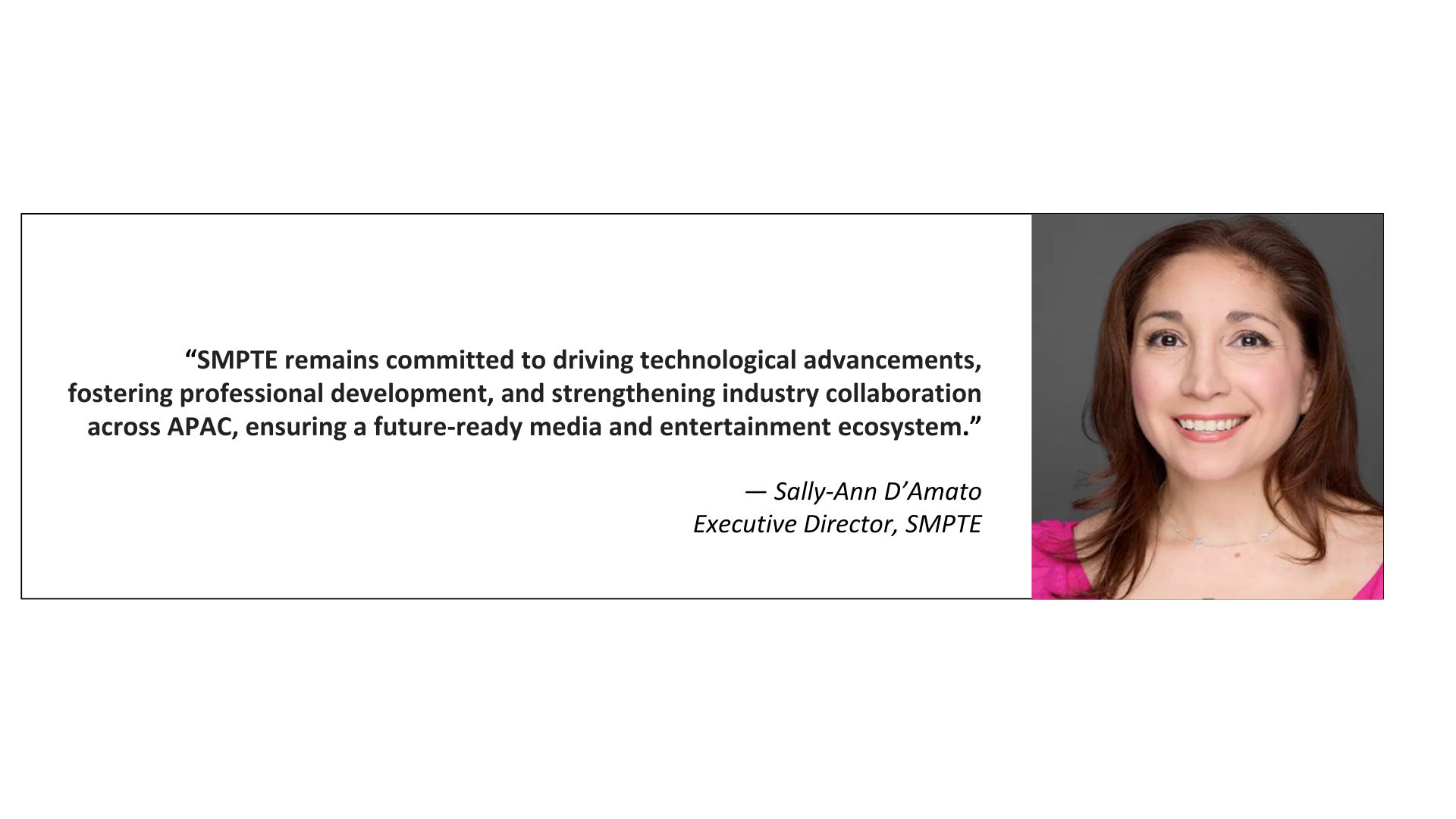
Joining the Society of Motion Picture & Television Engineers (SMPTE) in 2001 as an Administrative Assistant, Sally-Ann D’Amato rose through the ranks to be named as the organisation’s Executive Director in 2024.
Today, she plays a leading role in encouraging more collaboration and creating more opportunities for SMPTE members, strengthening the standards community, and reinforcing SMPTE’s infrastructure.
In this exclusive interview with APB+, Sally-Ann elaborates on what she hopes to achieve in her new role, why ST 2110 is the industry standard for IP-based video broadcasting, and how SMPTE is playing a key role in advancing technology and fostering industry collaboration in the Asia-Pacific region.
You have been with SMPTE for more than two decades. In your opinion, how has the media and entertainment industry evolved in this period?
Sally-Ann: Over my two decades at SMPTE, the media and entertainment industry has undergone a seismic shift, with SMPTE playing a crucial role in ensuring smooth transitions. Two of the most significant transformations we have driven are the shifts to digital cinema and high-definition television (HDTV).
When Hollywood moved from 35mm film to digital projection, SMPTE led the way by developing the Digital Cinema Package (DCP), replacing bulky film reels with secure, high-quality digital files. This ensured seamless compatibility between studios, theatres, and equipment manufacturers worldwide.
We also established 4K and 2K resolutions, frame rate standards, and SMPTE Digital Cinema (SMPTE DCP), creating a consistent digital cinema experience that revolutionised film-making and exhibition.
The transition from standard-definition (SD) to high-definition (HD) television was another milestone. SMPTE defined HD broadcast standards (1080i and 720p), developed the 1.5 Gbps Serial Digital Interface (SDI) for efficient HD signal transmission, and contributed to MPEG-2 and MPEG-4 compression, making HD broadcasting viable over limited bandwidth.
Our work on ATSC standards enabled the US switch from analogue to digital TV in 2009, and we established the 16:9 widescreen format as the global HDTV standard.
Today, SMPTE continues to drive innovation in Ultra HD (UHD), 4K/8K broadcasting, high dynamic range (HDR), wide colour gamut (WCG), and SMPTE 2110, which is transforming IP-based video broadcasting.
As we enter the era of artificial intelligence (AI), virtual production, and immersive media, SMPTE remains committed to pushing the boundaries of entertainment technology and shaping the future of the industry.
What are your personal goals for 2025, and what do you hope to achieve in your new role at SMPTE?
Sally-Ann: I feel fortunate to work alongside President Richard Welsh and our dedicated executive leadership team. Having witnessed SMPTE’s evolution through leadership changes, staff restructuring, global challenges, and technological advancements, I have come to appreciate Mark Twain’s words, “History doesn’t repeat itself, but it often rhymes.”
This perspective fuels my belief in SMPTE’s immense potential and my commitment to ensuring its continued success.
In 2025, my personal goal is to strengthen SMPTE’s sense of community and inclusivity while driving technological innovation and industry collaboration. Through the We Are One SMPTE campaign, we aim to foster a culture where every member — regardless of location, background, or expertise — feels valued and empowered. Although we are a global organisation with diverse interests, we are ONE Society, united in our mission to inspire technological advancement in art, science, and media everywhere, for everyone.
As Executive Director, my focus is on expanding engagement, amplifying member contributions, and ensuring SMPTE remains at the forefront of media technology.
Can you explain the significance of SMPTE 2110 and how it measures against competing standards as the transition to IP continues for many broadcasters?
Sally-Ann: Our Director of Standards Development, Thomas Bause Mason, explained that broadcasters sought to create IP-based, live, uncompressed TV studio production environments for greater flexibility and efficiency. Initially, they used ST 2022, which transmitted SDI over IP for facility-to-facility content contribution. However, its rigid structure — bundling video, audio, and data into a single stream — led to unnecessary bandwidth use.
To address this, ST 2110 was introduced, allowing video, audio, and data to be transmitted as separate IP streams, enabling independent routing and optimised bandwidth usage. For example, audio can be sent directly to processing equipment without video or data, and video feeds from studio cameras can be routed separately, reducing overall network load.
ST 2110 also delivers low-latency, uncompressed transmission, making it ideal for professional broadcasting. Unlike NDI, which relies on compression and introduces latency, ST 2110 ensures high-quality, real-time media workflows. While NDI is cloud-compatible, ST 2110 typically requires specialised setups for cloud implementation.
Ultimately, ST 2110 has become the industry standard, providing the scalability, efficiency, and flexibility needed for modern IP-based TV studio production.
In the APAC region, how is SMPTE working with other organisations or companies to advance technology and industry collaboration?
Sally-Ann: In the APAC region, SMPTE actively collaborates with organisations and companies to advance technology and foster industry collaboration through region-specific events, strategic partnerships, and the promotion of emerging standards. With three local Sections — Hong Kong, India, and Oceania — SMPTE provides networking, educational opportunities, and industry events tailored to the needs of professionals in each region.
The Oceania Section has long hosted an annual or biennial conference and expo, now known as METexpo, featuring three days of networking, exhibitions, and programming focused on the future of media, entertainment, and technology, with the next event taking place in July of this year. The section is also taking a leading role in training instructors to teach the SMPTE ST 2110 course, supporting the industry's transition to IP-based workflows.
Meanwhile, the India Section is undergoing significant expansion, with the introduction of reduced membership rates in local currency to engage more industry professionals and companies. It also works closely with Whistling Woods International, India's premier film, communication and creative arts institute, to offer programming and mentorship opportunities for students and young professionals. The Hong Kong Section continues to drive innovation by partnering with educational institutions and industry leaders. Recently, it participated in the opening ceremony of the Hong Kong Design Institute (HKDI) Virtual Production Studio at Shaw Studios. This initiative aims to establish Hong Kong’s largest virtual production training centre, equipping industry professionals with cutting-edge skills in emerging production technologies.
SMPTE is also at the forefront of adopting and promoting new industry standards across the APAC region. The increasing adoption of SMPTE ST 2110 is transforming the industry by enabling broadcasters to transmit uncompressed video, audio, and metadata over dedicated IP networks, significantly improving efficiency and flexibility. The Oceania Section has taken the lead in training instructors for ST 2110 courses, a model that SMPTE hopes to replicate throughout the broader region.
Through these initiatives, SMPTE remains committed to driving technological advancements, fostering professional development, and strengthening industry collaboration across APAC, ensuring a future-ready media and entertainment ecosystem.