


By Shirish Nadkarni
Green screens are passé. Or are they?
Elimination of the green backgrounds required for Chroma shooting is rapidly evolving from physical coloured screens to Artificial Intelligence (AI) powered subject segmentation and LED Virtual Production. These technologies allow creators to isolate subjects without specialised lighting or backgrounds, separating them from any environment.
Elimination of green screens for Chroma shooting is primarily achieved through LED Virtual Production (VP) stages and AI-driven background removal (roto/matte) software. Key industry leaders include Epic Games' Unreal Engine for real-time rendering, ILM StageCraft for LED volumes, and AI tools like RunwayML and DaVinci Resolve's Magic Mask.
In the recent past, the green screen would become the background for a person to walk into a bar, or into a packed athletic stadium, or a panoramic waterfall. But what happens when the imaginary planet is already there? The entire scenario undergoes a sea change.
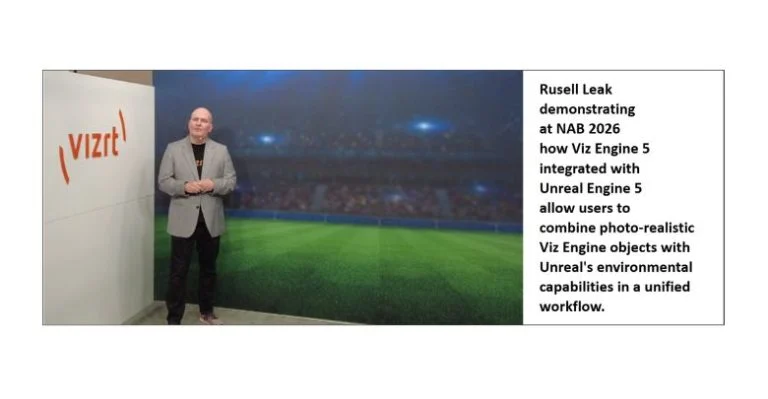
“You can see me waving in front of the background of a football match,” said Russell Leak, Senior Customer Success Manager for Vizrt (the company’s diminution of the phrase Visualisation in Real Time), which demonstrated the technology at the recently concluded NAB 2026 Show in Las Vegas.
“This is just to show you that, with Viz Engine 5, we can fly into the environment without any need for complex tracking or any canvases. You can see I am perfectly immersed without the need for any green screen.
“No extra hardware, no green screen — just the camera and the AI.
“The studio knows where I am walking around, and my exact position, so there are no ‘accidents’ of me walking through a table or a chair!”
Viz Engine 5 is a high-performance, real-time 3D graphics compositor and rendering engine designed for broadcast, virtual sets, and XR productions. It features deep integration with Unreal Engine 5, supports "Adaptive Graphics" for multi-platform publishing, and provides photo-realistic rendering capabilities for live media workflows.
“We used it to create a virtual studio at NAB,” added Leak, his reflection being seen clearly in the virtual floor of the studio output, as he walked around. “Viz Engine 5 integrates with Unreal Engine 5, allowing users to combine photo-realistic Viz Engine objects with Unreal's environmental capabilities in a unified workflow.
“Adaptive Graphics enables creating a graphic once and publishing it to multiple formats (e.g., social media, vertical mobile screens, traditional TV) automatically, ensuring that content fits the screen ratio.
“Apart from photo-realism and Extended Reality (XR), you get a streamlined workflow through improved import tools, such as the ability to import Adobe Photoshop files while retaining layer structures.”
There are several benefits in eliminating the green screen, one being natural lighting and reflections. Actors are lit by the environment itself (LEDs), eliminating spill light and improving realism.
“There is instant visualisation, with directors and talent being able to see the final scene on set, thus enhancing performances. There are substantially reduced post-production costs, since the technology eliminates the need for traditional roto-scoping and colour correction to fix green spill.
“Companies replacing green screens boast the latest technology, including LED Volume and Virtual Production, which employs high-resolution LED panels to display backgrounds behind actors in real time, providing natural lighting and reflections.
“Then there is ILM StageCraft, pioneer of the "Volume" technology used in ‘The Mandalorian’ – the live-action ‘Star Wars’ space Western – utilising Unreal Engine, which is the industry standard 3D engine driving real-time virtual production.
Other fresh innovations include PRG (Production Resource Group), which offers top-tier LED stages (e.g. Virtual Production Studio) that allow for in-camera visual effects (ICVFX); and Disguise, which specialises in high-performance hardware and software to manage LED screen visuals.
The other, equally important, aspect of having improved visual storytelling is using AI for background removal and matting. These tools utilise AI to identify subjects and remove backgrounds without needing a uniform green screen, allowing for shooting in real environments.
Companies that excel in the utilisation of AI to eliminate the irritants of green screen include:
- RunwayML, which offers robust AI tools, including Green Screen, for instant background separation in the browser.
- Blackmagic Design (DaVinci Resolve): The "Magic Mask" tool uses DaVinci Neural Engine to create instant mattes for roto-scoping.
- Adobe After Effects: Features AI-driven roto-scoping (Roto Brush 3.0) and keying tools.
- Boris FX (Continuum/Silhouette): Offers advanced matte tools like Primatte Keyer, which work effectively even with imperfect, non-green backgrounds.
- Netflix's Magenta Light Technique: A patented method using magenta-coloured LEDs to create high contrast for better AI-based separation.
With the rise of LED volumes and advances in tools such as Unreal Engine, virtual production is changing the way film and television shows are being produced.
The upside of this new tech is undeniable, the ability to swap out locations, control the sun and the weather, all in studio, capturing everything in camera has tremendous appeal for filmmakers, studios and actors.
But does this spell the end for green screen, the Chroma key technology that was invented in the 1930s?
In 1994, James Cameron was one of the first filmmakers to swap blue for green, when shooting the climax of his action film “True Lies”. The decision to move from blue screen to green screen had to do with the fact that Cameron wanted to shoot outside, rather than in studio, and green screens are easier to light than blue, and better suited to daylight situations.
Since the transition to digital cinema, green screens have become commonplace, so much so, that many blockbusters have been shot almost entirely against them. One of the greatest challenges of doing so, however, has been the inability to really know what the final product will look like, until months after the shoot has wrapped. All that changed with virtual production.
So why would any production use green screens today?
Probably the biggest reason — money. As fantastic as the above shows look, both in terms of the process of making a show in a volume, and the final look of each show, setups like these don't come cheap. In fact, some estimates suggest that the cost to set up a volume studio of a reasonable scale is somewhere between $20 million and $30 million.
For large, wealthy studios such as Netflix and Disney, this approach makes sense, especially if they can use it across back to back shows. Obviously as more and more volumes are built around the world, and the cost of technology comes down, production companies will have more opportunities to work with this new technology. But there does seem to be a large difference between volumes of this scale, and the smaller setups that are increasingly popping up, many of which don't allow for much movement in front of them.
Money, alone, is not the only reason that volumes may not always be the best solution, and that green screens are likely to be used for some time to come.
The second biggest hurdle to embracing virtual production is the increase in the amount of work required during pre-production. For films and shows financed through studios, this might not be that big an obstacle. However for independent producers, locking in finance months before a shoot, to allow for all of the extended pre-production and R&D required for virtual production, before the lead actor turns up on the set, might be significantly more challenging.
So is the green screen dead?
No, not yet. For shows and films that require large amounts of background replacements, virtual production will certainly become more commonplace, but for projects where only a handful of shots require vfx changes to backgrounds, green screen will, for now, remain the go-to choice.