
DAI comes alive: Dynamic advertising has come a long way but do not discount SSAI - APB+ News

APB+ News

APB AWARDS - NOMINATE NOW!

Test Advertisement

DAI comes alive: Dynamic advertising has come a long way but do not discount SSAI

Add Your Heading Text Here

By Shirish Nadkarni

In recent years, dynamic ad insertion (DAI) has become increasingly important for broadcasters and service providers in their constant efforts to reach, keep, grow and monetise their subscriber base. 

Today, there are multiple platforms and an abundance of devices and formats on which video is consumed. To stay profitable, service providers and broadcasters must meet the objectives of reaching, retaining and growing their subscriber base while increasing revenue and controlling costs.

“The task is to maximise revenue, enhance viewer engagement, and expand your audience with seamless, personalised ad experiences, delivered across all devices and content types,” said Nissim Dokey, Principal Product Manager for Streaming TV at Amagi.

“The goals of using DAI are to increase viewer engagement, boost your cost per mille, improve the ad experience, and increase overall ad revenue.

“It’s an alternative to client-side ad insertion (CSAI) that builds upon the successes of server-side ad insertion (SSAI).”

According to Dokey, Amagi’s advanced DAI solutions for linear TV can explain what dynamic ad insertion is, how it boosts revenue, and how to use DAI ad analytics to improve monetisation strategies.

“Our DAI capabilities for linear TV channel and video-on-demand (VoD) monetisation are superior to other solutions on the market,” Dokey said. “You can also use Amagi to handle content management; playout for linear TV, live TV, and VoD content; scheduling; and ad management – all in one unified location.

“Our DAI solution, Amagi THUNDERSTORM, boosts render/fill rates, reduces ad fatigue, provides detailed analytics, and incorporates cutting-edge DAI capabilities. We help our clients to deliver hyper-relevant ads that improve the viewer experience and boost ad revenue.”

Another notable video and streaming tech operator in the DAI space is Veset, which enables scalable linear TV channels to run dynamic ads without requiring heavy on-premise hardware. 

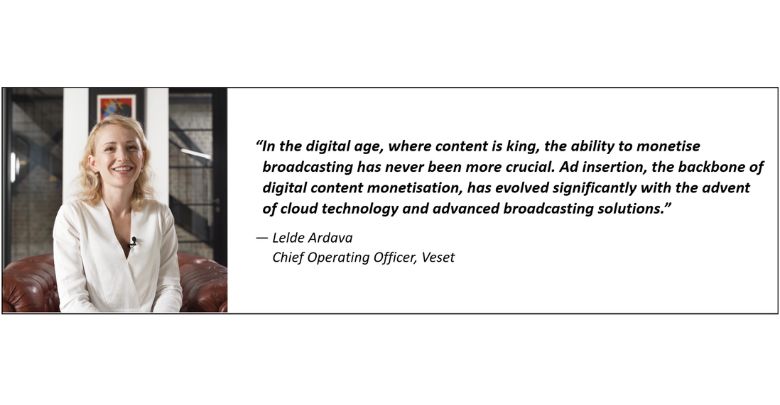
“In the digital age, where content is king, the ability to monetise broadcasting has never been more crucial,” said Lelde Ardava, Veset’s Chief Operating Officer. “Ad insertion, the backbone of digital content monetisation, has evolved significantly with the advent of cloud technology and advanced broadcasting solutions. 

“Veset’s Nimbus Cloud Playout Platform is designed to redefine how broadcasters and content creators approach ad insertion, particularly DAI, for both linear TV and live streaming.

“Nimbus offers a robust ad insertion platform that integrates seamlessly with linear and digital broadcasting workflows. By leveraging cloud-based technology, Nimbus provides a scalable, efficient, and highly flexible solution for DAI, making it possible to deliver targeted ads to the right audience at the right time, thereby enhancing viewer engagement and opening up new revenue streams for broadcasters.”

According to Ardava, the Nimbus platform stands out for its ability to automate and streamline the ad insertion process across various broadcasting formats. 

“Whether you're dealing with linear TV channels or navigating the complexities of live streaming, Nimbus ensures that your ads are not only inserted accurately, but also resonate with your target audience, thanks to its sophisticated targeting capabilities,” she said.

“Real-time insertion of ads into video streams makes it possible to serve personalised ads to viewers based on demographics, viewing habits, and other relevant criteria. This not only improves the viewer's experience by making ads more relevant, but also increases the effectiveness of ad campaigns, leading to higher engagement rates and increased revenue potential.”

Veset Nimbus offers a cloud-based ad insertion solution that is pivotal for broadcasters, service providers, technology partners, system integrators, and pop-up TV channels. With full Amazon Web Services (AWS) hosting, it provides operational flexibility and high-quality service delivery. 

“The platform supports DAI, enabling broadcasters to seamlessly integrate targeted ads for live and linear TV,” Ardava added. “By eliminating the need for long-term commitments or extensive infrastructure, Veset Nimbus ensures scalability and efficient content monetisation, making it an ideal solution for broadcasters of all sizes.”

Ably competing in a crowded DAI providers’ market is Broadpeak, which operates broadpeak.io, a Software-as-a-Service (SaaS) platform specialising in frame-accurate dynamic ad replacement, using SCTE-35 triggers for linear TV, catch-up, and VoD.

“The main benefits of targeted ad as-a-service are simplicity, server side ad insertion, and client-side ad tracking with SDKs available for any platform,” said Elodie Levrel, Marketing Director at Broadpeak.

“broadpeak.io is a scalable, agnostic solution that works with any third-party service. It has a local presence in 161 points of presences, and provides on-the-fly ad insertion and replacement, conformity, end-to-end ad tracking, fingerprinting and ad creative verification with video analysis.”

Yospace is another operator in the DAI space that claims to be a pioneer in taking ad insertion server-side, and has over a decade of in-production experience servicing the world's foremost broadcasters. 

“There is no better solution for broadcasters to monetise VoD and live content without sacrificing quality, reliability and transparency,” said Tim Sewell, CEO of Yospace. “The three most popular types of ad insertion used in modern streaming are CSAI, SSAI and Server-Guided Ad Insertion (SGAI).”

With CSAI, the video player is responsible for pausing the content, fetching an ad from an ad server, playing the ad, and then resuming the main video. SSAI shifts the ad insertion process to the server. Ads are stitched directly into the content before it reaches the user, creating a single continuous stream. 

“SGAI represents the next evolution in dynamic ad insertion,” said Sewell. “Built on HLS Interstitials and MPEG-DASH Events, it divides responsibilities between the server and the client to provide a more efficient ad insertion solution. With SGAI, the server identifies ad opportunities and sends signals to the client to fetch and play ads.”

SGAI offers benefits such as lower server load, enabling better monetisation of VoD and extended digital video recorder (DVR) windows, as well as a broader range of ad formats. Yospace’s SGAI has side-by-side ad formats and support for DAI during extended DVR windows, whereby ads viewed when a viewer scrolls back a live stream are replaced.

“This addresses a 12% live viewer segment that often goes unmonetised,” said Sewell. “Formats like L-shaped banners and in-screen ads are possible today with SSAI, but they require bespoke client-side development.

“Today, SGAI does not necessarily support these features ‘out of the box’, but in time, it will simplify implementation considerably.”

The Yospace solution is more than just an ‘ad stitcher’. Thanks to the insight the company has gained into the monetisation operations of broadcasters across the globe, its platform provides a comprehensive solution that not only delivers reliability at scale, but gives users the tools needed to maximise ad inventory.

“With integrated best-in-class ad measurement, you can rely on us to build trust with your advertisers,” claimed Sewell. “Lightweight client software development kits (SDKs) are available, allowing you to deliver custom ad experiences including supporting interactive formats such as SIMID. Furthermore, you can take advantage of our built-in IAB-certified viewability through the Open Measurement SDK.”

Allowing all these DAI operators the opportunity to parade their wares are the major cloud infrastructure providers, among which are the industry heavyweights, Amazon Web Services (AWS) and Google Ad Manager (GAM).

Whereas the former offers an enterprise-grade Google DAI solution that employs pre-fetching ad decisions to scale for millions of concurrent viewers during live and on-demand streaming, AWS provides live ad replacement through AWS Elemental Media Tailor, which uses manifest manipulation to switch smoothly between content and targeted ads.

Broadcasters and live streaming operators using AWS have been provided with new and innovative ways to monetise live streams and deliver personalised or regionalised ads. 

“Placing mid-rolls (as opposed to pre-rolls and post-rolls) during a live stream through DAI offers a great method for broadcasters and distributors to generate revenue,” said Raphael Goldwaser, Senior Specialist Solutions Architect for Media & Entertainment at AWS. “Live ad replacement replaces ads from a traditional live TV broadcast with digital ads during an ad break.

“By using AWS Media Services, broadcasters and distributors can see a fast time-to-market as they implement live ad replacement solutions with ‘manifest manipulation’, which lets them switch between content and personalised ads for viewers on over-the-top (OTT) solutions.”

Explaining the use of AWS Elemental Media Tailor, Goldwaser said that the benefit of SSAI, compared with CSAI, is that it improves the viewing experience by providing a TV-like playback experience with managed transcoding of ad assets to match programme content with no buffering before or between ads. 

“SSAI seamlessly stitches advertisements into the content,” he said. “Ads can be tailored to individual viewers, maximising monetisation opportunities for every ad break and mitigating ad blocking. 

“Another benefit of SSAI is that it simplifies development at the player level. By pushing the business logic to the server side, you can deliver a homogeneous experience across a broad range of internet-connected devices, like connected TVs, tablets, smart phones, and set-top boxes.”

With SSAI, the video resolution and bitrate of the ads can match live content, compared to client-side ad insertion, where ads tend to be of lower quality than primary content, creating a poor end user experience. 

By offering personalised ads, ad agencies and marketing teams can better address segmented markets and generate more revenue by reducing wasted advertising on audiences that are not within the targeting parameters and by delivering relevant ads to support the customer journey.
Join The Community

Join The Community

APB+

x Studio

Connect with your clients by working with our in-house brand studio, using our expertise and media reach to help you create and craft your message in video and podcast, native content and whitepapers, webinars and event formats.

DAI comes alive: Dynamic advertising has come a long way but do not discount SSAI

Add Your Heading Text Here

By Shirish Nadkarni

In recent years, dynamic ad insertion (DAI) has become increasingly important for broadcasters and service providers in their constant efforts to reach, keep, grow and monetise their subscriber base. 

Today, there are multiple platforms and an abundance of devices and formats on which video is consumed. To stay profitable, service providers and broadcasters must meet the objectives of reaching, retaining and growing their subscriber base while increasing revenue and controlling costs.

“The task is to maximise revenue, enhance viewer engagement, and expand your audience with seamless, personalised ad experiences, delivered across all devices and content types,” said Nissim Dokey, Principal Product Manager for Streaming TV at Amagi.

“The goals of using DAI are to increase viewer engagement, boost your cost per mille, improve the ad experience, and increase overall ad revenue.

“It’s an alternative to client-side ad insertion (CSAI) that builds upon the successes of server-side ad insertion (SSAI).”

According to Dokey, Amagi’s advanced DAI solutions for linear TV can explain what dynamic ad insertion is, how it boosts revenue, and how to use DAI ad analytics to improve monetisation strategies.

“Our DAI capabilities for linear TV channel and video-on-demand (VoD) monetisation are superior to other solutions on the market,” Dokey said. “You can also use Amagi to handle content management; playout for linear TV, live TV, and VoD content; scheduling; and ad management – all in one unified location.

“Our DAI solution, Amagi THUNDERSTORM, boosts render/fill rates, reduces ad fatigue, provides detailed analytics, and incorporates cutting-edge DAI capabilities. We help our clients to deliver hyper-relevant ads that improve the viewer experience and boost ad revenue.”

Another notable video and streaming tech operator in the DAI space is Veset, which enables scalable linear TV channels to run dynamic ads without requiring heavy on-premise hardware. 

“In the digital age, where content is king, the ability to monetise broadcasting has never been more crucial,” said Lelde Ardava, Veset’s Chief Operating Officer. “Ad insertion, the backbone of digital content monetisation, has evolved significantly with the advent of cloud technology and advanced broadcasting solutions. 

“Veset’s Nimbus Cloud Playout Platform is designed to redefine how broadcasters and content creators approach ad insertion, particularly DAI, for both linear TV and live streaming.

“Nimbus offers a robust ad insertion platform that integrates seamlessly with linear and digital broadcasting workflows. By leveraging cloud-based technology, Nimbus provides a scalable, efficient, and highly flexible solution for DAI, making it possible to deliver targeted ads to the right audience at the right time, thereby enhancing viewer engagement and opening up new revenue streams for broadcasters.”

According to Ardava, the Nimbus platform stands out for its ability to automate and streamline the ad insertion process across various broadcasting formats. 

“Whether you're dealing with linear TV channels or navigating the complexities of live streaming, Nimbus ensures that your ads are not only inserted accurately, but also resonate with your target audience, thanks to its sophisticated targeting capabilities,” she said.

“Real-time insertion of ads into video streams makes it possible to serve personalised ads to viewers based on demographics, viewing habits, and other relevant criteria. This not only improves the viewer's experience by making ads more relevant, but also increases the effectiveness of ad campaigns, leading to higher engagement rates and increased revenue potential.”

Veset Nimbus offers a cloud-based ad insertion solution that is pivotal for broadcasters, service providers, technology partners, system integrators, and pop-up TV channels. With full Amazon Web Services (AWS) hosting, it provides operational flexibility and high-quality service delivery. 

“The platform supports DAI, enabling broadcasters to seamlessly integrate targeted ads for live and linear TV,” Ardava added. “By eliminating the need for long-term commitments or extensive infrastructure, Veset Nimbus ensures scalability and efficient content monetisation, making it an ideal solution for broadcasters of all sizes.”

Ably competing in a crowded DAI providers’ market is Broadpeak, which operates broadpeak.io, a Software-as-a-Service (SaaS) platform specialising in frame-accurate dynamic ad replacement, using SCTE-35 triggers for linear TV, catch-up, and VoD.

“The main benefits of targeted ad as-a-service are simplicity, server side ad insertion, and client-side ad tracking with SDKs available for any platform,” said Elodie Levrel, Marketing Director at Broadpeak.

“broadpeak.io is a scalable, agnostic solution that works with any third-party service. It has a local presence in 161 points of presences, and provides on-the-fly ad insertion and replacement, conformity, end-to-end ad tracking, fingerprinting and ad creative verification with video analysis.”

Yospace is another operator in the DAI space that claims to be a pioneer in taking ad insertion server-side, and has over a decade of in-production experience servicing the world's foremost broadcasters. 

“There is no better solution for broadcasters to monetise VoD and live content without sacrificing quality, reliability and transparency,” said Tim Sewell, CEO of Yospace. “The three most popular types of ad insertion used in modern streaming are CSAI, SSAI and Server-Guided Ad Insertion (SGAI).”

With CSAI, the video player is responsible for pausing the content, fetching an ad from an ad server, playing the ad, and then resuming the main video. SSAI shifts the ad insertion process to the server. Ads are stitched directly into the content before it reaches the user, creating a single continuous stream. 

“SGAI represents the next evolution in dynamic ad insertion,” said Sewell. “Built on HLS Interstitials and MPEG-DASH Events, it divides responsibilities between the server and the client to provide a more efficient ad insertion solution. With SGAI, the server identifies ad opportunities and sends signals to the client to fetch and play ads.”

SGAI offers benefits such as lower server load, enabling better monetisation of VoD and extended digital video recorder (DVR) windows, as well as a broader range of ad formats. Yospace’s SGAI has side-by-side ad formats and support for DAI during extended DVR windows, whereby ads viewed when a viewer scrolls back a live stream are replaced.

“This addresses a 12% live viewer segment that often goes unmonetised,” said Sewell. “Formats like L-shaped banners and in-screen ads are possible today with SSAI, but they require bespoke client-side development.

“Today, SGAI does not necessarily support these features ‘out of the box’, but in time, it will simplify implementation considerably.”

The Yospace solution is more than just an ‘ad stitcher’. Thanks to the insight the company has gained into the monetisation operations of broadcasters across the globe, its platform provides a comprehensive solution that not only delivers reliability at scale, but gives users the tools needed to maximise ad inventory.

“With integrated best-in-class ad measurement, you can rely on us to build trust with your advertisers,” claimed Sewell. “Lightweight client software development kits (SDKs) are available, allowing you to deliver custom ad experiences including supporting interactive formats such as SIMID. Furthermore, you can take advantage of our built-in IAB-certified viewability through the Open Measurement SDK.”

Allowing all these DAI operators the opportunity to parade their wares are the major cloud infrastructure providers, among which are the industry heavyweights, Amazon Web Services (AWS) and Google Ad Manager (GAM).

Whereas the former offers an enterprise-grade Google DAI solution that employs pre-fetching ad decisions to scale for millions of concurrent viewers during live and on-demand streaming, AWS provides live ad replacement through AWS Elemental Media Tailor, which uses manifest manipulation to switch smoothly between content and targeted ads.

Broadcasters and live streaming operators using AWS have been provided with new and innovative ways to monetise live streams and deliver personalised or regionalised ads. 

“Placing mid-rolls (as opposed to pre-rolls and post-rolls) during a live stream through DAI offers a great method for broadcasters and distributors to generate revenue,” said Raphael Goldwaser, Senior Specialist Solutions Architect for Media & Entertainment at AWS. “Live ad replacement replaces ads from a traditional live TV broadcast with digital ads during an ad break.

“By using AWS Media Services, broadcasters and distributors can see a fast time-to-market as they implement live ad replacement solutions with ‘manifest manipulation’, which lets them switch between content and personalised ads for viewers on over-the-top (OTT) solutions.”

Explaining the use of AWS Elemental Media Tailor, Goldwaser said that the benefit of SSAI, compared with CSAI, is that it improves the viewing experience by providing a TV-like playback experience with managed transcoding of ad assets to match programme content with no buffering before or between ads. 

“SSAI seamlessly stitches advertisements into the content,” he said. “Ads can be tailored to individual viewers, maximising monetisation opportunities for every ad break and mitigating ad blocking. 

“Another benefit of SSAI is that it simplifies development at the player level. By pushing the business logic to the server side, you can deliver a homogeneous experience across a broad range of internet-connected devices, like connected TVs, tablets, smart phones, and set-top boxes.”

With SSAI, the video resolution and bitrate of the ads can match live content, compared to client-side ad insertion, where ads tend to be of lower quality than primary content, creating a poor end user experience. 

By offering personalised ads, ad agencies and marketing teams can better address segmented markets and generate more revenue by reducing wasted advertising on audiences that are not within the targeting parameters and by delivering relevant ads to support the customer journey.
Join The Community

Stay Connected

Facebook

101K

Twitter

3.9K

Instagram

1.7K

LinkedIn

19.9K

YouTube

0.2K

Subscribe to the latest news now!


    Scroll to Top