



By Shirish Nadkarni
The media and broadcasting industry is rapidly shifting toward cloud-native, IP-based, and remote production workflows to reduce capital expenditure, improve operational flexibility, and enable faster and scalable content delivery. Major players and technology vendors are operating in this space, including those specialising in SaaS (Software as a Service) based and hybrid models.
For the past three years, since March 2023, Imagine Communications has had a partnership with Vizrt in its bid to provide media companies with practical migration paths to the cloud. Imagine integrated its Aviator Make TV cloud playout solution with Viz Vectar Plus cloud live production solution. The product name was subsequently changed to TriCaster Vectar, the name by which it is known today.
By expanding the capabilities and workflow integrations of its Aviator platform, Imagine broadened the appeal of cloud-based solutions. Enabling live production workflows for sports, news, and live events to feed downstream live linear workflows, it combined the dynamic and fluid nature of live production with the content acquisition, playout, branding, master control switching, SCTE (Society of Cable Telecommunications Engineers) decoration, and ad insertion at the heart of Aviator.
“The demand for cloud-based production and playout continues to grow,” said Brendon Mills, General Manager of Networking & Playout at Imagine. “Our partnership with Vizrt made it easier for our mutual customers to leverage the flexibility and agility of the cloud to quickly respond to evolving market demands.
“Combining the low-latency live production power from Vizrt with the system orchestration and premium-quality cloud playout capabilities of Aviator made the resulting solution a powerful and compelling way to solve the most pressing problems our industry faces in the continued migration to cloud.”
Apart from Vizrt and Imagine Communications, a number of key companies operating in the Cloud Playout, IP & Remote Production space include Amagi (a leader in cloud-native playout and managed services for TV networks, sports, and FAST channels), Grass Valley (which provides a complete, cloud-native ecosystem with GV AMPP (Agile Media Processing Platform), and Evertz Microsystems (known for the Evertz.io SaaS platform, which handles cloud playout and live production).
There are also PlayBox Technology and PlayBox Neo (which provide Cosmos, a cloud-based, virtualised playout and channel management platform supporting, IP workflows), Harmonic (which focuses on all-IP, video processing and distribution for linear and OTT services, utilising cloud-based infrastructure), TVU Networks (which specialises in IP-based, live remote production, with cloud-based solutions for video, transport and management).
Mention must also be made of Pebble Beach Systems (which offers software-based, IP-compatible, playout and automation solutions), Qvest (a major systems integrator specialising in cloud-based master control rooms like Makalu), Globecast (which specialises in cloud-based playout and distribution services for international channels), and Veset (which provides cloud-based SaaS playout solutions, designed for channel creation in the cloud).
Hyperscalers (i.e. top cloud infrastructure providers) like Amazon Web Services (AWS), Microsoft Azure and Google Cloud, which are used for cloud, media and AI-driven workflows, are in huge demand as the media is increasingly drawn to the cloud.
“2025 has been a year packed with innovation at our company,” said Lelde Ardava, Chief Operating Officer at Veset. “Throughout the year, we worked to continually improve Veset Nimbus, our flagship SaaS cloud playout solution, by adding new features and functionality that improved operational efficiency and user experience, making it easier to create and manage high-quality linear channels in the cloud.
“We integrated JPEG XS and multicast networking capabilities into Veset Nimbus, enabling broadcasters to transmit high-quality live video content with minimal delay and ensure seamless live production workflows in the cloud.
“More recently, we also introduced a new self-service subscription portal enabling broadcasters, content owners and service providers immediate access to Veset Nimbus.”
The new self-service subscription offering allows users to sign up online for frictionless onboarding, so they can start creating and managing professional linear channels in the cloud immediately. The company has also added SDI support for edge/hybrid playout deployments, and has added a ChatGPT-based chatbot to Veset Nimbus.
Ardava added, with pride, “We have received strong validation from both broadcasters and service providers that the features and functionality introduced last year will bring real value to their operations.
“Our customers have responded positively, and we have also had a lot of interest from new customers, which has resulted in real-world deployments, most notably in the APAC region.”
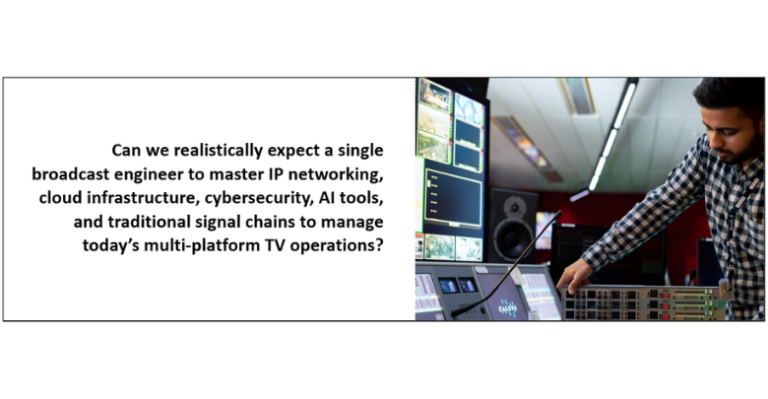
Lawo’s Head of Marketing Content, Chris Scheck, faced the critical concerns of several young European broadcast engineers about their line managers’ decision not to migrate to IP. They were beginning to fear that their skillset may soon be obsolete if they remained at their current employer.
“This fear is new,” said Scheck. “IP seems to be where the younger generation wants to be and build a career. This may be surprising in parts of the world where management decisions are never questioned, and careers rely on seniority. Yet, the mood is changing everywhere.
“IP is indispensable to save on processing hardware and avoid overspending on devices that are used perhaps twice a year. In the past, broadcasters used to plan for peak usage of their equipment at the busiest times of the year.
“Today, Lawo HOME Apps run on servers in a data centre. Several apps handling different kinds of video and audio processing can run on a single server.”
Scheck stressed that users were free to start and stop HOME Apps several times a day — which allowed them to reconfigure their virtual infrastructure at the press of a button. This approach is called the Dynamic Media Facility (or DMF).
The term was not coined by Lawo, but rather by the European Broadcasting Union (EBU), but it turned out that Lawo’s HOME Apps aligned so well with this philosophy that the company could call upon Japan’s national broadcaster NHK for endorsement.
“More technical developments are on the horizon,” said Scheck. “They are based on the broadcaster’s desire to run processing apps from different vendors on the same server.
“This is only feasible if all apps — not just the ones from Lawo — can co-exist on the same physical server. Once they can, there needs to be a quick and efficient way to exchange signals between such apps, while keeping latency to the bare minimum. This is what the Media Exchange Layer (MXL) is all about.”
All of the above starts with IP. SDI signals need to be converted to IP in order to arrive on the generic servers for processing. Even working in the cloud requires SMPTE ST2110 to get data into, and out of, the cloud.
“Lawo can assist you every step of the way,” said Scheck. “So, there are at least two good reasons to migrate to IP. One is to motivate and meaningfully train one’s junior workforce. The second is to reap the benefits of a cost-effective, software-based technology stack that can take any shape or guise within seconds.”
Getting signals into the IP network and beyond requires so-called gateways. Right now, there are audio gateways for audio signals, and video gateways for video, often with encapsulated audio. Workflows are becoming more compact and mobile; and companies are rushing to make industry-shaking announcements even before the arrival of NAB 2026 (... April 19 to 22 in Las Vegas).
Companies that have harnessed Artificial Intelligence (AI) in their playback systems — like Bitmovin, with their AI Scene Analysis and Bitmovin Observability — have seen strong adoption and have had very positive feedback from customers and industry peers alike.
“AI Scene Analysis, which uses machine learning to understand video content at a scene level, is being recognised for unlocking new monetisation and automation opportunities, while Bitmovin Observability has resonated as a critical solution for gaining real-time insight into playback quality and viewer experience,” said Jacob Arends, Senior Product Manager – Playback & AI, at Bitmovin.
“What’s been most encouraging is that customers aren’t just experimenting, they’re deploying these solutions to solve real operational and commercial challenges.
“We will be showcasing at NAB 2026 new agentic AI workflows within our upcoming Bitmovin AI Hub, including our Clipping Agent, which demonstrates how AI can intelligently identify, generate, and prepare clips for modern, multi-platform distribution.”
Bitmovin will also be previewing the next evolution of AI Scene Analysis, including early demonstrations of live scene detection. A key focus here is expected to be scene-aware SCTE marker insertion for live streams, opening the door to more precise ad placement and smarter live monetisation.
Companies operating in the Cloud Playout space are confident that cloud adoption will continue to build momentum over the coming months. Broadcasters are getting increasingly confident about cloud-based technology, and are using it to enhance their existing workflows.
This might include deploying disaster recovery in the cloud, or using it to experiment with new channel formats or to reach audiences in new regions, or to launch FAST channels.
Alongside this kind of hybrid working that supplements existing on-premises operations, we are likely to see more broadcasters carrying out full-scale cloud deployments. With continued cloud adoption, we could see greater workflow automation, as well as tighter convergence between linear and streaming delivery.
“2026 is likely to see ad workflows become far more intelligent and content-aware,” said Arends. “Contextual and scene-aware advertising is moving into real-world deployment, alongside widespread metadata enrichment.
“The next challenge will be interoperability, and this is where Bitmovin is investing heavily. We are continuing to advance real-time, AI-driven ad and monetisation workflows, with further innovations planned throughout the year.”
Ardava of Veset claimed that her company was using the feedback received from customers about the functionality introduced in 2025 to help the company further refine its cloud playout product, Veset Nimbus.
“These ongoing improvements will help our customers address practical, day-to-day broadcast challenges,” she said. “We are also actively working to enhance Veset Nimbus, to bring new capabilities that build on its cloud-first philosophy.
“While it is too early to share full details, we are focussing on making playout more flexible, scalable, and automation-driven. NAB 2026 will be an important milestone for showcasing how these developments translate into tangible coustomer value.”
Be ready to reconfigure your imagination and keep an eye on DMF if you are attending NAB 2026 next month.