
Get smart: Broadcast industry enters new era with IP, REMI, hybrid workflows - APB+ News

APB+ News

APB AWARDS - NOMINATE NOW!

Test Advertisement

Get smart: Broadcast industry enters new era with IP, REMI, hybrid workflows

Add Your Heading Text Here

With the demand for live production continuing to grow, broadcasters are prioritising flexible infrastructure, operational simplicity, and remote production. Stephan Stadler, Chief Product Officer at Appear, in an APB+ interview, maintains that our industry is now in the middle of a large-scale infrastructure transition and this is driven by the growing need for efficiency, operational agility, and long-term adaptability.

The media companies modernising the way live content is produced, distributed, and managed have been the driving force behind the rapid transformation of the broadcast industry. 

In sports, news, and major live events, broadcasters are now opting for greater flexibility and scalability through IP-based workflows, remote production operations, and hybrid cloud environments, moving away from rigid legacy systems.

https://youtu.be/9aIESdbf5tM

Transition from satellite to IP

Satellite technology served as the foundation of live broadcasting for decades. But amidst the production requirements becoming more dynamic and audience expectations rising, broadcasters have increasingly turned to IP infrastructure to modernise their operations. With IP workflows, broadcasters can quickly launch feeds, reroute signals, and scale distribution without making major infrastructure changes. 

“They are really rethinking their entire distribution and contribution architecture, and the result is leaner, more responsive workflows,” Stadler said.

The rise of REMI production is also reshaping live sports broadcasting. Remote production, which was once viewed mainly as a cost-saving strategy, has now become the standard operating model for many sports organisations looking to produce more events with centralised production teams.

However, scaling remote production successfully poses a challenge. “The real challenge, though, at scale isn't the technology. It’s actually consistency,” Stadler stated, stressing that this approach requires broadcasters to maintain synchronisation, low latency, and consistent operational standards across distributed teams and different event types.

At the same time, broadcasters have embraced hybrid infrastructure strategies that combine on-premises hardware with cloud-based workflows.

This hybrid model allows broadcasters to maintain the deterministic, frame-accurate performance required for live production. It also gains the elasticity and scalability offered by cloud environments during major events and audience spikes.

Helping broadcasters modernise live production

In the middle of the broadcast evolution, Appear has positioned itself as a key technology provider supporting broadcasters whilst they navigate this transition.

The company delivers high-capacity, low-latency media processing and delivery solutions designed for live production environments where reliability and speed are critical. Its platform supports workflows spanning satellite, IP, edge, core, and cloud infrastructure, which allows broadcasters to manage complexity in operations through a more unified system.

A major part of Appear’s strategy centres on simplifying live production architectures that have historically relied on fragmented technologies from multiple vendors.

The company’s unified platform offers broadcasters the ability to make a shift from using separate systems for satellite contribution, IP transport, processing, and cloud playout to consolidating these workflows into a single environment.  “A single platform approach changes the economics and the operational reality,” Stadler noted, adding that simplifying operations has become one of the industry's biggest priorities to prepare for the next phase of live production growth.

Broadcasters are now looking for infrastructure that can scale efficiently and adapt to future technologies without requiring major system overhauls every few years.

Furthermore, Appear’s solutions focus on operational efficiency as it addresses organisations’ need for investments with long-term scalability amidst cost pressures.

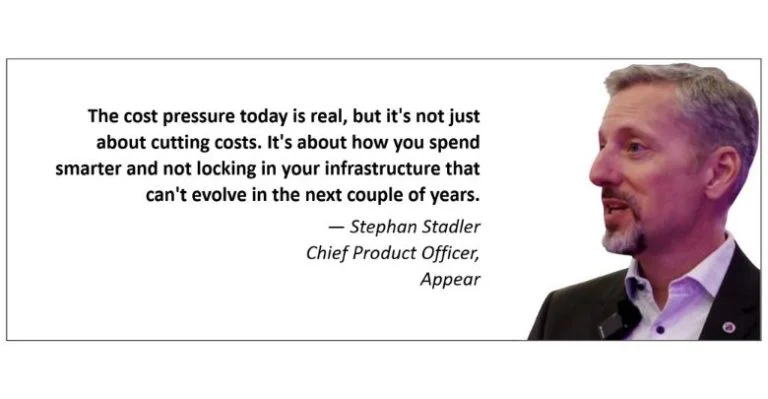
“The cost pressure today is real, but it's not just about cutting costs. It's about how you spend smarter and not locking in your infrastructure that can't evolve in the next couple of years,” Stadler said.

With broadcasters producing more live events across more platforms than ever before, the demand for flexible and software-driven infrastructure continues to rise. Appear is helping shape this transition through its emphasis on IP workflows, REMI production support, hybrid operations, and unified live production platforms.

To know more about Appear and its offerings, visit them at https://www.appear.net/.
Join The Community

Join The Community

APB+

x Studio

Connect with your clients by working with our in-house brand studio, using our expertise and media reach to help you create and craft your message in video and podcast, native content and whitepapers, webinars and event formats.

Get smart: Broadcast industry enters new era with IP, REMI, hybrid workflows

Add Your Heading Text Here

With the demand for live production continuing to grow, broadcasters are prioritising flexible infrastructure, operational simplicity, and remote production. Stephan Stadler, Chief Product Officer at Appear, in an APB+ interview, maintains that our industry is now in the middle of a large-scale infrastructure transition and this is driven by the growing need for efficiency, operational agility, and long-term adaptability.

The media companies modernising the way live content is produced, distributed, and managed have been the driving force behind the rapid transformation of the broadcast industry. 

In sports, news, and major live events, broadcasters are now opting for greater flexibility and scalability through IP-based workflows, remote production operations, and hybrid cloud environments, moving away from rigid legacy systems.

https://youtu.be/9aIESdbf5tM

Transition from satellite to IP

Satellite technology served as the foundation of live broadcasting for decades. But amidst the production requirements becoming more dynamic and audience expectations rising, broadcasters have increasingly turned to IP infrastructure to modernise their operations. With IP workflows, broadcasters can quickly launch feeds, reroute signals, and scale distribution without making major infrastructure changes. 

“They are really rethinking their entire distribution and contribution architecture, and the result is leaner, more responsive workflows,” Stadler said.

The rise of REMI production is also reshaping live sports broadcasting. Remote production, which was once viewed mainly as a cost-saving strategy, has now become the standard operating model for many sports organisations looking to produce more events with centralised production teams.

However, scaling remote production successfully poses a challenge. “The real challenge, though, at scale isn't the technology. It’s actually consistency,” Stadler stated, stressing that this approach requires broadcasters to maintain synchronisation, low latency, and consistent operational standards across distributed teams and different event types.

At the same time, broadcasters have embraced hybrid infrastructure strategies that combine on-premises hardware with cloud-based workflows.

This hybrid model allows broadcasters to maintain the deterministic, frame-accurate performance required for live production. It also gains the elasticity and scalability offered by cloud environments during major events and audience spikes.

Helping broadcasters modernise live production

In the middle of the broadcast evolution, Appear has positioned itself as a key technology provider supporting broadcasters whilst they navigate this transition.

The company delivers high-capacity, low-latency media processing and delivery solutions designed for live production environments where reliability and speed are critical. Its platform supports workflows spanning satellite, IP, edge, core, and cloud infrastructure, which allows broadcasters to manage complexity in operations through a more unified system.

A major part of Appear’s strategy centres on simplifying live production architectures that have historically relied on fragmented technologies from multiple vendors.

The company’s unified platform offers broadcasters the ability to make a shift from using separate systems for satellite contribution, IP transport, processing, and cloud playout to consolidating these workflows into a single environment.  “A single platform approach changes the economics and the operational reality,” Stadler noted, adding that simplifying operations has become one of the industry's biggest priorities to prepare for the next phase of live production growth.

Broadcasters are now looking for infrastructure that can scale efficiently and adapt to future technologies without requiring major system overhauls every few years.

Furthermore, Appear’s solutions focus on operational efficiency as it addresses organisations’ need for investments with long-term scalability amidst cost pressures.

“The cost pressure today is real, but it's not just about cutting costs. It's about how you spend smarter and not locking in your infrastructure that can't evolve in the next couple of years,” Stadler said.

With broadcasters producing more live events across more platforms than ever before, the demand for flexible and software-driven infrastructure continues to rise. Appear is helping shape this transition through its emphasis on IP workflows, REMI production support, hybrid operations, and unified live production platforms.

To know more about Appear and its offerings, visit them at https://www.appear.net/.
Join The Community

Stay Connected

Facebook

101K

Twitter

3.9K

Instagram

1.7K

LinkedIn

19.9K

YouTube

0.2K

Subscribe to the latest news now!


    Scroll to Top